
CHAPTER 1. SOIL PHYSICAL PROPERTIES
Soil Structure: The arrangement and organization of soil particles in the soil, and the tendency of individual soil particles to bind together in aggregates; Aggregation creates intra-aggregrate and inter-aggregate pore space, thereby changing flow paths for water, gases, solutes and pollutants; Effects on plant growth operates through: 1 ...
Download CHAPTER 1. SOIL PHYSICAL PROPERTIES

Information
Domain:
Source:
Link to this page:
Documents from same domain
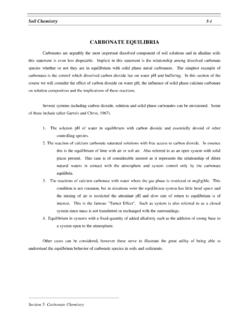
CARBONATE EQUILIBRIA - UC Davis
lawr.ucdavis.eduSoil Chemistry 5-1 Section 5- Carbonate Chemistry CARBONATE EQUILIBRIA Carbonates are arguably the most important dissolved component of …
CHAPTER 1. SOIL PHYSICAL PROPERTIES - UC Davis
lawr.ucdavis.eduSSC107-Fall 2000 Chapter 1, Page - 2 - Soils are extremely complex, hence we often simplify to study and understand soil physical

Ecology, Biodiversity & Conservation
lawr.ucdavis.eduBIS 2A Essentials of Life on Earth I, II, III, IV 5 BIS 2B Principles of Ecology and Evolution I, II, III, IV 5 BIS 2C Biodiversity and the Tree of Life I, II, III, IV 5 ... ESP 170* Conservation Biology Policy ESP 1, ECN 1A; ECN 100 or ARE 100A recommended III 4
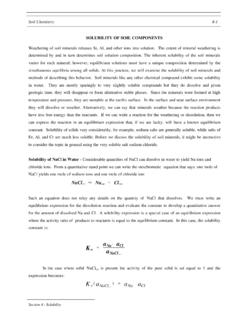
a a a - Department of Land, Air and Water Resources
lawr.ucdavis.eduSoil Chemistry 4-6 Section 4 - Solubility The Gibbsite case is a simple graphical representation of equilibrium over several values of pH. Application of this technique to any other chemical reaction is carried out in the same way.
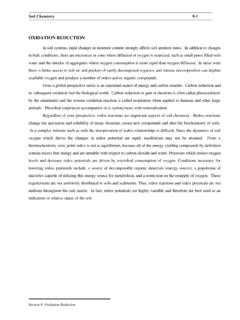
OXIDATION REDUCTION - University of California, Davis
lawr.ucdavis.eduSoil Chemistry 9-2 Section 9- Oxidation Reduction Eh -pH RELATIONSHIPS Thermochemistry background The Gibbs free energy (G) may be defined in differential form as: dG = - Sd T - V dP - w ′ (1) where w' is defined as the useful work in a chemical system ( non-pressure, volume work) in our case this will be the electrical work of the system.
CHAPTER 1. SOIL PHYSICAL PROPERTIES
lawr.ucdavis.edusubsequent weathering and recomposition into new ones (clay minerals). ... SSC107-Fall 2000 Chapter 1, Page - 11 - The following graph from Greacen (1958), shows the influence of exposure time to ... SSC107-Fall 2000 Chapter 1, Page - 17 - Water content measures: 1. Water content by mass (gravimetric water content: ...
CARBONATE EQUILIBRIA
lawr.ucdavis.eduCalcium carbonate in water with a fixed partial pressure of carbon dioxide. For the case of a fixed partial pressure of carbon dioxide and calcium carbonate dissolved in the aqueous phase one more equation is need to describe the system. This is the solubility product of calcium carbonate: = K ( CaCO ) ( Ca ) ( CO ) o CaCO 3 2 - 3 2 + 3 (19)
Related documents
Soil Remediation Guide - Department of Mineral Resources
www.dmr.nd.govsoil structure and plant growth. 1. Impact of hydrocarbon on soil structure When hydrocarbons are spilled on soil, the light hydrocarbons will evaporate according to the type of hydrocarbon, temperature, and wind conditions. It is not uncommon to …

Soil Texture Structure - Purdue Agriculture
ag.purdue.eduAgronomy 105 Soil & Water: Basic Soil Properties 4 Soil Descriptors •Texture: Relative proportion of sand, silt, and clay in the soil •Structure: Forms the soil takes as particles clump together •Peds: Structural units of soil •Bulk Density: A soil’s weight per volume •Horizon: Layer of soil with somewhat uniform color, texture, and structure

Soil Texture and Structure - carlisle.k12.ky.us
www.carlisle.k12.ky.usSoil Structure Sand, silt, clay, and organic matter particles in a soil combine with one another to form larger particles of various shapes and sizes and are often referred to as aggregates, or clus-ters. Soil structure is the arrangement of the soil particles into …

Inherent Factors Affecting Soil Infiltration - USDA
www.nrcs.usda.govMay 01, 2012 · Soil texture, or the percentage of sand, silt, and clay in a soil, is the major inherent factor affecting infiltration. Water moves more quickly through the large pores in sandy soil than it does through the small pores in clayey soil, especially if the clay is compacted and has little or no structure or aggregation.

Understanding Soil Texture and Structure
www.senecahs.orgSoil Structure Damage Soil structure can be destroyed. A major cause of damage is driv-ing heavy equipment over wet soil. Damage is also caused by working soil when it is either too wet or too dry. Either condition leads to the clay particles clogging the pore spaces. The soil becomes compacted and very dense; and when it dries, it becomes very ...

Cultivation and soil structure - Department of Primary ...
www.dpi.nsw.gov.auwith soil structure improvements. Direct drilling is therefore a recommended technique for improving soil structure. If you use direct drilling you are likely to get long-term improvements to soil structure and productivity. Direct drilling in hardsetting soils In soils with naturally poor structure, such as hardsetting soils,
Soil Lab - uwsp.edu
www3.uwsp.eduSoil structure refers to the tendency of soil particles to cluster together and function as soil units called aggregates. Aggregates or crumbs contain mostly clay, silt, and sand particles held together by a gel-type substance formed by organic matter. Aggregates absorb and hold water better than individual particles.