
CHAPTER 1. SOIL PHYSICAL PROPERTIES
g and Porosity (f)= V pores / V V = bulk volume of soil (total soil volume) Porosity in soils varies between 0.3 (sands, silts) to 0.45 (clays) to 0.7 (peat), and is largely determined by the soil bulk density: air water solids
Download CHAPTER 1. SOIL PHYSICAL PROPERTIES

Information
Domain:
Source:
Link to this page:
Documents from same domain
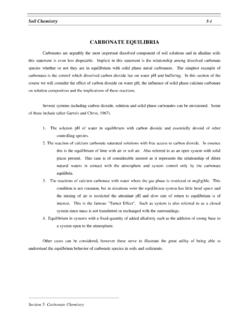
CARBONATE EQUILIBRIA - UC Davis
lawr.ucdavis.eduSoil Chemistry 5-1 Section 5- Carbonate Chemistry CARBONATE EQUILIBRIA Carbonates are arguably the most important dissolved component of …
CHAPTER 1. SOIL PHYSICAL PROPERTIES - UC Davis
lawr.ucdavis.eduSSC107-Fall 2000 Chapter 1, Page - 2 - Soils are extremely complex, hence we often simplify to study and understand soil physical
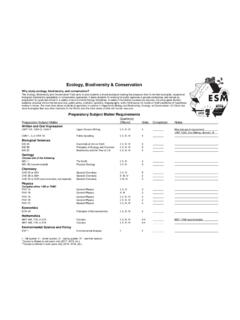
Ecology, Biodiversity & Conservation
lawr.ucdavis.eduBIS 2A Essentials of Life on Earth I, II, III, IV 5 BIS 2B Principles of Ecology and Evolution I, II, III, IV 5 BIS 2C Biodiversity and the Tree of Life I, II, III, IV 5 ... ESP 170* Conservation Biology Policy ESP 1, ECN 1A; ECN 100 or ARE 100A recommended III 4
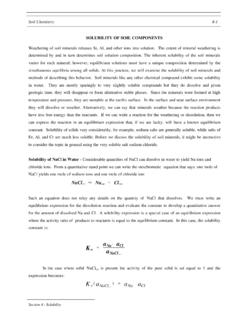
a a a - Department of Land, Air and Water Resources
lawr.ucdavis.eduSoil Chemistry 4-6 Section 4 - Solubility The Gibbsite case is a simple graphical representation of equilibrium over several values of pH. Application of this technique to any other chemical reaction is carried out in the same way.
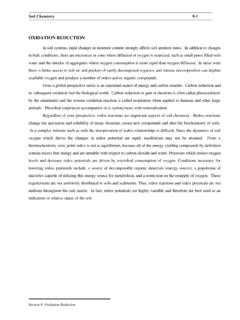
OXIDATION REDUCTION - University of California, Davis
lawr.ucdavis.eduSoil Chemistry 9-2 Section 9- Oxidation Reduction Eh -pH RELATIONSHIPS Thermochemistry background The Gibbs free energy (G) may be defined in differential form as: dG = - Sd T - V dP - w ′ (1) where w' is defined as the useful work in a chemical system ( non-pressure, volume work) in our case this will be the electrical work of the system.
CHAPTER 1. SOIL PHYSICAL PROPERTIES
lawr.ucdavis.edusubsequent weathering and recomposition into new ones (clay minerals). ... SSC107-Fall 2000 Chapter 1, Page - 11 - The following graph from Greacen (1958), shows the influence of exposure time to ... SSC107-Fall 2000 Chapter 1, Page - 17 - Water content measures: 1. Water content by mass (gravimetric water content: ...
CARBONATE EQUILIBRIA
lawr.ucdavis.eduCalcium carbonate in water with a fixed partial pressure of carbon dioxide. For the case of a fixed partial pressure of carbon dioxide and calcium carbonate dissolved in the aqueous phase one more equation is need to describe the system. This is the solubility product of calcium carbonate: = K ( CaCO ) ( Ca ) ( CO ) o CaCO 3 2 - 3 2 + 3 (19)
Related documents
37. DRY-BULK DENSITY: ITS USE AND DETERMINATION1
www-odp.tamu.eduporosity (and consequently dry-bulk density), but other processes such as early diagenetic changes (e.g., cementation and authigenic mineral formation) may also result in significant changes in the porosity of the deposit. Consequently, dry-bulk density values may provide additional information and actually prove more useful than

POROSITY LOGGING
www.kgs.ku.eduporosity tools). Density log: Porosity is calculated from the mass-balance relationship: where pb is the bulk density, 0 is the porosity, pma is the matrix density, and pf is the pore fluid density. If a sandstone, then the matrix density is 2.65 gm/cc (quartz), if a limestone, the matrix density is 2.71 gm/cc (calcite); if a dolomite,
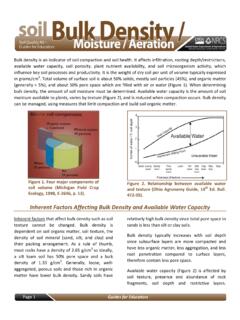
Inherent Factors Affecting Bulk Density and Available ...
www.nrcs.usda.govBulk density is an indicator of soil compaction and soil health. It affects infiltration, rooting depth/restrictions, available water capacity, soil porosity, plant nutrient availability, and soil microorganismactivity, which
Basic Relationships of Well Log Interpretation
store-assets.aapg.orgporosity logs (i.e., sonic, density, and neutron logs) are covered next, then the resistivity logs. Nuclear mag-netic-resonance logs, although they provide porosity (among other quantities of interest), are presented after resistivity logs. This is due in part to their recent arrival and to their relative absence in historical data archives.
4. Bulk Density Test - USDA
www.nrcs.usda.govSoil porosity (%) = 1 - soil bulk density 2.65 Volume of Rocks (cm3) = Fill 1/3 of a graduated cylinder with water, and record the amount. Add the rocks to the cylinder and record the change in the water level. The difference is the volume of rocks (1 mL = 1 cm3).

Sandstone? Shale? Formation Evaluations: Well logs
pages.geo.wvu.eduRHOB= Bulk Density g/cm3 Porosity Calculation. Neutron Log (CNL) • Tool has a neutron source • H absorbs neutrons and emits gamma rays • Tool detects the emitted gamma rays • H is mostly in formation fluids (water and hydrocarbons) • Can be run through casing • …

STANDARD OPERATING PROCEDURE No. 32 BULK DENSITY …
geoinfo.nmt.eduBulk density can be calculated from the particle density (dry mass of all solid particles in a sample divided by the volume of those solid particles) or the specific weight of a dry soil given the sample porosity. Bulk density or sample volume is needed to convert
1. INTRODUCTION TO PETROPHYSICS AND FORMATION …
homepages.see.leeds.ac.ukThe bulk volume of the reservoir V bulk=A × h. The majority of this volume is occupies by the solid rock matrix, and the remainder is made up of the pore space between the minerals. The relative amount of pore space to the bulk volume is denoted by the porosityf , where the porosity is the fraction of the bulk volume occupied by pore volume ...