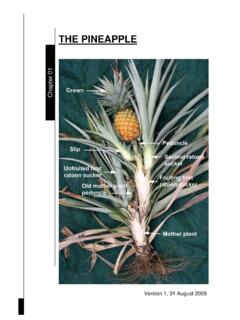
Chapter 1 - The pineapple
drawn upon to maintain plant growth, and even fruit development, during periods of inadequate moisture. After extended dry periods this tissue decreases to near nil – a sign of drought. Cross section of pineapple leaf showing water storage tissue making up the top half of the leaf Water storage tissue CAM photosynthesis
Download Chapter 1 - The pineapple

Information
Domain:
Source:
Link to this page:
Documents from same domain

Annual Report 2016 – 17: Department of …
www.daf.qld.gov.auDepartment of Agriculture and Fisheries GPO Box 46 Brisbane Qld 4001 Australia Interpreter statement
Accepted development requirements for operational work ...
www.daf.qld.gov.auplant or operational work completely or partly within in a declared fish habitat area or a material change of use for aquaculture, see the accepted development requirements in the following documents: Accepted development requirements for operational work that is the removal, destruction or damage of marine plants
African tulip tree
www.daf.qld.gov.auTriclopyr 200 g/L + Picloram 100 g/L (e.g. Slasher) 50 mL per 1 L water : Cut stumps to less than 10 cm above the ground and immediately: • paint stump after cutting • spot spray cut stump Follow-up treatment needed on suckers : Triclopyr 240 g/L + Picloram 120 g/L (e.g. Access) 1 L per 60 L diesel ; Either paint stump immediately after cutting
Restricted invasive plants of Queensland
www.daf.qld.gov.au• salvinia (Salvinia molesta) • Senegal tea (Gymnocoronis spilanthoides) • Siam weed (Chromolaena odorata and Chromolaena squalida) • Sicklepods: – foetid cassia (Senna tora) – hairy cassia (Senna hirsuta) – sicklepod (Senna obtusifolia) • Silver …
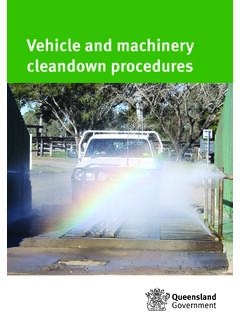
Vehicle and machinery cleandown procedures
www.daf.qld.gov.auknowledge (e.g. landholders, local and state government officers). 1.6 Tips for reducing the risk of spread • Avoid driving off-road in areas known to contain declared plants (e.g. giant rat’s-tail grass, parthenium weed) or in other areas that present a risk of vehicle or machinery contamination. • Do not drive through infested paddocks.
Queensland biosecurity manual - Department of Agriculture ...
www.daf.qld.gov.auBiosecurity is important to Queensland, as pests and diseases can have a long-term impact on our community, primary industries and unique biodiversity. The Queensland Biosecurity Act 2014 (the Act) and the Biosecurity Regulation 2016 (the Regulation) aim to protect Queensland from biosecurity threats that could adversely impact the State.
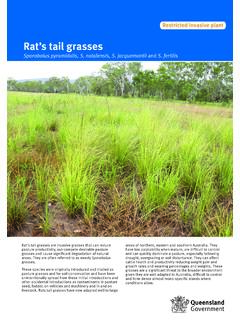
Rat's tail grasses
www.daf.qld.gov.auYork (Queensland) to the Central Coast of New South Wales including the Central Highlands of Queensland. American rat’s tail grass American rat’s tail grass grows to 50−75 cm tall, with a seed head of up to 25 cm long and 0.5−3 cm wide. Distribution: Coastal and sub-coastal areas from Cape York to South East Queensland. Giant Parramatta ...
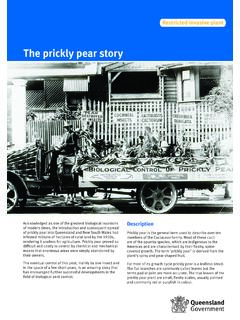
The prickly pear story - Department of Agriculture and ...
www.daf.qld.gov.auin the correct method of release. A fleet of seven trucks and 100 men distributed packed eggs across the state. This insect proved to be spectacularly successful in destroying the weed. By 1932, the stem-boring cactoblastis larvae had caused the general collapse and destruction of most of the original, thick stands of prickly pear.
Parthenium
www.daf.qld.gov.aualbocinereus (stem-galling weevil from Argentina) produces small galls and is still becoming established in Queensland. Bucculatrix parthenica (leaf mining moth from Mexico) larvae feed on leaves, leaving clear windows in the leaf. Carmentia ithacae is a stem boring moth from Mexico which is becoming established at favourable sites in the
Wandering jew or trad - Department of Agriculture and ...
www.daf.qld.gov.auWandering jew is a ground cover succulent. Stems are soft and easily broken. The fleshy stems root at any node that is on the surface. Leaves are oval dark green, and shiny 5–10 mm long, leaf blades 3–6.5 cm long, 1–3 cm wide, with parallel veins covered with small hairs. Flowers are small white and three-petalled flowers with yellow tipped
Related documents

Trees for Parking Lots and Paved Areas
www.fao.orggrowth due to low available oxygen. Trees planted near pavement often suffer due to root damage and soil volume restriction. The lateral growth of shallow tree roots causes sidewalks to crack and heave, creating “lips” or “stub-toe” spots because of uneven displace-ment of adjoining sections of concrete. This root vs. pave-ment conflict ...
Alfalfa Growth and Alfalfa
alfalfa.ucdavis.eduDevelopment. The adaptive value of contractile growth is . to provide protection of growing points from desiccation, cold, or . FIGurE 3.1 . Alfalfa seedling growth and development. The two leaves that first appear after emergence are called . cotyledons or seed leaves. The next leaf to emerge is the first true leaf. It is unifoliolate. The ...

Biology essay titles - AQA
filestore.aqa.org.uk10 (b) The importance to humans of the control of growth, reproduction and development of organisms, including themselves. Question Marking guidance Mark Comments 10 (b) The topics listed contain A - 3.1.1 Pathogens (and invasion of human tissues) and 3.2.10 Antibiotic resistance – control of bacterial growth Ch - 3.1.3 Cholera