Chapter 10.02 Parabolic Partial Differential Equations
Parabolic Partial Differential Equations . After reading this chapter, you should be able to: 1. Use numerical methods to solve parabolic partial differential eqplicit, uations by ex implicit, and Crank-Nicolson methods. The general second order linear PDE with two independent variables and one dependent variable is given by . 0. 2 2 2 2 2 ...
Download Chapter 10.02 Parabolic Partial Differential Equations

Information
Domain:
Source:
Link to this page:
Documents from same domain

Chapter 01.03 Sources of Error - MATH FOR COLLEGE
mathforcollege.com01.03.1 Chapter 01.03 Sources of Error After reading this chapter, you should be able to: 1. know that there are two inherent sources of error in numerical methods – round-

Runge-Kutta 4th Order Method for Ordinary …
mathforcollege.com08.04.1 Chapter 08.04 Runge-Kutta 4th Order Method for Ordinary Differential Equations . After reading this chapter, you should be able to . 1. develop Runge-Kutta 4th order method for solving ordinary differential equations,

Simpson 3/8 Rule for Integration - MATH FOR …
mathforcollege.comIn a similar fashion, Simpson rule for integration can be derived by 3/8 approximating the given function
Finite Difference Method for Solving Differential …
mathforcollege.com08.07.1 . Chapter 08.07 Finite Difference Method for Ordinary Differential Equations . After reading this chapter, you should be able to . 1. Understand what the finite difference method is and how to use it to solve problems.

Chapter 04.08 Gauss-Seidel Method
mathforcollege.comusing the Gauss-Seidel method. Assume an initial guess of the solution as = 5 2 1
Chapter 05.03 Newton’s Divided Difference Interpolation
mathforcollege.comNewton’s Divided Difference Interpolation 05.03.3 Figure 2 Linear interpolation. Example 1 The upward velocity of a rocket is given as a function of time in Table 1 (Figure 3).

False-Position Method of Solving a Nonlinear Equation
mathforcollege.com03.06.1 . Chapter 03.06 False-Position Method of Solving a Nonlinear Equation . After reading this chapter, you should be able to . 1. follow the algorithm of the false-position method of solving a nonlinear equation,
Bisection Method of Solving Nonlinear Equations: General ...
mathforcollege.comOne of the first numerical methods developed to find the root of a nonlinear equation . f (x) =0 was the bisection method (also called binary-search method). The method is based on the following theorem. Theorem. An equation. f (x) =0, where f (x) is a real continuous function, has at least one root between . x and . x. u. if f (x ) f (x. u ...
Runge-Kutta 4th Order Method for Ordinary Differential ...
mathforcollege.comOct 13, 2010 · 08.04.1 Chapter 08.04 Runge-Kutta 4th Order Method for Ordinary Differential Equations . After reading this chapter, you should be able to . 1. develop Runge-Kutta 4th order method for solving ordinary differential equations, 2. find the effect size of step size has on the solution, 3. know the formulas for other versions of the Runge-Kutta 4th order method

Chapter 03.04 Newton-Raphson Method of Solving a …
mathforcollege.com03.04.1 Chapter 03.04 Newton-Raphson Method of Solving a Nonlinear Equation After reading this chapter, you should be able to: 1. derive the Newton-Raphson method formula, 2. develop the algorithm of the Newton-Raphson method, 3. use the Newton-Raphson method to solve a nonlinear equation, and 4. discuss the drawbacks of the Newton-Raphson method. ...
Related documents
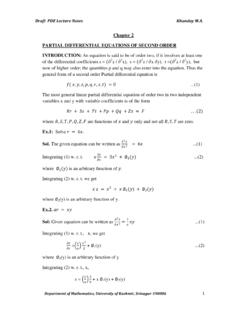
Chapter 2 PARTIAL DIFFERENTIAL EQUATIONS OF SECOND …
ddeku.edu.inPARTIAL DIFFERENTIAL EQUATIONS OF SECOND ORDER INTRODUCTION: An equation is said to be of order two, if it involves at least one of the differential coefficients r = (ò 2z / ò 2x), s = (ò 2z / ò x ò y), t = (ò 2z / ò 2y), but now of higher order; the quantities p and q may also enter into the equation. Thus the

First Order Partial Differential Equations
people.uncw.eduFirst Order Partial Differential Equations “The profound study of nature is the most fertile source of mathematical discover-ies.” - Joseph Fourier (1768-1830) 1.1 Introduction We begin our study of partial differential equations with first order partial differential equations. Before doing so, we need to define a few terms.
Solution of ODEs using Laplace Transforms
chemeng.queensu.caSolution of ODEs We can continue taking Laplace transforms and generate a catalogue of Laplace domain functions. The final aim is the solution of ordinary differential equations. Example Using Laplace Transform, solve Result

Maxwell’s equations • Wave equations • Plane Waves
uspas.fnal.govMaxwell’s equations in differential form require known boundary. values in order to have a complete and unique solution. The . so called boundary conditions (B/C) can be derived by considering. the integral form of Maxwell’s equations. ε 1µ 1σ 1 n ε 2µ 2σ 2

Ordinary and Partial Differential Equations
www.people.vcu.eduOrdinary and Partial Differential Equations by John W. Cain and Angela M. Reynolds Department of Mathematics & Applied Mathematics Virginia Commonwealth University Richmond, Virginia, 23284 ... Solution techniques for differential equations (des) depend in part upon how