
Chapter 11 – Torque and Angular Momentum
Linear Angular dt dl net τ = Single particle The vector sum of all torques acting on a particle is equal to the time rate of change of the angular momentum of that particle. Proof: ( ) r ma r Fnet ( )r F net dt dl v m r a v v m r a dt dr dt dv m r dt dl l m r v τ = × = × = × = = × + × = × = = × → = × + × ∑ ( ) V. Angular momentum ...
Download Chapter 11 – Torque and Angular Momentum

Information
Domain:
Source:
Link to this page:
Documents from same domain

Measuring blackbody radiaiton using infrared …
physics.ucf.eduMeasuringBlackbody!Radiation!usingInfrared!Detectors!! Theory!! ... Objective!3:!Measurement!of!spectralradianceforablackbodycurve !!
Physics for Scientists and Engineers I
physics.ucf.eduPhysics for Scientists and Engineers I Dr. Beatriz Roldán Cuenya University of Central Florida, Physics Department, Orlando, FL PHY 2048H. Chapter 1 - Introduction I. General II. International System of Units III. Conversion of units IV. Dimensional Analysis V. Problem Solving Strategies.
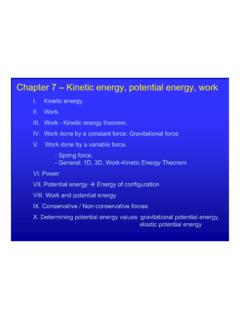
Chapter 7 – Kinetic energy, potential energy, work
physics.ucf.eduI. Kinetic energy Energy associated with the state of motion of an object. (7.1) 2 K 1 mv2 Units: 1 Joule = 1J = 1 kgm2/s2 = N m II. Work Energy transferred “to” or “from” an object by means of a force acting on the object. To +W From -W - Constant force: F x ma x d v v v v axd ax 2 2 2 0 2 2 0 2 Work done by the force = Energy
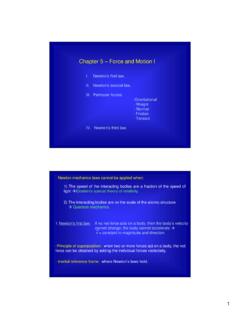
Chapter 5 – Force and Motion I
physics.ucf.eduChapter 5 – Force and Motion I I. Newton’s first law: If no net force acts on a body, then the body’s velocity cannot change; the body cannot accelerate v = constant in magnitude and direction. - Principle of superposition: when two or more forces act on a body, the net force can be obtained by adding the individual forces vectorially.
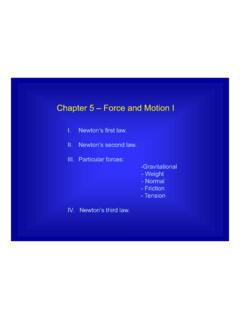
Chapter 5 – Force and Motion I - Physics
physics.ucf.eduN mg (5.5) - Normal force: perpendicular force on a body from a surface against which the body presses. - Frictional force: force on a body when the body attempts to slide along a surface. It is parallel ... Chapter 5 – Force and Motion II - Opposes the relative motion of a body in a fluid.
Chapter 29 – Electromagnetic Induction
physics.ucf.eduFaraday’s Law of Induction: - The induced emf in a closed loop equals the negative of the time rate of change of the magnetic flux through the loop. dt ε= − dΦB - Increasing flux ε< 0 ; Decreasing flux ε> 0 - Direction: curl fingers of right hand around A, if ε> 0 is in same direction of fingers (counter-clockwise), if ε< 0
Chapter 27 – Magnetic Field and Magnetic Forces
physics.ucf.edua magnet near a conducting loop can induce a current. - The magnetic forces between two bodies are due to the interaction between moving electrons in the atoms. - Inside a magnetized body (permanent magnet) there is a coordinated motion …
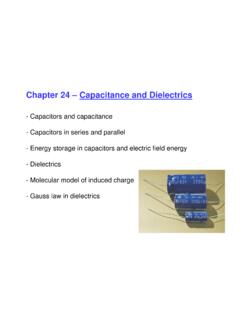
Chapter 24 – Capacitance and Dielectrics
physics.ucf.edu- Capacitance is a measurement of the ability of capacitor to store energy (V = U / q). Capacitors in Vacuum - Parallel Plate Capacitor: uniform electric field between the plates, charge uniformly distributed over opposite surfaces A Q E εo εo σ = = d A V Q C ab = =ε0 A Qd V E d o ab ε 1 = ⋅ = ε0 = 8.85 x 10⁻¹² F/m
Black Body Radiation - Physics
physics.ucf.eduBlackbody Radiation 1/10/13 1:12 PM http://www.egglescliffe.org.uk/physics/astronomy/blackbody/bbody.html Page 1 of 7 Black Body Radiation Astronomy Main
Chapter 6 – Force and Motion II
physics.ucf.eduA centripetal force accelerates a body by changing the direction of the body’s velocity without changing its speed. v, a = ctes, but direction changes during motion.-Centripetal force: a, F are directed toward the center of curvature of the particle’s path. 3 III. Non-Uniform circular motion
Related documents

Chapter 19 Angular Momentum
www.lehman.educoncept of angular momentum for a point-like particle of mass m with linear momentum p about a point S, defined by the equation L S = r S × p, (19.1.2) where r S is the vector from the point S to the particle. We will show in this chapter that the torque about the point S acting on the particle is equal to the rate of change of the
Linear Impulse and Momentum; Collisions
ocw.mit.eduConservation of Linear Momentum We see from equation (1) that if the resultant force on a particle is zero during an interval of time, then its linear momentum L must remain constant. Since equation (1) is a vector quantity, we can have situations in which only some components of the resultant force are zero.
Quantum Physics III Chapter 2: Hydrogen Fine Structure
ocw.mit.eduthis is the azimuthal quantum number for orbital angular momentum. Since we are not combining the electron spin to its orbital angular momentum, the states formthe “uncoupled basis”: Uncoupled basis quantum numbers: (n,ℓ,mℓ,ms). (2.1.14) The states are completely specified by these quantum numbers. As we let those quantum