
CHAPTER 17 Reflection and Mirrors
5. Two plane mirrors are positioned at right angles to one another. A ray of light strikes one mirror at an angle of 30° to the normal. It then reflects toward the second mirror. What is the angle of reflection of the light ray off the second mirror?! r1!! i1! 30°! i2! 90° "! r1! 90° " 30° ! 60° Section Review 17.1 Reflection from Plane ...
Download CHAPTER 17 Reflection and Mirrors

Information
Domain:
Source:
Link to this page:
Documents from same domain

CHAPTER 4 Forces in One Dimension - Mr. Nguyen's Website
nguyenmapleleaf.weebly.compage 93 6. Two horizontal forces, 225 N and 165 N, are exerted on a canoe. If these forces are applied in the same direction, find the net horizontal force on the canoe.
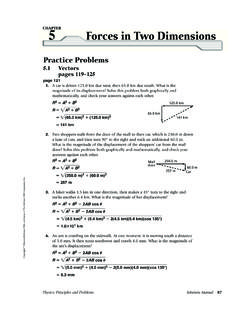
CHAPTER 5 Forces in Two Dimensions
nguyenmapleleaf.weebly.comChapter Assessment Concept Mapping page 140 to # $"# "# "# "#
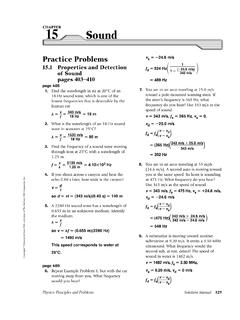
CHAPTER 15 Sound - Mr. Nguyen's Website
nguyenmapleleaf.weebly.comResonance on Strings A violin sounds a note of F sharp, with a pitch of 370 Hz. What are the frequencies of the next three harmonics produced with this note? A string’s harmonics are whole number multiples of the fundamental, so the fre-quencies are: Chapter 15 continued. f 2! 2f 1! (2)(370 Hz) ! 740 Hz f 3! 3f 1! (3)(370 Hz) ! 1110 Hz
CHAPTER 4 Forces in One Dimension
nguyenmapleleaf.weebly.comCHAPTER Practice Problems 4.1 Force and Motion pages 87–95 page 89 For each of the following situations, specify the system and draw a motion diagram and a free-body dia-gram. Label all forces with their agents, and indicate the direction of the acceleration and of the net force. Draw vectors of appropriate lengths. 1.
CHAPTER 5 Forces in Two Dimensions - Mr. Nguyen's Website
nguyenmapleleaf.weebly.comthe angles are equal, the horizontal forces will be equal and opposite and cancel out.The magnitude of this vertical force is F combined! F rope1 on swing cos ! " F rope2 on swing cos !! 2F rope2 on swing cos !! (2)(2.28 N)(cos 13.0°)! 4.44 N upward 9. Could a vector ever be shorter than one of its components? Equal in length to one of its ...

Energy, Work, and - Mr. Nguyen's Website
nguyenmapleleaf.weebly.com6. An airplane passenger carries a 215-N suit-case up the stairs, a displacement of 4.20 m vertically, and 4.60 m horizontally. a. How much work does the passenger do? Since gravity acts vertically, only the vertical displacement needs to be considered. W! Fd! (215 N)(4.20 m) ! 903 J b. The same passenger carries the same suitcase back down the ...
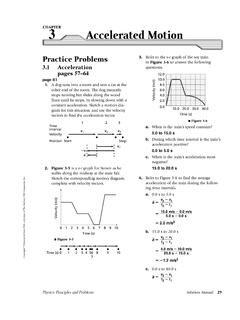
CHAPTER 3 Accelerated Motion - Mr. Nguyen's Website
nguyenmapleleaf.weebly.composition-time graphs of their motion? Both lines would have the same slope, but they would rise from the d-axis at different points, #15 m, and "15 m. b. What would be the difference(s) in their velocity-time graphs? Their velocity-time graphs would be identical. 14. Velocity Explain how you would use a velocity-time graph to find the time at
Related documents

Vortex Optics Viper PST Gen II Rifle Scope Manual
308ar.comSecond Focal Plane Reticles Second focal plane (SFP) reticles are located near the scope’s eyepiece behind the image erecting and magnifying lenses. This style of reticle does not visually change in size when you change the magnification. The advantage of an SFP reticle is that it always maintains the same appearance.

Using a Mil Based Scope - Easy Transition
coretacsolutions.comworks, whether or not the reticle is located in the First Focal Plane or the Second Focal Plane. Now, both have their advantages and disadvantages based on their use and the user, but for the most part I recommend the First Focal Plane Scope …

OPTICS - Leapers
leapers.comAll current UTG scopes have second focal plane reticles. The reticle does not change when magnification is adjusted, but the subtensions relative to the target image does. The smaller the magnification, the larger the space the reticle occupies on the target image. All reticles are calibrated at 10x magnification. E. Summary of Reticles

To determine the wavelength of a monochromatic source of ...
repo.iitbhu.ac.infringe from eleventh, second from twelfth and so on. After taking the mean, fringe width β for one fringe is calculated. Figure. 3 Measurement of d Without changing the position of the slit, biprism and the eye-piece; a convex lens is mounted on the optical bench between the latter two. The distances d 1 and d 2 between the well-defined

RIFLESCOPE OWNER’S GUIDE
tasco.com• SECOND FOCAL PLANE - Ensures accuracy at highest magnification • HIGH LIGHT TRANSMISSION - Fully-coated optics provide a brighter image in every lighting condition. • VALUE - Industry-best technology at an affordable price. KEY ELEMENTS OF A SCOPE There are four major elements of a scope: 1. Objective Lens: This lens has three functions ...

Diagnosis and Management of Common Foot Fractures
www.aafp.orgFeb 01, 2016 · of focal pain, swelling, and difficulty bear- ... which involves manual axial loading of the ... fractures of the second to fifth metatarsal Table 1. Summary and Comparison of Common Foot Fractures

DEAD-HOLD BDC
www.krale.shopNOTE: This Vortex® riflescope uses a second focal plane reticle design and the listed BDC yardages will be valid at the highest magnification for most models. For 6–24x50 models, the listed BDC yardages will only be valid with the magnification set at 18x (indicated by a red mark on the magnification ring). 1st Hashmark 2nd Hashmark

PHYSICS-I PHY-101-F (1003) LAB MANUAL I SEMESTER B. Tech.
www.wctmgurgaon.comThe slit is adjusted in the focal plane of lens in order to obtain a parallel beam. The collimator also has two screws for adjusting the inclination of the axis of the collimator. The prism table is a circular table, which moves over a graduated circular scale carried by the telescope. Fig.2 Let a collimated beam is