
Chapter 19: Lipids
1. Be familiar with the physical and chemical properties and biological function of each of the families of lipids. 2. Write the structures of simple examples of each of the classes of lipids. Name the common lipids. 3. Know the method of synthesizing glycerides and the reactions of
Download Chapter 19: Lipids

Information
Domain:
Source:
Link to this page:
Documents from same domain

Answers to Assigned Problems from Chapter 2
www.chem.latech.eduAnswers to Assigned Problems from Chapter 2 2.2. 1 mol of ice has a volume of 18.01 g/0.9168 g cmŒ3 = 19.64 cm3 1 mol of water has a volume of 18.01 g/0.9998 g cmŒ3

Chapter 18: Carbohydrates - latech.edu
www.chem.latech.edulife in and of themselves. Yet when these substances are gathered together ... 6. note the highest numbered chiral center to distinguish D and L sugars. ... Plane polarized light is rotated clockwise (to right) or counterclockwise (to left) when passed

Introduction to TG/DTA/DSC - latech.edu
www.chem.latech.eduMetallurgy application Isothermal transformation of a high speed steel First heating 0.51.0 1.52.0 2.53.0Time/ h Heat Flow/ mW 1 2 3 4 5 6 7 8 9 Temperature/

Chapter 17: Amines and Amides - latech.edu
www.chem.latech.eduto relieve anxiety, tension, insomnia, epilepsy and hypertension. People using barbiturates should be aware of the extreme danger they are in if they combine alcohol and barbiturates. The barbiturate and alcohol combination has proven to be deadly many . ))). The group. N CH C CH NH. amides amides ...
Chapter 22. Nucleic Acids - latech.edu
www.chem.latech.edu22.11 Translation: Protein Synthesis 22.12 Mutations Chemistry at a Glance: Protein Synthesis 22.13 Nucleic Acids and Viruses 22.14 Recombinant DNA and Genetic Engineering 22.15 The Polymerase Chain Reaction 22.16 DNA Sequencing Students should be able to: 1. Relate DNA to genes and chromosomes. 2.

Chemistry 254 Lab Experiment 1: Qualitative Organic ...
www.chem.latech.eduChemistry 254 Lab Experiment 1: Qualitative Organic Analysis Summer 2004 Introduction: Qualitative organic analysis, the identification and characterization of unknown compounds, in an important part of organic chemistry. Every chemist must learn the appropriate methods (physical, chemical, spectroscopic) for
Related documents
3. CHEMICAL AND PHYSICAL INFORMATION 3.1 CHEMICAL …
www.atsdr.cdc.govCHEMICAL AND PHYSICAL INFORMATION 3.1 CHEMICAL IDENTITY Information regarding the chemical identity of fuel oils is located in Table 3-l. Information on the composition of selected fuel oils, specifically fuel oil no. 2 and kerosene, is presented in Table 3-2.

CERAMICS: Properties 1 (Physical, Chemical, Mechanical)
www-personal.umich.edu2 PHYSICAL PROPERTIES Mass properties, thermal, and electrical properties. 1. Mass Properties (e.g., density) Ceramics are intermediate (density = = 2.00-6.00 gms/cm3) Different for ALLOTROPES (e.g., glass, cristobalite, tridymite, quartz) 2. Thermal properties: Melting points high (600-4000C) Thermal conductivities are low (insulators)
Physical and Chemical Changes Worksheet
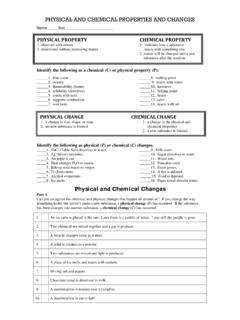
www.mayfieldschools.orgPHYSICAL PROPERTY CHEMICAL PROPERTY 1. observed with senses 1. indicates how a substance 2. determined without destroying matter reacts with something else 2. matter will be changed into a new substance after the reaction PHYSICAL AND CHEMICAL PROPERTIES AND CHANGES Name _____Key_____

Calcium Chloride
www.oxy.com2 The data in the physical properties tables in this section are laboratory results typical of the products, and should not be confused with, or regarded as, specifications . Physical Properties of Calcium Chloride Literature data on the physical properties of calcium chloride, its hydrates and solutions generally refer to pure material.

Chemical & Physical Properties of Crude Oil
osha.washington.edu•2.5 –5.0 •As such vapors can accumulate in low or depressed areas •These vapors can be both flammable and toxic. Vapor Pressure •Vapor Pressure is the pressure exerted by a vapor at a given temperature in a closed system ... Chemical & Physical Properties of Crude Oil
3. CHEMICAL AND PHYSICAL INFORMATION
www.atsdr.cdc.gov3.2 PHYSICAL AND CHEMICAL PROPERTIES Information regarding the physical and chemical properties for the gasoline mixture is located in Table 3-2. In cases where data are not available for gasoline, ranges are given to indicate the different values for the individual components. Title: Microsoft Word - GASOLINE.rtf
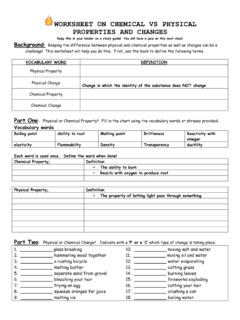
WORKSHEET ON CHEMICAL VS PHYSICAL PROPERTIES …
www.currituck.k12.nc.usKEY: WORKSHEET ON CHEMICAL VS PHYSICAL PROPERTIES AND CHANGES Keep this in your binder as a study guide! Background: Keeping the difference between physical and chemical properties as well as changes can be a challenge! This worksheet will help you do this. First, use the book to define the following terms.
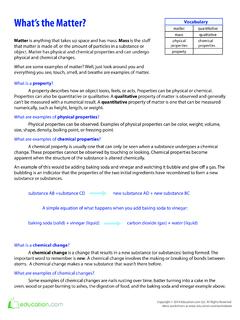
Physical and Chemical Changes Packet
www.sisd.netProperties can be physical or chemical. A pr Properties can also be quantitative or qualitative. A qualitative property of matter is observed and generally can t be measured with a numerical result. A quantitative property of matter is one that can be measured numerically, such as height, length, or weight.
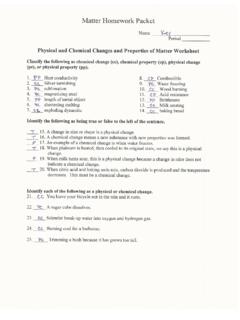
Properties and Changes Practice ... - Thomas County Schools
www.thomas.k12.ga.usWorksheet #2: Physical/Chemical Properties/Changes Fill in the Blanks Name properties can be observed without chemically changing matter. properties describe how a substance interacts with other substances. have definite shapes and definite volumes. have indefinite shapes and definite volumes. indefinite shapes and indefinite volumes.