Chapter 2 Data Models - Cleveland State University
Jan 29, 2014 · Object/Relational and XML Extended relational data model (ERDM) Supports OO features and complex data representation Object/Relational Database Management System (O/R DBMS) Based on ERDM, focuses on better data management Extensible Markup Language (XML) Manages unstructured data for efficient and effective exchange of all data types 29
Download Chapter 2 Data Models - Cleveland State University

Information
Domain:
Source:
Link to this page:
Documents from same domain

ESC120 Lab Assignment 1 Computer Science …
cis.csuohio.eduJava - MyJavaPrograms/WeIcome.java - Eclipse File Edit Source Refactor Navigate Search Project Run Window Help FirstJavaCIm Task List Find All

Extension to SQL: View, Triggers, Transaction
cis.csuohio.edu3 Specification of Views in SQL CREATE VIEWcommand Give Table (View) name, list of attribute names for the View (table), and a Query to specify the contents of the View
Tutorials for Project on Building a Business Analytic ...
cis.csuohio.eduGetting familiar with SQL Server Analysis Services (SSAS) tools and various data mining algorithms such as Clustering, Association, Time Series etc in the SSAS tool 3.
Running Java and Eclipse From Your USB Flash Drive
cis.csuohio.eduinstall Java and Eclipse in a portable USB flash drive. Next time you work on that machine, all you need to do is insert the USB flash drive, run a batch program to tell Windows to look first in your Flash dive for Java libraries, and execute Eclipse.

Text Mining Transformations - cis.csuohio.edu
cis.csuohio.eduthat facilitate text mining: Term Extraction and Term Lookup. SQL Server Data Mining supports the TEXT data type, but that data type is not enough to perform meaningful text analysis. From the algorithm’s perspective, columns having the TEXT data type are treated just like discrete columns that have the LONG data type — as a collection of ...
Translation of ER -diagram into Relational Schema
cis.csuohio.eduDiagram into an equivalent set of well-structured relations. 3. 4 9.49.4. 5. 6 Process of Database Design • Logical Design – Based upon the conceptual data model – Four key steps 1. Develop a logical data model for each known user interface for the application using normalization principles. 2. Combine normalized data requirements from ...
Chapter 8 Advanced SQL
cis.csuohio.eduRelational join operation merges rows from two tables and returns rows with one of the following ... Allows comparison of a single value with a list of ... Independent object in the database Have a name and can be used anywhere a value expected
Related documents

Java - Tutorialspoint
www.tutorialspoint.comObject Oriented: In Java, everything is an Object. Java can be easily extended since it is based on the Object model. Platform Independent: Unlike many other programming languages including C and C++, when Java is compiled, it is not compiled into platform specific machine, rather into …
SQL - Tutorialspoint
www.tutorialspoint.comThe standard SQL commands to interact with relational databases are CREATE, SELECT, INSERT, UPDATE, DELETE and DROP. These commands can be classified into the following groups based on their nature: DDL - Data Definition Language Command Description CREATE Creates a new table, a view of a table, or other object in the database.

Theory: Empathic attunement and transference in Kohut’s ...
www.relational-integrative-psychotherapy.ukThe relational psychoanalyst Heinz Kohut (1984) theorised that it was the therapist’s task is to provide the client with a ‘corrective emotional experience’ through empathy/attunement. Through empathy, he suggested, the therapist can be used (as …

A Three-Way Model for Collective Learning on Multi ...
icml.ccThe modelling approach of relational domains in this pa-per is the following. To represent dyadic relational data we make use of the semantic web’s RDF formalism where relations are modeled as triples of the form (subject, predicate, object) and where a predicate either models the relationship between two entities or between
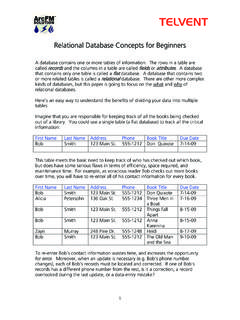
relational database concepts for beginners
webs.wofford.eduRelational Database Concepts for Beginners A database contains one or more tables of information. The rows in a table are called records and the columns in a table are called fields or attributes. A database that contains only one table is called a flat database. A database that contains two or more related tables is called a relational database.

Introduction to Relational Database
www.cis.uni-muenchen.de10 Relational Database Relational Database Management System (RDBMS) consists of: – A set of tables – A schema A schema: – is a description of data in terms of data model – Defines tables and their attributes (field or column) The central data description construct is a relation: – Can be thought as records – eg. information on student is stored in a relation with

C Operator Precedence Table
www.cs.uic.eduC Operator Precedence Table C operators are listed in order of precedence (highest to lowest). Their associativity indicates in what order operators …

Data Modeling
www.liberty.eduabout relational database design, the relational database model, and relational database ... Entities are the principal data object about which information is to be collected. Entities
Diagnostic Criteria for Relational Problems
www.mcgill.caRelational Problems Table of Contents ... or other object, or confining a child to an enclosed area [such as a closet]) (5) Egregious scapegoating of child (6) Coercing the child to inflict pain on him/herself (including, but not limited to, ordering