
Chapter 2 Electric Fields
2. An electron is released from rest in a uniform electric of magnitude 2.00×10⁴ N C. Calculate the acceleration of the electron. (Ignore gravitation.) [HRW6 23-29] The magnitude of the force on a charge q in an electricfield is givenby F = |qE|, where E is the magnitude of the field. The magnitude of the electron’s charge is e = 1.602×10 ...
Download Chapter 2 Electric Fields

Information
Domain:
Source:
Link to this page:
Documents from same domain
Chapter 6 Work, Kinetic Energy and Potential Energy
www2.tntech.eduThe potential energy U(r) also has units of joules in the SI system. When our physics problems involve forces for which we can have a potential energy function, we usually think about the change in potential energy of the objects rather than the work done by these forces. However for non–conservative forces, we must directly calculate
Chapter 4 Oscillatory Motion
www2.tntech.edu72 CHAPTER 4. OSCILLATORY MOTION m m (a) (b) (c) x Figure 4.3: (a) Unstretched vertical spring of force constant k (assumed massless). (b) Mass attached to spring is at equilibrium when the spring has been extended by a distance mg/k.

Worked Examples from Introductory Physics (Algebra–Based ...
www2.tntech.edu• A summary of the material in the first semester of the non–calculus physics course as I teach it at Tennessee Tech. • A set of example problems typical of those given in non–calculus physics courses solved and explained as well as I know how. It is not intended as a substitute for any textbook suggested by a professor...at least not yet!

Chapter 1 Units and Vectors: Tools for Physics
www2.tntech.eduIf two vectors are perpendicular then their scalar product is zero. The vector product (or cross product) of vectors a and b is a vector c whose mag-nitude is given by c = absinφ (1.9) where φ is the smallest angle between a and b. The direction of c is perpendicular to the

Chapter 3 Static Equilibrium
www2.tntech.eduChapter 3 Static Equilibrium 3.1 The Important Stuff In this chapter we study a special case of the dynamics of rigid objects covered in the last two chapters. It is the (very important!) special case where the center of mass of the object has no motion and the object is not rotating. 3.1.1 Conditions for Equilibrium of a Rigid Object

Chapter 1 Electric Charge; Coulomb’s Law
www2.tntech.eduChapter 1 Electric Charge; Coulomb’s Law 1.1 The Important Stuff 1.1.1 Introduction During the second semester of your introductory year of physics you will study two special types of forces which occur in nature as a result of the fact that the constituents of matter have electric charge; these forces are the electric force and the magnetic ...

Chapter 4 Forces I
www2.tntech.eduChapter 4 Forces I 4.1 The Important Stuff 4.1.1 Newton’s First Law With Newton’s Laws we begin the study of how motion occurs in the real world. The study of the causes of motion is called dynamics, or mechanics. The relation between force and acceleration was given by Isaac Newton in his three laws of motion, which form the

Chapter 7 Linear Momentum and Collisions
www2.tntech.eduThe value of the average force depends on the time interval chosen. 7.1.3 Conservation of Linear Momentum Linear momentum is a useful quantity for cases where we have a few particles (objects) ... again moving freely. For such an event, the two particles have well-defined momenta p1i and p2i before the

Chapter 1 Rotation of an Object About a Fixed Axis
www2.tntech.eduRotation of an Object About a Fixed Axis ... 1.1.2 Angular Displacement As a rotating object moves through an angle θ from the starting position, a mass point on the object at radius r will move a distance s; s length of arc of a circle of radius r, subtended by the angle θ.
Chapter 3 Motion in Two and Three Dimensions
www2.tntech.eduChapter 3 Motion in Two and Three Dimensions ... a medium like air or water which itself is moving with respect to the stationary ground; we can then find the velocity of the plane or boat with respect to the ground from the vector sum in Eq. 3.24. 3.2 Worked Examples 3.2.1 Velocity 1.
Related documents
Gauss’ Law - University of Tennessee
www.phys.utk.eduthe electric field is uniform and the surface area is plane What happens when either one or the other or both is not true. Physics 231 Lecture 2-11 Fall 2008 Electric Flux We proceed as we did in the transition from discrete charges to a continuous distribution of charges
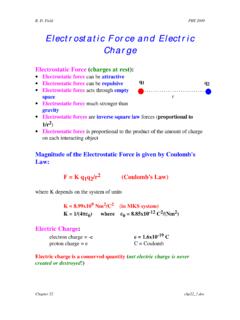
Electrostatic Force and Electric Charge
www.phys.ufl.eduThe electric field at the point q due to Q is simply the force per unit positive charge at the point q : E = F/ q E = KQ/r 2 The units of E are Newtons per Coulomb ( units = N/C ). The electric field is a physical object which can carry both momentum and energy. It …