
Chapter 2 Ordinary Differential Equations
Chapter 2 Ordinary Differential Equations (PDE). In Example 1, equations a),b) and d) are ODE’s, and equation c) is a PDE; equation e) can be considered an ordinary differential equation with the parameter t. Differential operator D It is often convenient to use a special notation when dealing with differential equations.
Download Chapter 2 Ordinary Differential Equations

Information
Domain:
Source:
Link to this page:
Documents from same domain

table of laplace transforms - Educating Global Leaders
www.et.byu.edutable of laplace transforms 1 f(t) f(s) tn n = 1,2,... s > 0 † n! † sn+1 1 s2 † t † ta † a>-1 † G(a+1) sa+1 s > 0 † eat † teat † tneat † 1 s-a † 1 (s-a)2 † n! ... Laplace transform is calculated with the command laplace (f(t),t,s): f(t) denotes the function to be transformed,

Chapter 5 Special Functions
www.et.byu.eduChapter 5 SPECIAL FUNCTIONS Chapter 5 SPECIAL FUNCTIONS Introduction In this chapter we summarize information about several functions which are widely used for mathematical modeling in engineering. Some of them play a supplemental role, while the others, such as the Bessel and Legendre functions, are of primary importance. ...

CHAPTER 3 PRESSURE AND FLUID STATICS
www.et.byu.edu(a) The fluid level in the arm attached to the tank is higher (vacuum): PP P . . .abs atm vac 12 7 1 26 11 44 psia 11.4 psia (b) The fluid level in the arm attached to the tank is lower: PP P . . .abs gage atm 12 7 1 26 13 96 psia 14.0 psia Discussion The final results are reported to three significant digits. Note

Second Order Systems
www.et.byu.eduSecond Order Systems Second Order Equations 2 2 +2 +1 = s s K G s τ ζτ Standard Form τ2 d 2 y dt2 +2ζτ dy dt +y =Kf(t) Corresponding Differential Equation K = Gain τ= Natural Period of Oscillation ζ= Damping Factor (zeta) Note: this has to be 1.0!!!
CHAPTER 6 MOMENTUM ANALYSIS OF FLOW SYSTEMS
www.et.byu.edutorque, the angular momentum remains constant, but the angular velocity changes in accordance with I = constant where I is the moment of inertia of the body. Discussion Angular momentum is analogous to linear momentum in this way: Linear momentum does not change unless a force acts on it. Angular momentum does not change unless a torque acts on it.

CHAPTER 5 BERNOULLI AND ENERGY EQUATIONS
www.et.byu.edu5-1 Solutions Manual for Fluid Mechanics: Fundamentals and Applications Third Edition Yunus A. Çengel & John M. Cimbala McGraw-Hill, 2013 CHAPTER 5 BERNOULLI AND ENERGY EQUATIONS PROPRIETARY AND CONFIDENTIAL This Manual is the proprietary property of The McGraw-Hill Companies, Inc.

1 HOMOGENEOUS TRANSFORMATIONS - Ira A. Fulton …
www.et.byu.edusimple 4 x 4 transformation is used in the geometry engines of CAD systems and in the kinematics model in robot controllers. It is very useful for examining rigid-body position and orientation (pose) of a sequence of robotic links and joint frames. Script Notation: Pre super- and pre sub-scripts are often used to denote frames of reference B
Related documents
SECOND-ORDER LINEAR DIFFERENTIAL EQUATIONS
www.che.ncku.edu.twConsider the second order homogeneous linear differential equa-tion: y'' + p(x) y' + q(x) y = 0 where p(x) and q(x) are continuous functions, then (1) Two linearly independent solutions of the equation can always be found. (2) Let y 1 (x) and y 2 (x) be any two solutions of the homogeneous equa-tion, then any linear combination of them (i.e., c ...
Second Order Differential Equation Non Homogeneous
bionics.seas.ucla.eduSecond Order Linear Differential Equations – Homogeneous & Non Homogenous v • p, q, g are given, continuous functions on the open interval I
DIFFERENTIAL EQUATIONS - Mathematics
www.ms.uky.eduLinear Homogeneous Differential Equations – In this section we’ll take a look at extending the ideas behind solving 2nd order differential equations to higher order. Undetermined Coefficients – Here we’ll look at undetermined coefficients for higher order differential equations. order differential equations in this section. order .
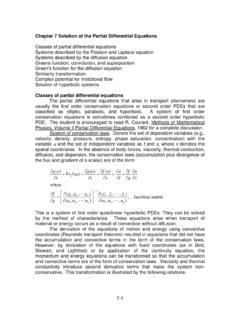
Chapter 7 Solution of the Partial Differential Equations
www.owlnet.rice.eduThe partial differential equations that arise in transport phenomena are usually the first order conservation equations or second order PDEs that are classified as elliptic, parabolic, and hyperbolic. A system of first order conservation equations is sometimes combined as a second order hyperbolic PDE.
MATHEMATICS
cisce.org(iv) Differential Equations Definition, order and degree, general and particular solutions of a differential equation. Formationof differential equation whose general solution is given. Solution of differential equations by method of separation of variables solutions of homogeneous differential equations of first
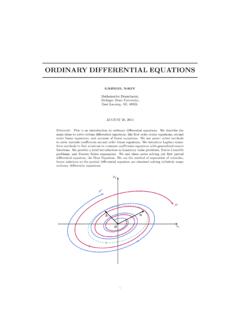
ORDINARY DIFFERENTIAL EQUATIONS
users.math.msu.eduSchr odinger’s equation for quantum mechanics, and Einstein’s equation for the general the-ory of gravitation. In the following examples we show how di erential equations look like. (a) Newton’s Law: ma= f, mass times acceleration equals force. Newton’s second law of motion for a single particle is a di erential equation.
PARTIAL DIFFERENTIAL EQUATIONS
web.math.ucsb.eduThus, in order to nd the general solution of the inhomogeneous equation (1.11), it is enough to nd the general solution of the homogeneous equation (1.9), and add to this a particular solution of the inhomogeneous equation (check that the di erence of any two solutions of the inhomogeneous equation is a solution of the homogeneous equation).

DIFFERENTIAL EQUATIONS PRACTICE PROBLEMS: ANSWERS
mathserver.neu.eduUsing the differential operator D, the homogeneous equation y00 −y0 =0becomes D2 −D=0which has solutions D=1and D=0, corresponding to Dy= y(y= ex)andDy=0(y= constant). Thus, the general solution to the homogeneous equation is yh= c1 + c2ex.Wenowfind a particular solution to the original equation using undetermined coefficients.
SERIES SOLUTIONS OF DIFFERENTIAL EQUATIONS
www.dslavsk.sites.luc.eduLet’s start with a simple differential equation: ′′− ′+y y y =2 0 (1) We recognize this instantly as a second order homogeneous constant coefficient equation. Just as instantly we realize the characteristic equation has equal roots, so we can write the solution to this equation as: x = + y e A Bx ( ) (2) where A and B are constants ...
The Schrödinger Equation in One Dimension
faculty.chas.uni.eduLike Newton’s second law, our quantum wave equation cannot be derived. It must be postulated and then shown to be consistent with experiment. What are some of the properties that the quantum wave equation should have? (1) Linear, homogeneous differential equation. This ensures that the principle of superposition is valid, i.e., if Ψ
Related search queries
Second, Order, DIFFERENTIAL, Second order homogeneous, Differential equa-tion, Equation, Homogeneous equa-tion, Second Order Differential Equation Non Homogeneous, Second order, Homogeneous, Homogeneous differential, Order differential, Differential equation, ORDINARY DIFFERENTIAL EQUATIONS, Homogeneous equation, Schrödinger Equation in One Dimension, Homogeneous differential equation