
CHAPTER 3: CRYSTAL STRUCTURES & PROPERTIES
• Rare due to poor packing (only Po [84] has this structure) • Close-packed directions are cube edges. Coordination number = 6 Simple Cubic (SC) Structure •Coordination number is the number of nearest neighbors •Linear density (LD) is the number of atoms per unit length along a specific crystallographic direction a1 a2 a3 . . . LD
Download CHAPTER 3: CRYSTAL STRUCTURES & PROPERTIES

Information
Domain:
Source:
Link to this page:
Documents from same domain
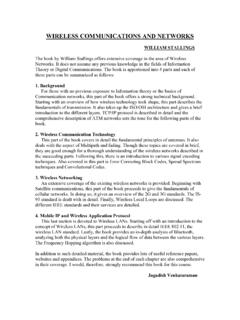
WIRELESS COMMUNICATIONS AND NETWORKS
www3.nd.eduWIRELESS COMMUNICATIONS AND NETWORKS WILLIAM STALLINGS The book by William Stallings offers extensive coverage in the area of Wireless Networks. It does not assume any previous knowledge in the fields of Information
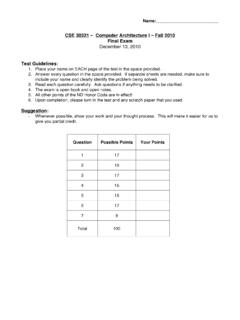
CSE 30321 – Computer Architecture I – Fall 2010 …
www3.nd.eduName:_____ CSE 30321 – Computer Architecture I – Fall 2010 Final Exam December 13, 2010 Test Guidelines: 1. Place your name on …
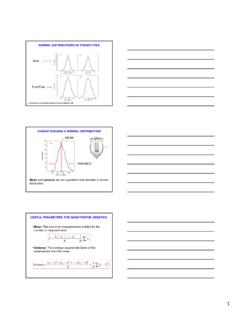
In:Introduction to Quantitative Genetics Falconer …
www3.nd.edu1 NORMAL DISTRIBUTIONS OF PHENOTYPES Mice Fruit Flies In:Introduction to Quantitative Genetics Falconer & Mackay 1996 CHARACTERIZING A NORMAL DISTRIBUTION Meanand variance are two quantities that describe a normal
Angels and Demons - nd.edu
www3.nd.eduIn the First Part of the Summa St. Thomas deals with angels and demons in two separate places: first, ... So the angels are, like God, immaterial substances.
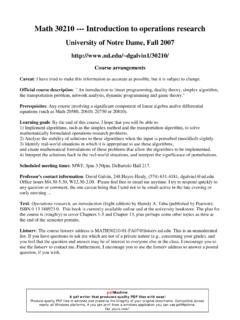
Math 30210 --- Introduction to operations research
www3.nd.eduMath 30210 --- Introduction to operations research University of Notre Dame, Fall 2007 http://www.nd.edu/~dgalvin1/30210/ Course arrangements
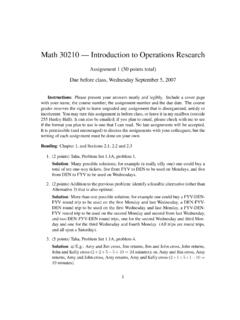
Math 30210 — Introduction to Operations Research
www3.nd.eduMath 30210 — Introduction to Operations Research Assignment 1 (50 points total) Due before class, Wednesday September 5, 2007 Instructions: Please present your answers neatly and legibly.
Statistics in Business Course Syllabus
www3.nd.eduStatistics in Business Course Syllabus Information ... widely used business statistics series and is highly regarded in the eld. ... Exam 2 (i.e., the Final Exam) ...

HOW TO WRITE AN EFFECTIVE RESEARCH PAPER
www3.nd.eduHOW TO WRITE AN EFFECTIVE RESEARCH PAPER ... • Add 2-3 paragraphs that discuss previous work. ... good presentation with proper usage of English

LECTURENOTESON GASDYNAMICS - University of …
www3.nd.eduLECTURENOTESON GASDYNAMICS ... These are a set of class notes for a gas dynamics/viscous flow course taught to juniors in ... • solid mechanics

BaseTech 1 Introducing Basic Network Concepts
www3.nd.edu1 Introducing Basic Network Concepts “In the beginning, there were no networks. ... Networking computers first and tracking the connections later can quickly
Related documents

Chapter 17: Alcohols and Phenols - Vanderbilt University
as.vanderbilt.eduChapter 17: Alcohols and Phenols phenol (aromatic alcohol) pKa~ 10 alcohol pKa~ 16-18 O C H C O CC H ... non covalent interaction between a hydrogen atom ... a ~ 9.9 9.38 9.35 7.15 10.16 10.21 10.46 ~ pK a X= -Cl 9.38 8 ...

Chapter 14
capricorn.bc.eduChapter 14 Objectives. 124 Chapter 14 SDS-PAGE is widely used to analyze the proteins in complex extracts. The most ... any covalent bonds between cysteine residues. Like other detergents, SDS is an amphipathic ... is 9.6, considerably higher than the …

1331 – CHAPTER 11 QUESTIONS IGNORE QUESTIONS 3, 10, …
uh.edu9. When liquid bromine is cooled to form a solid, which of the following types of solid would it form? A. atomic B. metallic C. molecular D ionic E. covalent network 10. Which one of the following substances does not exist in the indicated solid type? A. graphite – network covalent B. Na – metallic C. SiO2 - molecular

Chapter 2. Atomic Structure and Interatomic Bonding
web.eng.fiu.edu• The covalent bond is directional. • The number of covalent bonds that is possible for a particular atom is determined by the number of valence electrons. • Most bonds between two different types of atoms are somewhere in between ionic and covalent. Very few compounds exhibit pure ionic or covalent bonding.
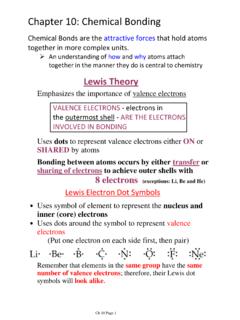
Chapter 10: Chemical Bonding
webs.anokaramsey.eduForm covalent bonds between the central atom and the surrounding atoms -called the "skeletal structure". Count how many electrons have been used to form these bonds. 3. Subtract electrons used to form covalent bonds from total number of valence electrons in the molecule or ion to determine how many electrons remain (if any). 4.
CHAPTER 6: ACID-BASE AND DONOR-ACCEPTOR CHEMISTRY
www.chem.uci.edu6.9 These data indicate that triphenylphosphine (PPh 3) is more basic than triphenylamine (NPh 3) in the gas phase. On the sole basis of electronics, triphenylamine would be expected to be more basic by virtue of the higher electronegativity of N relative to P, leading to the N center being more electron rich than the P center.
Answers – Naming Chemical Compounds
www.npsd.k12.nj.us9) CO carbon monoxide. 10) P4 phosphorus. For each of the following questions, determine whether the compound is ionic or covalent and write the appropriate formula for it. 11) dinitrogen trioxide N2O3. 12) nitrogen N2. 13) methane CH4. 14) lithium acetate LiC2H3O2. 15) phosphorus trifluoride PF3. 16) vanadium (V) oxide V2O5