
CHAPTER 3: INTERPERSONAL COMMUNICATIONS
A. Modes of Transmission of Nonverbal Communication Seven categories of nonverbal messages are (1) environment, (2) interpersonal distance, (3) posture, (4) gestures, (5) facial expressions, (6) voice quality, and (7)
Download CHAPTER 3: INTERPERSONAL COMMUNICATIONS

Information
Domain:
Source:
Link to this page:
Documents from same domain

CHAPTER 5: GROUP PROBLEM SOLVING - …
cwarden.org51 CHAPTER 5: GROUP PROBLEM SOLVING The purpose of this chapter is to present practical information about group problem solving, thus enabling the reader to contribute more effectively to group decision-making.
CHAPTER 13: ENHANCING ETHICAL BEHAVIOR
cwarden.org172 long- and short-term consequences should be specified. The symbolic consequences are important in that every act and decision sends a message.
CHAPTER 8: BECOMING AN EFFECTIVE LEADER
cwarden.org98 CHAPTER 8: BECOMING AN EFFECTIVE LEADER The purpose of this chapter is to present information about leadership that students can apply to developing their leadership skills.
CHAPTER 6: CROSS-CULTURAL RELATIONS AND …
cwarden.org66 CHAPTER 6: CROSS-CULTURAL RELATIONS AND DIVERSITY The purpose of this chapter is to provide the reader with insight into, and skills for, relating effectively to people from other cultures.

CHAPTER 12: CUSTOMER SATISFACTION SKILLS
cwarden.org157 technology is to preserve the human touch. For example, (a) when you respond to a voice-mail outgoing message, leave specific, relevant information, and (b) use the

CHAPTER 4: DEVELOPING TEAMWORK SKILLS
cwarden.org37 CHAPTER 4: DEVELOPING TEAMWORK SKILLS The purpose of this chapter is to present information and self-assessment, and skill-development exercises that will assist the reader to develop teamwork skills.

CHAPTER 7: RESOLVING CONFLICTS WITH OTHERS
cwarden.org81 CHAPTER 7: RESOLVING CONFLICTS WITH OTHERS The major purpose of this chapter is to provide insights and skills into resolving interpersonal conflict in the workplace.

CHAPTER 1: A FRAMEWORK FOR INTERPERSONAL SKILL …
cwarden.orgmanagerial, professional, technical, and sales personnel. A universal training need is an area for improvement common to most people. The text is organized around universal needs, as follows: 1. Understanding individual differences 2. Interpersonal communication 3. Developing teamwork skills 4. Group problem solving 5. Cross-cultural relations 6.

CHAPTER 2: UNDERSTANDING INDIVIDUAL DIFFERENCES
cwarden.orgPeople who do not consider themselves to be very smart typically use scholastic achievement and abstract problem solving as their frame of reference for judging intelligence. A person with such a self-evaluation might be reminded that he or she has great aptitude for dancing (or something else), this indicating high bodily/kinesthetic
Related documents
IEP Goals and Objectives Bank (Redmond, Oregon)
bridges4kids.orgFA1 Communication FA2 Communication FA3 Communication FA4 Communication FA5 Communication FA6 Communication ... SE14 Interpersonal Skills Table Of Contents. SE15 Problem Solving Skills ... Objective #4 Begin to understand the modes of writing by an author.
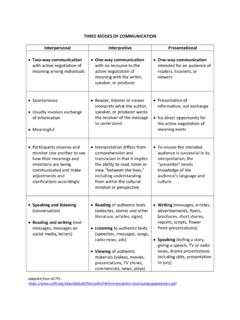
THREE MODES OF COMMUNICATION Interpersonal …
www.longwood.eduTHREE MODES OF COMMUNICATION Interpersonal Interpretive Presentational Two -way communication with active negotiation of meaning among individuals One -way communication with no recourse to the active negotiation of meaning with the writer, speaker, or producer One -way communication intended for an audience of readers, listeners, or
Communication cycle: Definition, process, models and …
wseas.usCommunication is the act of conveying information for the purpose of creating a shared under- ... and may occur through spoken or other modes." 3. This act of making common and known is car-ried out through exchange of thoughts, ideas or the ... Interpersonal Communication .
STAGE 1 COMPETENCY STANDARD FOR PROFESSIONAL …
www.engineersaustralia.org.au3.2. Effective oral and written communication in professional and lay domains. 3.3. Creative, innovative and pro-active demeanour. 3.4. Professional use and management of information. 3.5. Orderly management of self, and professional conduct. 3.6. …

Improving students’ critical thinking, creativity, and ...
files.eric.ed.govinterpersonal skills, multicultural skills, negotiation, leadership development, and change management” (Management Education at Risk, 2002). Determining how to teach the skills is an ongoing dilemma. Business professors have responded to the challenge of …