
Chapter 3 - Vectors
iˆ, jˆ,kˆ unit vectors in positive direction of x,y,z axes a a iˆ a ˆj (3.6) x y Vector component-Analytical method: adding vectors by components. Vector addition: r a …
Download Chapter 3 - Vectors

Information
Domain:
Source:
Link to this page:
Documents from same domain

Measuring blackbody radiaiton using infrared …
physics.ucf.eduMeasuringBlackbody!Radiation!usingInfrared!Detectors!! Theory!! ... Objective!3:!Measurement!of!spectralradianceforablackbodycurve !!
Physics for Scientists and Engineers I
physics.ucf.eduPhysics for Scientists and Engineers I Dr. Beatriz Roldán Cuenya University of Central Florida, Physics Department, Orlando, FL PHY 2048H. Chapter 1 - Introduction I. General II. International System of Units III. Conversion of units IV. Dimensional Analysis V. Problem Solving Strategies.
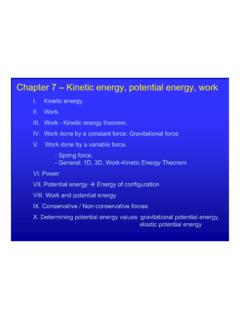
Chapter 7 – Kinetic energy, potential energy, work
physics.ucf.eduI. Kinetic energy Energy associated with the state of motion of an object. (7.1) 2 K 1 mv2 Units: 1 Joule = 1J = 1 kgm2/s2 = N m II. Work Energy transferred “to” or “from” an object by means of a force acting on the object. To +W From -W - Constant force: F x ma x d v v v v axd ax 2 2 2 0 2 2 0 2 Work done by the force = Energy
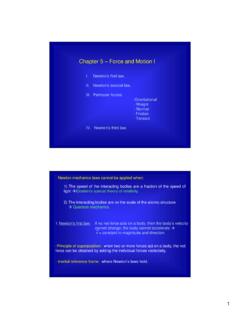
Chapter 5 – Force and Motion I
physics.ucf.eduChapter 5 – Force and Motion I I. Newton’s first law: If no net force acts on a body, then the body’s velocity cannot change; the body cannot accelerate v = constant in magnitude and direction. - Principle of superposition: when two or more forces act on a body, the net force can be obtained by adding the individual forces vectorially.
Chapter 5 – Force and Motion I - Physics
physics.ucf.eduN mg (5.5) - Normal force: perpendicular force on a body from a surface against which the body presses. - Frictional force: force on a body when the body attempts to slide along a surface. It is parallel ... Chapter 5 – Force and Motion II - Opposes the relative motion of a body in a fluid.
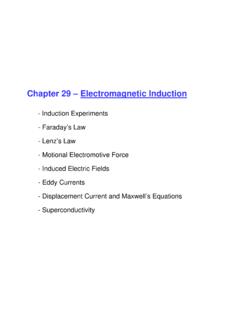
Chapter 29 – Electromagnetic Induction
physics.ucf.eduFaraday’s Law of Induction: - The induced emf in a closed loop equals the negative of the time rate of change of the magnetic flux through the loop. dt ε= − dΦB - Increasing flux ε< 0 ; Decreasing flux ε> 0 - Direction: curl fingers of right hand around A, if ε> 0 is in same direction of fingers (counter-clockwise), if ε< 0
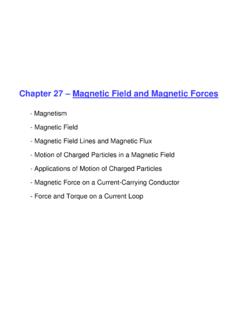
Chapter 27 – Magnetic Field and Magnetic Forces
physics.ucf.edua magnet near a conducting loop can induce a current. - The magnetic forces between two bodies are due to the interaction between moving electrons in the atoms. - Inside a magnetized body (permanent magnet) there is a coordinated motion …
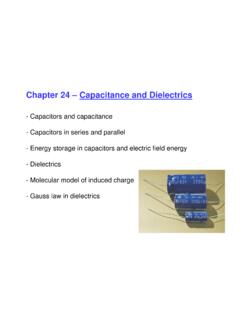
Chapter 24 – Capacitance and Dielectrics
physics.ucf.edu- Capacitance is a measurement of the ability of capacitor to store energy (V = U / q). Capacitors in Vacuum - Parallel Plate Capacitor: uniform electric field between the plates, charge uniformly distributed over opposite surfaces A Q E εo εo σ = = d A V Q C ab = =ε0 A Qd V E d o ab ε 1 = ⋅ = ε0 = 8.85 x 10⁻¹² F/m
Black Body Radiation - Physics
physics.ucf.eduBlackbody Radiation 1/10/13 1:12 PM http://www.egglescliffe.org.uk/physics/astronomy/blackbody/bbody.html Page 1 of 7 Black Body Radiation Astronomy Main
Chapter 6 – Force and Motion II
physics.ucf.eduA centripetal force accelerates a body by changing the direction of the body’s velocity without changing its speed. v, a = ctes, but direction changes during motion.-Centripetal force: a, F are directed toward the center of curvature of the particle’s path. 3 III. Non-Uniform circular motion
Related documents

8.1 Span of aSet ofVectors - Oregon Institute of Technology
math.oit.edu• The last two bullet items tell us that adding or removing vectors from a set of vectors may or may not change its span. This is a somewhat undesirable situation that we will remedy in the next chapter. • It may be obvious, but it is worth emphasizing that (in this course) we will consider spans of finite (and usually
Vectors - Clemson University
people.cs.clemson.eduAlgebraically, this is equivalent to adding corresponding terms of the two vectors: a + b = " a x a y # + " b x b y # = " a x + b x a y + b y #: We can think of this as again making a trip from the start of the first vector to the end of the second vector, but this time traveling first horizontally the distance a x + b x and then vertically the ...
Experiment 3 – Forces are Vectors
www.asc.ohio-state.eduthe Resultant Vector. If the two vectors are not parallel, adding them requires establishing an x-y coordinate system, then breaking down each vector into its “x” and “y” components before algebraically adding these vector components together to yield the Resultant Vector’s “x” and “y” components. The Resultant

Guideline Development Manufacture Lentiviral Vectors
www.ema.europa.euwith wild-type HIV. On the other hand, some SIN vectors contain highly active promoters, such as the Cytomegalovirus (CMV) promoter, which contain enhancer activity that may result in proto-oncogene activation. Additional modifications to improve safety include adding genetic elements that

MATH 304 Linear Algebra Lecture 16: Basis and dimension.
www.math.tamu.eduThese vectors are linearly independent as they are not parallel. Thus {v1,v2} is a basis so that the dimension of the plane is 2. ... set adding one vector at a time. If the vector space V is trivial, it has the empty basis. If V 6= {0}, pick any vector v1 6= 0. …

Introduction to vectors
www.mathcentre.ac.uk5. Adding two vectors One of the things we can do with vectors is to add them together. We shall start by adding two vectors together. Once we have done that, we can add any number of vectors together by adding the first two, then adding the result to the third, and so on. In order to add two vectors, we think of them as displacements.
VECTORS WORKSHEETS pg 1 of 13 VECTORS
www.mrwaynesclass.com7 Be able to identify if two vectors are equal 8 Graphically show the result of multiplying a vector by a positive scalar. 9 Graphically show the result of multiplying a vector by a negative scalar. 10 Graphically add vectors. 11 Graphically subtract vectors. 12 Graphically add, subtract and multiply vectors by a scalar in one equation.
4.1 Vector Spaces & Subspaces - University of Connecticut
www2.math.uconn.edub. Adding two vectors in H always produces another vector whose second entry is _____ and therefore the sum of two vectors in H is also in H. (H is closed under addition) c. Multiplying a vector in H by a scalar produces another vector in H (H is closed under scalar multiplication). Since properties a, b, and c hold, V is a subspace of R3. Note ...