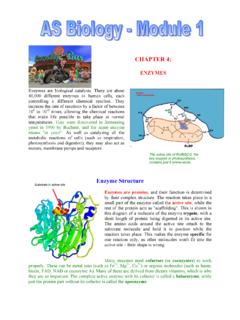
CHAPTER 4
How do enzymes work? There are three parts to our thinking about enzyme catalysis. They each describe different aspects of the same process, and you should know about each of them.
Download CHAPTER 4

Information
Domain:
Source:
Link to this page:
Documents from same domain
Rate of diffusion surface area x concentration …
biologymad.comHuman Breathing System In mammals the gas exchange surfaces are the lungs, which develop in the embryo from the gut wall - which relates us to some fossil fish!
INTRODUCTION TO THE CELL - BiologyMad A …
biologymad.comCHAPTER 1: STRUCTURE AND FUNCTION OF THE CELL INTRODUCTION TO THE CELL Both living and non-living things are composed of molecules made from chemical elements such as
Temperature Homeostasis (thermoregulation) - …
biologymad.comHomeostasis literally means “same state” and it refers to the process of keeping the internal body environment in a steady state, when the external environment is changed.

Diffusion, Osmosis, Active Transport
biologymad.comDiffusion, Osmosis, Active Transport There are two ways in which substances can enter or leave a cell: 1) Passive a) Simple Diffusion b) …
CHAPTER 5 - BREATHING - BiologyMad A-Level …
biologymad.comCHAPTER 5 - BREATHING "THE RESPIRATORY SYSTEM" You have read how the blood transports oxygen from the lungs to cells and carries carbon dioxide
Enzyme Technology - BiologyMad
biologymad.comEnzyme Technology For thousands of years natural enzymes made by microorganisms have been used to make products such as cheese, bread, wine, and beer.
General Properties Protein Nature of Enzymes - …
biologymad.comIndustrial Uses of Enzymes Bioprocessing is the use of biological materials (organisms, cells, organelles, enzymes) to carry out manufacturing or treatment procedures of commercial or scientific interest.

THE CIRCULATORY SYSTEM - BiologyMad
biologymad.comCHAPTER 6: THE CIRCULATORY SYSTEM THE CIRCULATORY SYSTEM and the LYMPHATIC SYSTEM Most of the cells in the human body are not in direct contact with the external environment, so rely

to renal vein away bladder - BiologyMad
biologymad.comThe first part of the loop (the descending limb) is impermeable to ions, but some water leaves by osmosis.This makes the filtrate more concentrated as it descends. The second part of the loop (the

Continuous and discontinuous variation - …
biologymad.comContinuous and discontinuous variation Variation, the small differences that exist between individuals, can be described as being either discontinuous or continuous. ...
Related documents
Enzyme Technology - BiologyMad
biologymad.comEnzyme Technology For thousands of years natural enzymes made by microorganisms have been used to make products such as cheese, bread, wine, and beer.

The Moderately Efficient Enzyme: Evolutionary and ...
sbrg.ucsd.edu4403 dx.doi.org/10.1021/bi2002289 | Biochemistry2011, 50, 4402 4410 Biochemistry CURRENT TOPIC phase and a water phase. This indicator of hydrophobicity was found to correlate with the binding ...

Risk Assessment Guidance for Enzyme-Containing Products
www.aciscience.org2 For additional information on risk assessment and risk practices for enzymes, contact your enzyme supplier, or The Soap and Detergent Association
ENZYME KINETICS - Columbia University
www.columbia.edu1 Enzyme Kinetics In this exercise we will look at the catalytic behavior of enzymes. You will use Excel to answer the questions in the exercise section.
Factors that Affect Enzyme Catalysis
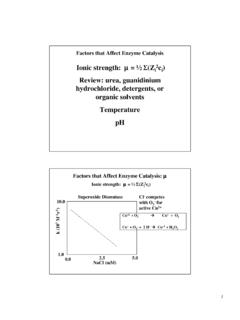
www.csun.edu1 Factors that Affect Enzyme Catalysis Ionic strength: m = ½ S(Z i 2c i) Review: urea, guanidinium hydrochloride, detergents, or organic solvents Temperature
Enzyme Kinetics - University Science Books - Home Page
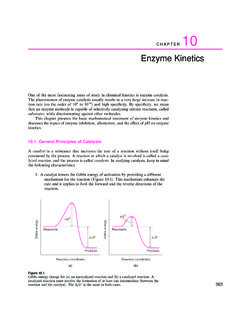
www.uscibooks.comCHAPTER 10 Enzyme Kinetics One of the most fascinating areas of study in chemical kinetics is enzyme catalysis. The phenomenon of enzyme catalysis usually …