
CHAPTER 4: DEVELOPING TEAMWORK SKILLS
effective team player is one of the most important sets of behaviors in the modern ... of active listening, and is a model of etiquette and professionalism. E. Challenger ... group focused on deadlines is valuable because meeting deadlines is vital to team success.
Download CHAPTER 4: DEVELOPING TEAMWORK SKILLS

Information
Domain:
Source:
Link to this page:
Documents from same domain

CHAPTER 5: GROUP PROBLEM SOLVING - …
cwarden.org51 CHAPTER 5: GROUP PROBLEM SOLVING The purpose of this chapter is to present practical information about group problem solving, thus enabling the reader to contribute more effectively to group decision-making.
CHAPTER 13: ENHANCING ETHICAL BEHAVIOR
cwarden.org172 long- and short-term consequences should be specified. The symbolic consequences are important in that every act and decision sends a message.
CHAPTER 8: BECOMING AN EFFECTIVE LEADER
cwarden.org98 CHAPTER 8: BECOMING AN EFFECTIVE LEADER The purpose of this chapter is to present information about leadership that students can apply to developing their leadership skills.
CHAPTER 6: CROSS-CULTURAL RELATIONS AND …
cwarden.org66 CHAPTER 6: CROSS-CULTURAL RELATIONS AND DIVERSITY The purpose of this chapter is to provide the reader with insight into, and skills for, relating effectively to people from other cultures.

CHAPTER 12: CUSTOMER SATISFACTION SKILLS
cwarden.org157 technology is to preserve the human touch. For example, (a) when you respond to a voice-mail outgoing message, leave specific, relevant information, and (b) use the

CHAPTER 7: RESOLVING CONFLICTS WITH OTHERS
cwarden.org81 CHAPTER 7: RESOLVING CONFLICTS WITH OTHERS The major purpose of this chapter is to provide insights and skills into resolving interpersonal conflict in the workplace.

CHAPTER 3: INTERPERSONAL COMMUNICATIONS
cwarden.orgA. Modes of Transmission of Nonverbal Communication Seven categories of nonverbal messages are (1) environment, (2) interpersonal distance, (3) posture, (4) gestures, (5…

CHAPTER 1: A FRAMEWORK FOR INTERPERSONAL SKILL …
cwarden.orgmanagerial, professional, technical, and sales personnel. A universal training need is an area for improvement common to most people. The text is organized around universal needs, as follows: 1. Understanding individual differences 2. Interpersonal communication 3. Developing teamwork skills 4. Group problem solving 5. Cross-cultural relations 6.

CHAPTER 2: UNDERSTANDING INDIVIDUAL DIFFERENCES
cwarden.orgPeople who do not consider themselves to be very smart typically use scholastic achievement and abstract problem solving as their frame of reference for judging intelligence. A person with such a self-evaluation might be reminded that he or she has great aptitude for dancing (or something else), this indicating high bodily/kinesthetic
Related documents
Employee Engagement Specialist
pennquarter.dcconvention.comincluding contests, meeting logistics, meeting recaps, budget summaries, etc., to ensure all engagement programs are successfully implemented. In collaboration with Communications and Marketing Department, designs regular employee engagement communication vehicles to employees by creating multimedia messages.

THE EDUCATIONAL LEADER RESOURCE
www.acecqa.gov.auMeeting with the team 25 Responding to challenging people 26 Mentoring 28 ... Generative listening 118 Powerful questions 118 Models of reflection 120 Getting practical 120 ... and care provision, they also promote a sense of professionalism for the sector now and in
Annual Staff Performance Evaluation –Competency-Based
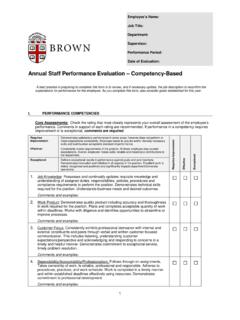
www.brown.eduseeks input and expertise of others. Contributes to the team environment by working effectively with others on the team to accomplish work. Treats co-workers with respect, honesty and fairness. Resolves issues effectively and is viewed as a positive team member and/or colleague. Comments and examples: 6.
Professional Standards Leadership
www.cno.orgon his condition. After listening to the concerns, Diana researches appropriate infection control measures, addresses the issues with the health care team and develops solutions involving all parties. Diana suggests that Holly, a novice nurse, assist her with the communication between the health care team and the family.

Standards for pharmacy professionals
www.pharmacyregulation.orgThe professionalism they demonstrate is central to maintaining ... • demonstrate effective team working • adapt their communication to bring about ... than giving a person information, asking questions and listening. It is the exchange of information between people. Body language, tone of voice and the words pharmacy professionals use all

TRAINING REGULATIONS
www.tesda.gov.ph1. Describe team role and scope 1.1. The role and objective of the team is identified from available sources of information 1.2. Team parameters, reporting relationships and responsibilities are identified from team discussions and appropriate external sources 2. Identify own role and responsibility within team 2.1.

TRAINING REGULATIONS - Tesda
www.tesda.gov.ph500311106 Work in team environment ... 1.2 Effective questioning , active listening and speaking skills ... 3.3 Meeting inputs are consistent with the meeting purpose and established protocols 3.4 Workplace interactions are conducted in a courteous manner