
Chapter 4. HORTICULTURAL SOCIETIES
Hunter gatherer Horticultural Agrarian number of societies. 4-62 Horticultural Societies B. History Horticulture first developed in the Middle East beginning about 9,500 years ago and by about 5,000 years ago this technology had spread far eastward and to the Atlantic in the
Download Chapter 4. HORTICULTURAL SOCIETIES

Information
Domain:
Source:
Link to this page:
Documents from same domain

INTERNATIONAL JOURNAL OF STRATEGIC …
www.des.ucdavis.eduInternational Academy of Business and Economics ... INTERNATIONAL JOURNAL OF STRATEGIC MANAGEMENT, Volume 11, Number 1, 2011 96 q ...

Writing Memos - Environmental Science & Policy
www.des.ucdavis.eduWriting Memos Blinn College-Bryan Writing Center Fall 2008 Summaries Long memos (those longer than one page) often have a short summary following the

Chapter 16. CRIME AND CRIMINALITY
www.des.ucdavis.edu16-286 Crime and Criminality result in pain or discomfort for victims and offer few or meager long-term benefits because they interfere with careers, family, and friendships.

Churches and mosques have set up where commerce once …
www.des.ucdavis.eduChurches and mosques have set up where commerce once ruled. religious organizations may warrant spe-cial protection under such state laws as well as the federal Religious Land Use ... A mosque is trickier be-cause Muslims meet for worship on Fri-days during the day. Nevertheless, Wood-
Oil and Gas Service Contracts around the World: A Review
www.des.ucdavis.eduOil and Gas Service Contracts around the World: A Review1 Abbas Ghandia, C.-Y. Cynthia Linb aInstitute of Transportation Studies, University of California at Davis, One Shields Avenue, 1605 Tilia Street, Suite 100, Davis, CA 95616, United States. Email: aghandi@ucdavis.edu.

Part I. Introduction Chapter 1. What is Human Ecology ...
www.des.ucdavis.eduChapter 1. WHAT IS HUMAN ECOLOGY? Another Unique Species (Title of Robert Foley’s 1987 book on evolutionary human ecology) I. Introduction What is human ecology? Human ecology is an approach to the study of human be-havior marked by two committments. First, human ecologists think that humans should be

Human Adaptations - Environmental Science & Policy
www.des.ucdavis.eduKalahari San plant intensive foragers The San are every bit as “crafty” as the Inuit, though they don’t need fancy clothes or boats. Men use tiny bows and arrows to kill large animals using poisons. Women have clever ways of rendering low quality plant foods edible.

CHAPTER 6. AGRARIAN SOCIETIES
www.des.ucdavis.eduThis hypothesis is hard to test, but it is clear that the average person ... Reliable documentary. Agrarian Societies 6-96 sources for India, to mention a classical agrarian civilization, are almost absent, for exam-ple. You’ve all heard the maxim that …
Chapter 25. ORIGIN OF FOOD PRODUCTION
www.des.ucdavis.eduThe food production revolution greatly impressed earlier scholars because it was the economic basis of “civilization”—literacy, mathematics, state ... It took a similar length of time for horticulture to spread from the Near East to far-Western Europe. From a macro-evolutionary perspective, however, the
Related documents

The Heart of Darkness - SourceForge
foa.sourceforge.nethere in the train of some prefect, or tax-gatherer, or trader even, to mend his fortunes. Land in a swamp, march through the woods, and in some inland post feel the savagery, the utter savagery, had closed round him -- all that mysterious life of the wilderness that stirs in …
Reading Essentials and Study Guide - Student Edition
www.glencoe.comWH6.1.1 Describe the hunter-gatherer societies, including the development of tools and the use of fire. WH6.1.2 Identify the locations of human communities that populated the major regions of the world and describe how humans adapted to a variety of environments. WH6.1.3 Discuss the climatic changes and human modifications of the

Where did the Ancient Semites come from?
biblicaltheology.com3 languages. Indeed, the Sahara has not always been a fruitless desert, but the problem lies in the fact that it had already become a desert earlier than the whole of northern Arabia
World History: Grade Seven Social Studies Notebook
carrithers7ss.weebly.com- 16 - Mesopotamia Map Complete the map below following the directions at the bottom of the page. Find and label these locations: Step 1: In Green - Outline and Color in the area of Mesopotamia Step 2: In Red - Label the following countries: o Turkey, Syria, Iraq, Iran, Kuwait, Saudi Arabia, Jordan, Egypt, Israel, Lebanon
Periods List (Historic England) - FISH
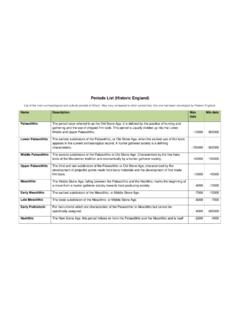
heritage-standards.org.ukA hunter gatherer society is a defining characteristic. -150000 -500000 Middle Palaeolithic The second subdivision of the Palaeolithic or Old Stone Age. Characterized by the fine flake tools of the Mousterian tradition and economically by a hunter gatherer society. -40000 -150000

Grade 6 World History Review - 6th Grade Social Studies
nsms6thgradesocialstudies.weebly.comcan reconstruct the development of humans from hunter-gatherer societies to settled communities. Early human communities populated Africa, Europe, and Asia, and later migrated to Australia and North and South America, adapting to the diverse environments found in each location. Time Frame: 3 Million BCE - 3000 BCE Where in the World? Questions Text

Changes in Britain from the Stone Age to the Iron Age ...
www.hornpark.greenwich.sch.ukgatherer people who live by hunting, fishing, and harvesting wild food. Nomads people that travel and have no permanent home Tribe people who live in a group for protection Settlement A place where a group live together in buildings building a community Agriculture farming Flint Stone used in Stone Age for blades, knives and spears

ES04 Ch01 001-007
www.jonesscience.comb. agricultural revolution d. hunter-gatherer period _____14. Which major changes in human society and the environment occurred during the Industrial Revolution? a. People lived in small tribes; many mammals went extinct. b. Domesticated plants …

Primary KS2 Stone Age to Iron Age - Museum of London
www.museumoflondon.org.ukThe hunter-gatherer groups that set up camp at Three Ways Wharf in Uxbridge sat around the fire when they made their tools. Archaeologists learnt about their lives by looking at the traces they left behind. Share the case study about Three Ways Wharf and think about all the different artefacts found at the site.