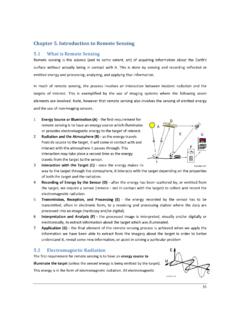
Chapter 5. Introduction to Remote Sensing
5.3 The Electromagnetic Spectrum The electromagnetic spectrum ranges from the shorter wavelengths (including gamma and x-rays) to the longer wavelengths (including microwaves and broadcast radio waves). There are several regions of the electromagnetic spectrum which are useful for remote sensing. For most purposes, the ultraviolet or UV portion ...
Download Chapter 5. Introduction to Remote Sensing

Information
Domain:
Source:
Link to this page:
Documents from same domain
Lecture 7 Cooling and lubrication - Hill Agric
hillagric.ac.inAG ENGG 243 lecture 7 1 COOLING SYSTEM A system, which controls the engine temperature, is known as a cooling system. NECESSITY OF COOLING SYSTEM

ENGINE & WORKING PRINCIPLES - Hill Agric
hillagric.ac.inENGINE & WORKING PRINCIPLES A heat engine is a machine, which converts heat energy into mechanical energy. The combustion …
Lecture 6 Fuel System - Hill Agric
hillagric.ac.inAG ENGG 243 Lecture 6 2 mixture within the cylinder after the ignition has taken place. It is an undesirable combustion and results in sudden rise in pressure, a loss of power and overheating of the engine.

Study Material Course No.: Ag Econ 122 (Production ...
hillagric.ac.inagricultural production economics involves the study of factor-product, factor-factor and product-product relationships, the size of the farm, returns to scale, credit and risk and uncertainty, etc.

History of Plant Pathology - Hill Agric
hillagric.ac.inAnton de bary (1831 – 1888) – the father of plant pathology, In 1853 he established that rust and smuts are causes not the results of disease,
ENGINE & WORKING PRINCIPLES
hillagric.ac.inA heat engine is a machine, which converts heat energy into mechanical energy. The combustion of fuel such as coal, petrol, diesel generates heat. This heat is supplied to a working substance at high temperature. By the expansion of this substance in suitable machines, heat energy is converted into useful work.
PRINCIPLES OF PLANT PATHOLOGY
hillagric.ac.inPlant Pathology- Today & Future Molecular Plant Pathology – Discovery of WM Stanley in 1935 about proteinaceous nature of the TMV can be considered as beginning of the molecular Plant \Pathology, though two years later, Bawden and Pierie …

Defense Mechanism in Plants
hillagric.ac.inphenols that affect the pathogen . Role of phenol oxidizing enzymes •Enzymes like –poplyphenol oxidases- oxidises phenols to quinones ... –others such as poly acrylic acid, 2-chloroethylphosphonic acid, acetyl- salicylic acid, benzoic acid, indole-3-acetic acid, 2, 4-

Fundamentals of Rural Sociology and Educational Psychology
hillagric.ac.indevelopment. Rural sociology studies social situation s and collects social facts of rural society. Agricultural extension makes uses of such social data as basis for building up extension programmes for farmers. Rural sociology investigates the social, cultural, political and religious problems of rural society.

Natural resource management
hillagric.ac.insustainable methods of managing those resources to ensure their availability to future generations. Resource economists study interactions between economic and natural systems, with the goal of developing a sustainable and efficient economy. It is a multi - disciplinary field of academic research. Natural resource management
Related documents

Introduction to the Electromagnetic Spectrum
fusioned.gat.comThe Electromagnetic Spectrum Introduction–Visible Light 1 Instructor’s Guide to Lab No. 1: The Visible Electromagnetic Spectrum Goal The goal is to introduce the visible electromagnetic spectrum to students through use of materials readily available to most high school science classes.

INTRODUCTION The Electromagnetic Spectrum
homepages.uc.eduINTRODUCTION The Electromagnetic Spectrum Fig. 1. The electromagnetic spectrum. Human Eye Response {increasing increasing decreasing decreasing decreasing increasing ENERGY frequency wavelength Cosmic and gamma rays X-rays Ultraviolet Lght …
Introduction to X-Ray Fluorescence (XRF) - Unicamp
www.fem.unicamp.brIntroduction to X-Ray Fluorescence (XRF) Fundamental Principles 1 1. Fundamental Principles 1.1 Electromagnetic Radiation, Quanta From a physical point of view, X-rays are of the same nature as visible light. Visible light can be described as electromagnetic wave radiation whose variety of colors (e.g. the colors of the rainbow) we interpret as

The Electromagnetic Spectrum - queenwhitley.com
queenwhitley.comThe Electromagnetic Spectrum Introduction Imagine playing beach volleyball, like the young men in Figure 1.1. They may not realize it, but they are being bombarded by electromagnetic radiation as play in the sunlight. The only kinds of radiation they can detect are

Chapter 13 Distributed Feedback (DFB) Structures and ...
courses.cit.cornell.eduresults from the Bragg scattering of electromagnetic waves from the periodic index of the medium, and the strength of the bandgap also depends on the strength of the index variations as captured by the coupling constant . 13.2 Distributed Feedback (DFB) Lasers (1D Photonic Crystal Lasers) 13.2.1 Introduction: ~.
Chapter 5:X-Ray Production - International Atomic Energy ...
humanhealth.iaea.org5.2.3 X-ray Spectrum a) Ideal Bremsstrahlung spectrum for a tungsten anode (tube voltage 90 kV) b) An Actual spectrum at the beam exit port with characteristic X rays (anode angle: 20°, inherent filtration: 1 mm Be) c) The spectrum Filtered with an equivalent of 2.5 mm Al Diagnostic Radiology Physics: a Handbook for Teachers and Students ...
Radio Waves and the Electromagnetic Spectrum
radiojove.gsfc.nasa.govEngagement: Introduction of the activity A. Ask the students to identify where on the electromagnetic spectrum radio waves are located. B. Ask the students to identify as many possible types of electromagnetic waves that they can. Can the students identify common uses of various wave types?
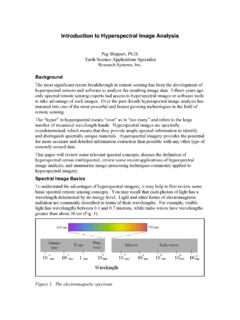
Introduction to Hyperspectral Image Analysis
spacejournal.ohio.eduIntroduction to Hyperspectral Image Analysis Peg Shippert, Ph.D. Earth Science Applications Specialist Research Systems, Inc. Background ... The electromagnetic spectrum. Reflectance is the percentage of the light hitting a material that is then reflected by that material (as opposed to being absorbed or transmitted). ...
Non-Ionizing Radiations – Sources, Biological Effects ...
www.who.intElectromagnetic Fields and Our Health 20th n– 22 d October 2003 2 INTRODUCTION Non-ionizing radiations (NIR) encompass the long wavelength (> 100 nm), low photon energy (<12.4 eV) portion of the electromagnetic spectrum, from 1 Hz to 3 x 10¹⁵ Hz. Except
High Frequency Radiation and Human Exposure
www.who.intINTRODUCTION In many applications, electromagnetic waves are generated and travel through free space at the speed of light. Radio waves and microwaves emitted by transmitting antennas are one form of electromagnetic energy. This electromagnetic energy is characterized by its frequency (in Hz) and wavelength.
Related search queries
INTRODUCTION, Electromagnetic spectrum, Electromagnetic Spectrum Introduction, Electromagnetic, The Electromagnetic Spectrum, The Electromagnetic Spectrum Introduction, Distributed Feedback (DFB) Structures and, Spectrum, Radio Waves, Electromagnetic spectrum radio waves, Hyperspectral, Non-Ionizing Radiations, INTRODUCTION Non-ionizing radiations