Chapter 5: Major Metabolic Pathways
Catabolism Metabolic reactions in the cell that degrade a substrate into smaller / simpler products. Glucose → CO 2 Anabolism Metabolic reactions that result in the synthesis of larger / more complex molecules. 4 ... Principles of ME and Mixed Acid Fermentation
Download Chapter 5: Major Metabolic Pathways

Information
Domain:
Source:
Link to this page:
Documents from same domain
CM3215 Fundamentals of Chemical Engineering …
pages.mtu.eduControl Valve Lecture, CM3215 Morrison 2/17/2016 1 CM3215 Fundamentals of Chemical Engineering Laboratory Professor Faith Morrison Department of Chemical Engineering

Basic Concepts of Human Genetics - pages.mtu.edu
pages.mtu.edu1 Basic Concepts of Human Genetics • The genetic information of an individual is contained in 23 pairs of chromosomes. Every human cell contains the 23 pair of chromosomes. • One pair is called sex chromosomes Male: XY Female: XX • Other 22 pairs of homologous chromosomes are called autosomes. • The autosome …

Pumping System Curves - Michigan Technological …
pages.mtu.eduPumping System Head CM3215 FAM 3Mar2014 1 CM3215 Fundamentals of Chemical Engineering Laboratory Professor Faith Morrison Department of Chemical Engineering
Chapter 4 - Student
pages.mtu.eduIn Chapter 4, the following problem modules explain the heat transfer processes involved in fuel cell vehicles and in the processes for producing fuel for fuel cells. 4.1-1 Heat Loss through a Stainless Steel Bipolar Plate
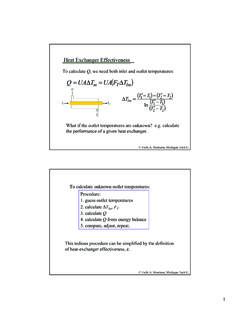
Heat Exchanger Effectiveness
pages.mtu.eduHeat Exchanger Effectiveness ... Double-pipe or 1-1 Shell-and-Tube Heat Exchangers ©Faith A. Morrison, Michigan Tech U. 8 Final Exam CM 310 November 16, 1998 ... The heat capacity of the oil is 1.89 kJ/kg K, and the average heat capacity of water over the temperature range of interest is 4.192 kJ/kg K. The overall heat-transfer coefficient of ...

Introduction to Electromagnetic Theory
pages.mtu.edu1/19/18 1 Lecture topics • Laws of magnetism and electricity • Meaning of Maxwell’s equations • Solution of Maxwell’s equations Introduction to Electromagnetic Theory

Note: This document represents a draft of text that is ...
pages.mtu.edubalance equations we choose the boundaries and then note the quantities of mass, energy, or momentum that cross the boundaries (Figure 2). A closed system is a system that does not have any mass crossing its boundaries.

Compressibility Factor from Redlick-Kwong Equations
pages.mtu.eduCompressibility Factor from Redlick-Kwong Equations (Dr. Tom Co 9/2/08) Working Equations: (based on Cutlip and Shacham, 2008, pp. 101-103) Let be pressure in …
STEAM TABLES - Michigan Technological University
pages.mtu.eduSaturated Steam: TEMPERATURE Table STEAM TABLES ( from M. D. Koretsky, "Engineering and Chemical Thermodynamics", John Wiley & Sons, 2004)

ROBOT OPERATIONS - Michigan Technological University
pages.mtu.eduR-J3, R-J3iB and R-30iA Controller This training focuses on the FANUC Robotics R-J3, R-J3iB and R-30iA controller. The R-J3 series uses advanced technology packaged in a
Related documents

Chap. 1 Introduction to Biochemistry Reading Assignment
www.uwyo.edulipids is a fatty acid. The most common structural lipid in cell membranes--glycerophospholipid--contains 2 fatty acids, glycerol and a polar head group (Fig. 1.11 & 1.12). When collected as ... from catabolism is used to drive biosynthetic processes collectively referred to as anabolism.
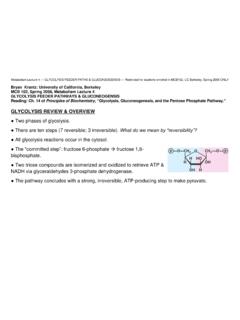
GLYCOLYSIS REVIEW & OVERVIEW
mcb.berkeley.eduregulated step. A by-product of fatty acid catabolism is acetyl-CoA, which actually stimulates pyruvate carboxylase. Also the enzyme can provide oxaloacetate, which is an important metabolite in the TCA cycle (more on that in CH. 16.)

27.1: Classification of Amino Acids.
www.vanderbilt.eduenzymes involved in amino acid biosynthesis, metabolism and catabolism are pyridoxal phosphate (vitamin B 6) dependent (please read) NH 3 RCO 2-H L-amino acid H H CO 2-D-amino acid racemase, epimras H 3N R H H decarboxylase O RCO 2-transmie N 2-O 3P OH OH pyridoxal phosphate (PLP) + N H PO N O RCO 2-27.5: Reactions of Amino Acids. Amino …

Cell Str UC tU re and F C tion 9 Cellular Respiration and ...
www.pearson.comglucose in photosynthesis is related to its catabolism in cellular respiration on pages 232–233.) 9.1 An Overview of Cellular Respiration In general, a cell contains only enough ATP to sustain from 30 seconds to a few minutes of normal activity. Because it has such high potential energy, ATP is unstable and is not stored. As a
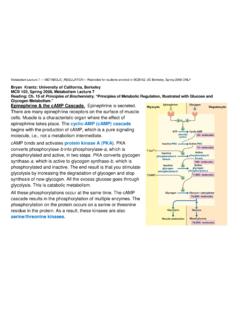
cyclic-AMP (cAMP) cascade protein kinase A (PKA). PKA
mcb.berkeley.eduAerobic catabolism takes place in mitochondria. Glucose + O 2 CO 2 + H 2 O + Work + Heat Oxidation. Why does all the metabolism of citric acid cycle and oxidative phosphorylation take place in the mitochondria? We are now getting into oxidative metabolism. Oxidation is a dangerous process that generates a number of highly reactive molecules.

AP Biology 2015 Free-Response Questions - College Board
secure-media.collegeboard.orgx Catabolism of glucose in glycolysis and pyruvate oxidation x Oxidation of intermediates in the Krebs cycle x Formation of a proton gradient by the electron transport chain (b) Use each of the following observations to . justify. ... The amino acid sequence of cytochrome . c .

Citric Acid Cycle - California State University, Northridge
www.csun.eduCitric Acid Cycle: Central Role in Catabolism • Stage II of catabolism involves the conversion of carbohydrates, fats and aminoacids into acetylCoA • In aerobic organisms, citric acid cycle makes up the final stage of catabolism when acetyl CoA is completely oxidized to CO2. • Also called Krebs cycle or tricarboxylic acid (TCA) cycle.

Role of Microbes in Dairy Industry
juniperpublishers.comamino acid catabolism. The ability of lactic acid bacteria and other cheese microorganisms to degrade amino acids to aroma compounds is highly strain dependent. These are equipped with enzyme systems for using amino acids in their metabolism. Different amino acids catabolism gives different flavors’ as follows [7,8]:

Chapter 5: Microbial Metabolism
www.lamission.eduCatabolism Lipids and proteins can also be used as sources of energy to produce ATP • different amino acids enter glycolysis or the Krebs cycle at various stages • fatty acids are broken down to acetyl groups & fed into the Krebs cycle