
Chapter 5 Storage Devices - FTMS
• It is called Random Access Memory because any of the data in RAM can be accessed just as fast as any of the other data. • There are two types of RAM: –DRAM (Dynamic Random Access Memory) –SRAM (Static Random Access Memory) CSCA0101 Computing Basics 7 Storage Devices Primary Storage RAM Static RAM Dynamic RAM • Faster
Download Chapter 5 Storage Devices - FTMS

Information
Domain:
Source:
Link to this page:
Documents from same domain
THE IMPACT OF SOCIAL MEDIA ON STUDENTS …
www.ftms.edu.myISSN: 2289-6694 Page 14 International Journal of Education, Learning and Training www.ftms.edu.my/journals/index.php/journals/ijelt Vol. 1 (No.1), November, 2016

INTRODUCTION TO MULTIMEDIA - FTMS
www.ftms.edu.myWhat is Multimedia? Multimedia means that computer information can be represented through audio, video, and animation in addition to traditional media (i.e., text, ...
Chapter 1 History of Computers - FTMS
www.ftms.edu.myCSCA0101 Computing Basics 3 History of Computers Definition of Computer • Computer is a programmable machine. • Computer is a machine that manipulates data

COMMENTARY Transforming the Balanced …
www.ftms.edu.myTransforming the Balanced Scorecard from Performance M easurement to Strategic Management: Part II 149 their own bodies of knowledge, language, and culture.

Chapter 6
www.ftms.edu.myPlanning for Competitive Advantage •Planning for competitive advantage is especially important in today’s competitive business arena and

Module: Auditing Session 10: AUDIT FAILURES - …
www.ftms.edu.my1 Module: Auditing Session 10: AUDIT FAILURES Introduction In modern societies, external auditing is promoted as a technology that enables the stakeholders to manage, control and prevent risks.

BASIC CONCEPTS OF NETWORK - ftms.edu.my
www.ftms.edu.myCN1047 INTRODUCTION TO COMPUTER NETWORKING CHAPTER 1 BASIC CONCEPTS OF NETWORK. DEFINTION & APPLICATIONS DEFINTION: A computer network is defined as the interconnection

CHAPTER 6 MARKET SEGMENTATION - FTMS
www.ftms.edu.myCHAPTER 6 MARKET SEGMENTATION Objectives: After completing this chapter, student should be able to understand: 1.Market segmentation 2.Benefits of segmentation

Introduction to International business - ftms.edu.my
www.ftms.edu.myWall, Minocha and Rees, International Business, 3rd Edition, ... Introduction to International business Chapter 1 . Slide 1.2 Wall, Minocha and Rees, ...

Introduction 1.2. Patterns and trends in …
www.ftms.edu.myInternational Business (MOD001055) Chapter 1: Introduction to International Business Zubair Hassan zubair@ftms.edu.my or …
Related documents
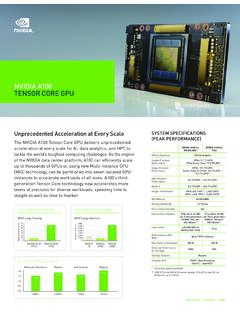
NVIDIA A100 | Tensor Core GPU
www.nvidia.comas well as higher dynamic random-access memory (DRAM) utilization efficiency at 95 percent. A100 delivers 1.7X higher memory bandwidth over the previous generation. MULTI-INSTANCE GPU (MIG) An A100 GPU can be partitioned into as many as seven GPU instances, fully isolated at the hardware level with their own high-bandwidth memory,
LPC546xx Product data sheet
www.nxp.comExternal Memory Controller (EMC) provides support for asynchronous static memory devices such as RAM, ROM and flash, in addition to dynamic memories such as single data rate SDRAM with an SDRAM clock of up to 100 MHz. EMC bus width (bit) on TFBGA180, TFBGA100, and LQFP100 and packages supports up to

Memory Basics - Michigan State University
www.egr.msu.edu– non-volatile memory stores date even when power is removed • ROM is non-volatile • Static vs. Dynamic Memory – Static: holds data as long as power is applied (SRAM) – Dynamic: will lose data unless refreshed periodically (DRAM) ECE 331, Prof. A. Mason Memory Overview.2 SRAM/DRAM Basics •SRAM: Static Random Access Memory
Introduction Target candidate description
d1.awsstatic.comrandom access, continuous usage vs.ad hoc) ... Evaluate dynamic, interactive, and static presentations of data ... Implement the appropriate data access mechanism (e.g., in memory vs. direct access) Implement an integrated solution from multiple heterogeneous data sources Domain 5: Security
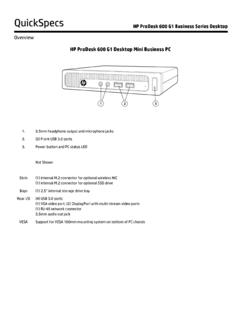
HP ProDesk 600 G1 Business PC Series QuickSpecs 12.03.13
www.hp.com• DDR3 Synchronous Dynamic Random Access Memory (SDRAM)! • Multi-independent monitor support via VGA and dual digital DisplayPort video interfaces with multi-stream! • Discrete graphics options available for SFF and TWR platforms! • DTS+ Sound audio management software! • Standard and high efficiency energy saving power supply options!
Pointers and Memory - Stanford University
cslibrary.stanford.edudeallocation, memory ownership models, and memory leaks. The text focuses on pointers and memory in compiled languages like C and C++. At the end of each section, there is some related but optional material, and in particular there are occasional notes …
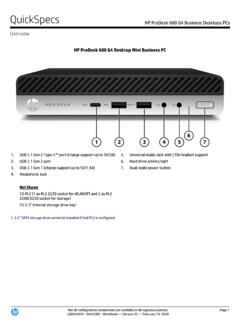
HP ProDesk 600 G4 Business Desktops PCs
h20195.www2.hp.com• Intel® Optane memory available as optional feature • Choice of Windows 10 Professional, Windows 10 Home, and FreeDOS 2.0 • Integrated 10/100/1000 Ethernet Controller, with optional 802.11ac Wi-Fi and/or Bluetooth® 5.0 • Up to 64 GB of DDR4 Synchronous Dynamic Random Access Memory (SDRAM) on MT and SFF, and up to 32 GB on DM and AiO
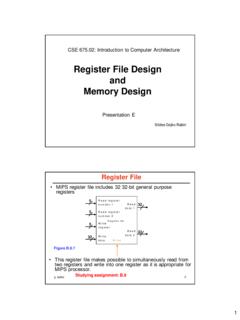
Register File Design and Memory Design
web.cse.ohio-state.edu• Main memory is built in one of two technologies: –SRAM-Static Random Access Memory –DRAM - Dynamic Random Access Memory • Both memory technologies arevolatile • A memory is normally built using a number of memory chips. • Memory chips have specific configurations given as a product of two numbers, e.g.