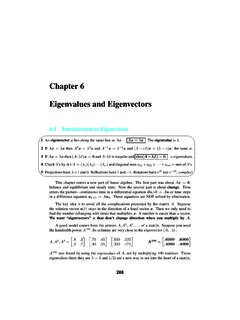
Chapter 6 Eigenvalues and Eigenvectors
11 +a 22 +···+ann=sum of λ’s. 5 Projectionshave λ=1and0. Reflections have 1and−1. Rotations haveeiθ and e−iθ: complex! This chapter enters a new part of linear algebra. The first par t was about Ax = b: balance and equilibrium and steady state. …
Download Chapter 6 Eigenvalues and Eigenvectors

Information
Domain:
Source:
Link to this page:
Documents from same domain
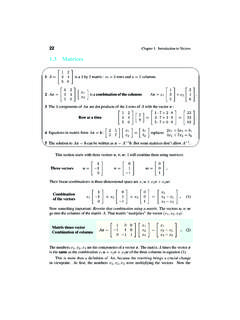
Introduction to Linear Algebra, 5th Edition
math.mit.edu1.3 Matrices 1 A = ... Linear Equations One more change in viewpoint is crucial. Up to now, the numbers x 1,x 2,x 3 were known. The right hand side b was not known. We found that vector of differences by multiplying A times x. Now we think of b as known and we look for x.
Eigenvalues and Eigenvectors
math.mit.eduSpecial properties of a matrix lead to special eigenvalues and eigenvectors. That is a major theme of this chapter (it is captured in a table at the very end). 286 Chapter 6.
Eigenvalues and Eigenvectors - MIT Mathematics
math.mit.edu6.1. Introduction to Eigenvalues 287 Eigenvalues The number is an eigenvalue of Aif and only if I is singular: det.A I/ D 0: (3) This “characteristic equation” det.A I/ D 0 involves only , not x. When A is n by n,
4 Cauchy’s integral formula - MIT Mathematics
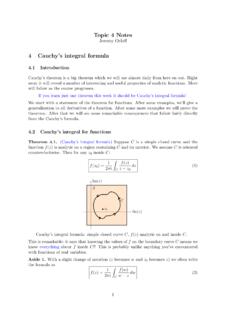
math.mit.edu4 Cauchy’s integral formula 4.1 Introduction ... 4 CAUCHY’S INTEGRAL FORMULA 4 4.3.1 Another approach to some basic examples Suppose Cis a simple closed curve around 0. We have seen that Z C 1 z ... Since an integral is basically a sum, this translates to the triangle inequality for integrals.
A FRIENDLY INTRODUCTION TO GROUP THEORY
math.mit.eduA FRIENDLY INTRODUCTION TO GROUP THEORY 3 A good way to check your understanding of the above de nitions is to make sure you understand why the following equation is correct: jhgij= o(g): (1) De nition 5: A group Gis called abelian (or commutative) if gh = hg for all g;h2G. A group is called cyclic if it is generated by a single element, that is,
4.3 Least Squares Approximations
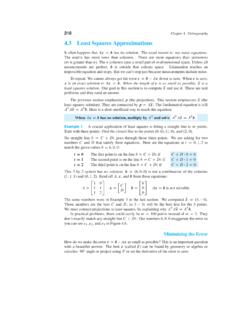
math.mit.edu4.3. Least Squares Approximations 221 Figure 4.7: The projection p DAbx is closest to b,sobxminimizes E Dkb Axk2. In this section the situation is just the opposite. There are no solutions to Ax Db. Instead of splitting up x we are splitting up b. Figure 4.3 shows the big picture for least squares. Instead of Ax Db we solve Abx Dp.

Linear programming 1 Basics - MIT Mathematics
math.mit.edu2 subject to: 5x 1 + 7x 2 8 4x 1 + 2x 2 15 2x 1 + x 2 3 x 1 0;x 2 0: Some more terminology. A solution x= (x 1;x 2) is said to be feasible with respect to the above linear program if it satis es all the above constraints. The set of feasible solutions is called the feasible space or feasible region. A feasible solution is optimal if its ...
Square Roots via Newton’s Method
math.mit.eduSquare Roots via Newton’s Method S. G. Johnson, MIT Course 18.335 February 4, 2015 1 Overview ...
V7. Laplace’s Equation and Harmonic Functions
math.mit.eduA. Existence. Does there exist a φ(x,y) harmonic in some region containing Cand its interior R, and taking on the prescribed boundary values? B. Uniqueness. If it exists, is there only one such φ(x,y)? C. Solving. If there is a unique φ(x,y), determine it by some explicit formula, or approximate it by some numerical method.
The Limit of a Sequence - MIT Mathematics
math.mit.edu“obvious” using the definition of limit we started with in Chapter 1, but we are committed now and for the rest of the book to using the newer Definition 3.1 of limit, and therefore the theorem requires proof. Theorem 3.2B {an} increasing, L = liman ⇒ an ≤ L for all n; {an} decreasing, L = liman ⇒ an ≥ L for all n. Proof.
Related documents
Dimensionality Reduction - Stanford University
infolab.stanford.eduChapter 11 Dimensionality Reduction There are many sources of data that can be viewed as a large matrix. We saw in Chapter 5 how the Web can be represented as a transition matrix. In Chapter 9, the utility matrix was a point of focus. And in Chapter 10 we examined matrices that represent social networks. In many of these matrix
4.3 Least Squares Approximations
math.mit.edualgebra. These are the key equations of least squares: The partial derivatives of kAx bk2 are zero when ATAbx DATb: The solution is C D5 and D D3. Therefore b D5 3t is the best line—it comes closest to the three points. At t D0, 1, 2 this line goes through p D5, 2, 1. It could not go through b D6, 0, 0. The errors are 1, 2, 1. This is the ...

Holt Algebra 1 - Sr. Mai
sr-mai.weebly.comChapter 11 Key Vocabulary 178 Lesson 11-1 180 Lesson 11-2 181 Lesson 11-3 182 Lesson 11-4 184 Lesson 11-5 185 Lesson 11-6 187 Lesson 11-7 189 Lesson 11-8 190 Lesson 11-9 191 Chapter 11 Review 192 Chapter 11 Big Idea Questions 196 Chapter 12 Key Vocabulary 198 Lesson 12-1 200 Lesson 12-2 201 Lesson 12-3 203 Lesson 12-4 204 Lesson 12-5 205 Lesson ...

COMMUTATIVE ALGEBRA Contents - Columbia University
stacks.math.columbia.edu1 →R 2 isaringhomomorphism00AY , 00AZ (8) ϕ: R 1 →R 2 is of finite presentation, or R 2 is a finitely presented R 1-algebra,seeDefinition6.1, 00B0 (9) ϕ: R 1 →R 2 isoffinitetype,orR 2 isafinitetypeR 1-algebra,seeDefinition 6.1, 00B1 (10) ϕ: R 1 →R 2 isfinite,orR 2 isafiniteR 1-algebra, (11) Risa(integral)domain00B2 , (12 ...