Chapter 8 Advanced SQL
How to use SQL functions to manipulate dates, strings, and other data ... GROUP BY expressions or aggregate functions cannot be used Set operators cannot be used ... Trigger action based on DML predicates Actions depend on …
Download Chapter 8 Advanced SQL

Information
Domain:
Source:
Link to this page:
Documents from same domain

ESC120 Lab Assignment 1 Computer Science …
cis.csuohio.eduJava - MyJavaPrograms/WeIcome.java - Eclipse File Edit Source Refactor Navigate Search Project Run Window Help FirstJavaCIm Task List Find All

Extension to SQL: View, Triggers, Transaction
cis.csuohio.edu3 Specification of Views in SQL CREATE VIEWcommand Give Table (View) name, list of attribute names for the View (table), and a Query to specify the contents of the View
Tutorials for Project on Building a Business Analytic ...
cis.csuohio.eduGetting familiar with SQL Server Analysis Services (SSAS) tools and various data mining algorithms such as Clustering, Association, Time Series etc in the SSAS tool 3.
Running Java and Eclipse From Your USB Flash Drive
cis.csuohio.eduinstall Java and Eclipse in a portable USB flash drive. Next time you work on that machine, all you need to do is insert the USB flash drive, run a batch program to tell Windows to look first in your Flash dive for Java libraries, and execute Eclipse.

Text Mining Transformations - cis.csuohio.edu
cis.csuohio.eduthat facilitate text mining: Term Extraction and Term Lookup. SQL Server Data Mining supports the TEXT data type, but that data type is not enough to perform meaningful text analysis. From the algorithm’s perspective, columns having the TEXT data type are treated just like discrete columns that have the LONG data type — as a collection of ...
Chapter 2 Data Models - Cleveland State University
cis.csuohio.eduJan 29, 2014 · Object/Relational and XML Extended relational data model (ERDM) Supports OO features and complex data representation Object/Relational Database Management System (O/R DBMS) Based on ERDM, focuses on better data management Extensible Markup Language (XML) Manages unstructured data for efficient and effective exchange of all data types 29
Translation of ER -diagram into Relational Schema
cis.csuohio.eduDiagram into an equivalent set of well-structured relations. 3. 4 9.49.4. 5. 6 Process of Database Design • Logical Design – Based upon the conceptual data model – Four key steps 1. Develop a logical data model for each known user interface for the application using normalization principles. 2. Combine normalized data requirements from ...
Related documents

Basics of Compiler Design - hjemmesider.diku.dk
hjemmesider.diku.dkPublished through lulu.com. c Torben Ægidius Mogensen 2000 – 2010 torbenm@diku.dk Department of Computer Science University of Copenhagen Universitetsparken 1
Predicate Logic - Stanford University
infolab.stanford.eduexpressions, clauses, and so on — carry over to predicate logic. In the next section we introduce two additional operators to form logical expressions. However, the basic idea behind the construction of logical expressions remains essentially the same in both propositional and predicate logic. Literals

SKILL Language User Guide
cpb-us-w2.wpmucdn.comSKILL Language User Guide January 2007 4 Product Version 06.70 Displaying Data ...
T-SQL Fundamentals, Third Edition
ptgmedia.pearsoncmg.comContents at a glance Introduction xix CHAPTER 1 Background to T-SQL querying and programming 1 CHAPTER 2 Single-table queries 27 CHAPTER 3 Joins 103 CHAPTER 4 Subqueries 133 CHAPTER 5 Table expressions 161 CHAPTER 6 Set operators 193 CHAPTER 7 Beyond the fundamentals of querying 213 CHAPTER 8 Data modification 249 CHAPTER 9 …
261-30: Manipulating Data with PROC SQL - SAS
support.sas.com2) logical operators, 3) arithmetic operators, 4) character string operators, and 5) summary functions. Comparison Operators Comparison operators are used in the SQL procedure to compare one character or numeric values to another. As in the DATA step, PROC SQL comparison operators, mnemonics, and their descriptions appear in the following table.
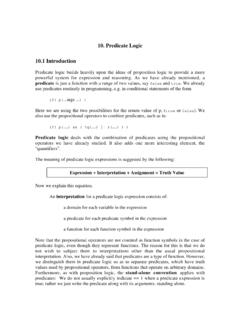
10. Predicate Logic 10.1 Introduction - Harvey Mudd College
www.cs.hmc.eduinterpretation. Also, we have already said that predicates are a type of function. However, we distinguish them in predicate logic so as to separate predicates, which have truth values used by propositional operators, from functions that operate on arbitrary domains. Furthermore, as with proposition logic, the stand-alone convention applies with
Discrete Mathematics, Chapter 1.4-1.5: Predicate Logic
www.inf.ed.ac.ukStatements involving predicates and quantifiers are logically equivalent if and only if they have the same truth value for every predicate substituted into these statements and for every domain of discourse used for the variables in the expressions. The notation S T indicates that S and T are logically equivalent. Example: 8x ::S(x) 8x S(x).
SQL For Dummies® 9th Edition - Programmer Books
www.programmer-books.comSQL 9th Edition by Allen G. Taylor Author of SQL All-in-One For Dummies www.allitebooks.com