
Chapter 8 PETROLEUM
138 CHAPTER 8 Petroleum (or crude oil) is a complex, naturally occurring liquid mixture containing mostly hydrocarbons, but containing also some compounds of oxygen, nitrogen and sulfur. It is often referred to as the “black gold.” The Rockefellers, the Rothschilds, the Gettys, the
Download Chapter 8 PETROLEUM

Information
Domain:
Source:
Link to this page:
Documents from same domain

Chapter 7 COAL - Pennsylvania State University
personal.ems.psu.eduelectricity came into widespread use in European and American homes around 1900. Edwin Drake drilled the first oil well in Titusville, Pennsylvania in 1859; automobiles became affordable when Henry Ford introduced his Model T in 1908, with a price tag of $825. Henri Becquerel discovered the spontaneous disintegration of uranium atoms in 1896; the
Chapter 13 NUCLEAR FISSION
personal.ems.psu.eduThis heat is used in turn to produce electricity in a nuclear reactor or is allowed to cause an explosion in an atomic bomb. The fate of the neutrons produced in the fission process is the key to understanding the difference between a controlled nuclear reaction, which takes place inside a nuclear reactor, and an uncontrolled nuclear reaction ...

Chapter 4 EFFICIENCY OF ENERGY CONVERSION
personal.ems.psu.edumaintained properly. For example, your car engine will be more efficient if you change the oil regularly. Why some numbers are high and others are low can be understood, at least in part, from the information provided in Chapter 3. The ‘easiest’ conversions are those that are in
Chemkin Theory Manual
personal.ems.psu.edu17.0 Chemkin Theory Manual Chemkin® Software CK-THE-15151-1601-UG-1 January 2016

Chapter 14 NUCLEAR FUSION
personal.ems.psu.eduannounce a startling discovery which had eluded physicists for decades. They claimed to have produced “fusion in a jar.” This reaction was claimed to have occurred at room temperature within a palladium electrode immersed in a beaker of deuterium-containing water: + =

Chapter 17 SOLAR ENERGY - Pennsylvania State University
personal.ems.psu.eduChapter 14 we discussed nuclear fusion; it could solve all our energy problems, but many technical problems need to be overcome before it can be harnessed and commercialized. The production of electricity using fusion must go through the ‘bottleneck’ of thermal-to-mechanical energy conversion, which is inherently inefficient.

Air Stripping - Pennsylvania State University
personal.ems.psu.edumaterial (steel, plastic or ceramic) • Air flows into bottom of column and blows countercurrent to water flow . Low Profile (Sieve Tray) Air Stripper ... La Brea Tar Pits and Museum C) Hollywood Boulevard D) L.A. Coroner’s Gift Shop . Case Study #2 - Culver City, California

Chapter 2 CONCEPT OF ENERGY
personal.ems.psu.eduThere is some irony in these historical developments: just before major social upheavals were to spread throughout most of Europe in the revolutions of 1848, the collective efforts of the European scientific community brought about one of the major intellectual syntheses of all time. Energy in Its Various Forms: First approximation Work.
Chapter 11 FOSSIL FUELS: ENVIRONMENTAL EFFECTS
personal.ems.psu.edufrequent short trips – and of improperly tuned engines simply does not allow the carbon in gasoline to burn completely into carbon dioxide. As much as 80% of today's automobile emissions occur during cold starts (see “Corning Introduces System to Cut Emissions as Vehicle Is Started," NYT of 2/26/96).

CHEMKIN Tutorials Manual
personal.ems.psu.edu2-20 Predicted pyrene (A4) profile showing soot inception mainly occurs in the region between the stagnation plane and the diffusion flame in Flame 1 studied by Atreya et al. 13 (p. 48).....54 2-21 Predicted soot volume fraction profile is compared against the experimental profile as a …
Related documents

Chapter 18: Carbohydrates - latech.edu
www.chem.latech.eduChapter 18: Carbohydrates Instructional Objectives 1. Know the difference between complex and simple carbohydrates and the amounts of each recommended in the daily diet. 2. Know the difference between complex and simple carbohydrates and the amounts of each recommended in the daily diet. 3.
8.044 Lecture Notes Chapter 9: Quantum Ideal Gases
mcgreevy.physics.ucsd.edu8.044 Lecture Notes Chapter 9: Quantum Ideal Gases Lecturer: McGreevy 9.1 Range of validity of classical ideal gas . . . . . . . . . . . . . . . . . . . . . .9-2
Physics Notes Class 11 CHAPTER 5 LAWS OF MOTION
ncerthelp.comPhysics Notes Class 11 CHAPTER 5 LAWS OF MOTION Inertia The property of an object by virtue of which it cannot change its state of rest or of uniform motion along a straight line its own, is called inertia. Inertia is a measure of mass of a body. Greater the mass of a body greater will be its inertia or vice-versa. Inertia is of three types:
Chapter 17 SOLAR ENERGY - Pennsylvania State University
personal.ems.psu.eduChapter 14 we discussed nuclear fusion; it could solve all our energy problems, but many technical problems need to be overcome before it can be harnessed and commercialized. The production of electricity using fusion must go through the ‘bottleneck’ of thermal-to-mechanical energy conversion, which is inherently inefficient.

Chapter 4-1
www.mccc.eduChapter 4-6 Allocates overhead using a single predetermined rate. Job order costing: direct labor cost is assumed to be the relevant activity base. Process costing: machine hours is the relevant activity base. Assumption was satisfactory when direct labor was a major portion of total manufacturing costs.
Physics I Notes Chapter 14: Light, Reflection, and Color
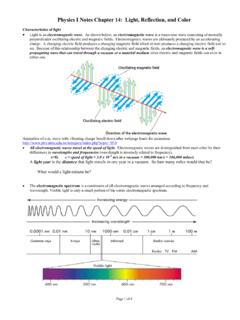
www.quia.comPhysics I Notes Chapter 14: Light, Reflection, and Color Characteristics of light • Light is an electromagnetic wave. As shown below, an electromagnetic wave is a transverse wave consisting of mutually perpendicular oscillating electric and magnetic fields. Electromagnetic waves are ultimately produced by an accelerating charge.