
Chapter 9 Adsorption
Chapter 9 Adsorption 9.1 Introduction Adsorption: (i) the principle ways in which high-energy interfaces lower the overall ... z An example for a hypothetical heterogeneous oxidation of A with O2: O2 +2A+catalyst →2AO +catalyst ... z Example: Sulfur-containing compounds (especially thiols) adsorb strongly on metal. (The poison of catalytic ...
Download Chapter 9 Adsorption

Information
Domain:
Source:
Link to this page:
Documents from same domain
Equation of state - National Cheng Kung University
www.che.ncku.edu.twThermodynamics Classical · Statistical · Chemical Equilibrium / Non-equilibrium Thermofluids Zeroth · First · Second · Third State: Equation of state Ideal gas · Real gas Phase of matter· Equilibrium

Compressibility factor - NCKU
www.che.ncku.edu.twmethane, ethane, ethylene, propane, n-butane, i-pentane, n-hexane, nitrogen, carbon dioxide and steam. There are more detailed generalized compressibility factor graphs based on as many as 25 or more different pure gases, such as the Nelson-Obert graphs. Such graphs are said to have an accuracy within

Helmholtz free energy - NCKU
www.che.ncku.edu.twThermodynamics Classical · ... Heat engines · Heat pumps Thermal efficiency ... the letter A as well as the use of name Helmholtz energy.[1] In physics, the letter F is usually used to denote the Helmholtz energy, which is often referred to as the Helmholtz function or simply “free energy."
SECOND-ORDER LINEAR DIFFERENTIAL EQUATIONS
www.che.ncku.edu.twnd-Order ODE - 8 2.2 Linear Independence Two functions, y 1 (x) and y 2 (x), are linearly independent on an interval [x 0, x 1] whenever the relation c 1 y 1 (x) + c 2 y 2 (x) = 0 for all x in the interval implies that c 1 = c 2 = 0. Otherwise, they are linearly dependent. There is an easier way to see if two functions y 1 and y 2
Related documents

Cysteinyl-tRNA synthetase governs cysteine polysulfidation ...
www.bio-xcelerator.comARTICLE Cysteinyl-tRNA synthetase governs cysteine polysulfidation and mitochondrial bioenergetics Takaaki Akaike1, Tomoaki Ida1, Fan-Yan Wei2, Motohiro Nishida3,4, Yoshito Kumagai5, Md. Morshedul Alam6, Hideshi Ihara7, Tomohiro Sawa8, Tetsuro Matsunaga1, Shingo Kasamatsu1, Akiyuki Nishimura3, Masanobu Morita1, Kazuhito Tomizawa2, Akira Nishimura1, Satoshi Watanabe 9, Kenji Inaba9,
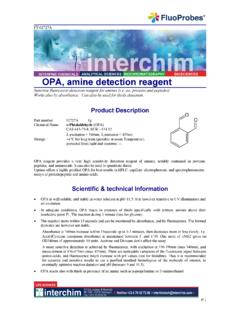
OPA, amine detection reagent - INTERCHIM: Home
www.interchim.frFT-02727A OPA, amine detection reagent Sensitive fluorescent detection reagent for amines (i.e. aa, proteins and peptides) Works also by absorbance; Can also be used for thiols detection.

Professor J. Stephen Clark
www.chem.gla.ac.uk10 Functional Group Chemistry Enols and Enolates R1 O R1 OH keto form enol form E R2 R2 R1 O R2 H H B R1 O R2 R1 O R2 ... thioketones thiols thioethers OH O R H2N O NH2 H2N NH NH2 NH2 O R O O R1 R2 NH2 NH R O O ... Ring Construction Manipulation of Oxidation State Y X Y X X, Y = O, S, NR δ+ δ+ conjugate addition δ+

Chapter 17: Alcohols and Phenols
as.vanderbilt.eduthiols thioether disulfides Alcohols are classified as primary (1°), secondary (2°) or tertiary (3°), ... 3 10.21 9.65-CH 3 10.17 10.16 X O OH X ... Increasing oxidation state 89 17.5: Alcohols from reduction of carbonyl compounds
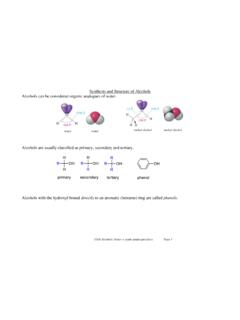
Synthesis and Structure of Alcohols
crab.rutgers.eduThiols Thiols are sulfur analogues of alcohols, they contain an –SH group. They are named using the suffix –thiol, and as a substituent as mercapto-. CH 3-SH CH 3 CH 2 CH 2 CH 2-SH HS-CH 2 CH 2 OH Methanethiol 1-butanethiol 2-mercaptoethanol Thiols stink, literally. O H …

Protecting Groups (PG)
ethz.chProtected thiols can still undergo several side reaction Ex: β‐Elimination, reaction with carbocations, …. Scavengers are necessary during deprotection (TIPS, p‐anisole, … ) Thiol PGs Introduction Meb‐Br Acm‐OH Removal HF, MeSiCl 3 I 2, DTNP, Tl(III), Hg(II), Stable Basic conditions Basic and Acidic conditions

Hydroprocessing: Hydrotreating& Hydrocracking
inside.mines.eduMinimal conversion –10% to 20% typical Products suitable for further processing or final blending •Reforming, catalytic cracking, hydrocracking Hydrocracking Severe form of hydroprocessing •Break carbon‐carbon bonds •Drastic reduction of …

ORGANOMETALLIC CHEMISTRY
profiles.uonbi.ac.ke9 Lithium-halogen exchange reactions proceed in the direction of forming the more stable organolithium reagent, that is, the one derived from the more acidic compound by using the more basic organolithium compounds such as n-BuLi and t-BuLi. Example Example Retention of configuration is often observed when organolithium compounds are
DTT (DithioThreitol)
www.interchim.frno remaining free thiols. Hints / reducing proteins and peptides DTT replaces in most applications the very pungent 2-mercaptoethanol. The optimal pH range for DTT is between 7.1 and 8.0, but the reagent can be used effectively at pH 6.5-9.0. DTT …
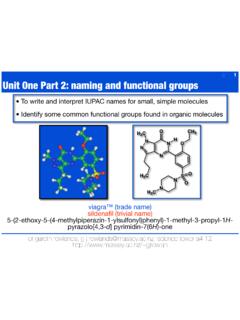
Unit One Part 2: naming and functional groups
www.massey.ac.nz4 but 9 non 5 pent 10 dec Bond Multiple-bond index C–C an(e) C=C en(e) ... Functional groups: alkyl halides and thiols gjr-–-• Alkyl halides are incredibly useful compounds - used extensively ... oxidation reduction RC OH H H alcohol oxidation reduction • Many …