
Chapter2
A function f is bounded from above on A if supAf is finite, bounded from below on A if infAf is finite, and bounded on A if both are finite. Inequalities and operations on functions are defined pointwise as usual; for example, if f,g : A → R, then f ≤ g …
Download Chapter2

Information
Domain:
Source:
Link to this page:
Documents from same domain

LECTURE 5 - UC Davis Mathematics
www.math.ucdavis.eduLECTURE 5. STOCHASTIC PROCESSES 133 We say that random variables X 1;X 2;:::X n: !R are jointly continuous if there is a joint probability density function p(x
A concise introduction to quantum probability, …
www.math.ucdavis.eduA concise introduction to quantum probability, quantum mechanics, and ... precepts of quantum mechanics are sometimes called ... This article is a concise introduction to quantum probability theory, quantum mechanics, and quan-tum computation for the mathematically prepared
An introduction to quantum probability, quantum …
www.math.ucdavis.eduAn introduction to quantum probability, quantum mechanics, and quantum computation Greg Kuperberg∗ UC Davis (Dated: October 8, 2007) Quantum mechanics is one of the most surprising

Linear Algebra in Twenty Five Lectures
www.math.ucdavis.eduThese linear algebra lecture notes are designed to be presented as twenty ve, fty minute lectures suitable for sophomores likely to use the material for applications but still requiring a solid foundation in this fundamental branch
What is Linear Algebra? - University of California, …
www.math.ucdavis.eduWhat is Linear Algebra? In this course, we’ll learn about three main topics: Linear Systems, Vec-tor Spaces, and Linear Transformations. Along the way we’ll learn about
Twenty problems in probability - UC Davis …
www.math.ucdavis.eduTwenty problems in probability This section is a selection of famous probability puzzles, job interview questions (most high- tech companies ask their applicants math questions) and math competition problems.
Complex Analysis Lecture Notes - UC Davis Mathematics
www.math.ucdavis.edu\entropy"), and lots of applications to things that seem unrelated to complex numbers, for example: Solving cubic equations that have only real roots (historically, this was the
David Cherney, Tom Denton, Rohit Thomas and Andrew …
www.math.ucdavis.eduLinear algebra is the study of vectors and linear functions. In broad terms, vectors are things you can add and linear functions are functions of vectors that respect vector addition.
Power Series - UC Davis Mathematics :: Home
www.math.ucdavis.eduThe power series in Definition 6.1 is a formal expression, since we have not said anything about its convergence. By changing variables x→ ( x−c ), we can assume
LECTURE NOTES ON APPLIED MATHEMATICS
www.math.ucdavis.eduLECTURE 1 Introduction The source of all great mathematics is the special case, the con-crete example. It is frequent in mathematics that every instance
Related documents
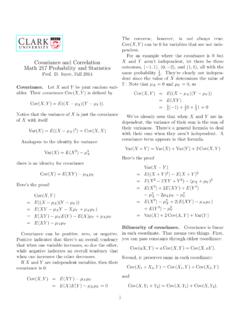
Covariance and Correlation Math 217 Probability and ...
mathcs.clarku.edudard deviations, the correlation becomes bounded ... kind of thing that goes on in linear algebra. In fact, it is the same thing exactly. Take a set of real-valued random variables, not necessarily inde-pendent. Their linear combinations form a vector space. Their covariance is …

SOLUTION OF LINEAR PROGRAMMING PROBLEMS
www.math.tamu.eduIf S is bounded then P has both a maximum and minimum value on S If S is unbounded and both a and b are nonnegative, then P has a minimum value on S provided that the constraints defining S include the inequalities x≥ 0 and y≥ 0. If S is the empty set, then the linear programming problem has no solution; that is, P has neither

Lecture 13 Linear quadratic Lyapunov theory
web.stanford.edu• the sublevel sets are ellipsoids (and bounded) • V(z) = zTPz = 0 ⇔ z = 0 boundedness condition: if P > 0, Q ≥ 0 then • all trajectories of x˙ = Ax are bounded (this means ℜλi ≤ 0, and if ℜλi = 0, then λi corresponds to a Jordan block of size one) • the ellipsoids {z | zTPz ≤ a} are invariant Linear quadratic Lyapunov ...

Chapter 8 Bounded Linear Operators on a Hilbert Space
www.math.ucdavis.eduThus, every bounded linear functional is given by the inner product with a xed vector. We have already seen that ’y(x) = hy;xi de nes a bounded linear functional on H for every y 2 H. To prove that there is a unique y in H associated with a given linear functional, suppose that ’y1 = ’y2. Then ’y1(y) = ’y2(y) when y = y1 y2,

MixedIntegerLinearProgramming
www.cs.upc.eduBranch&Bound 7/61 Assume variables are bounded, i.e., have lower and upper bounds Let P0 be the initial problem, LP(P0)be the LP relaxation of P0 If in optimal solution of LP(P0)all integer variables take integer values then it is also an optimal solution to P0 Else Let xj be integer variable whose value βj at optimal solution of LP(P0)is such that βj ∈Z.

Linear Programming I: Maximization - Sam Baker
sambaker.comLinear programming is constrained optimization, where the constraints and the objective function are all linear. It is called "programming" becaus e the goal of the calculations help you choose a "program" of ... corner, bounded by the constraints. 4. Find the highest value isoprofit line that touches the feasible region. Imagine moving that 3x ...
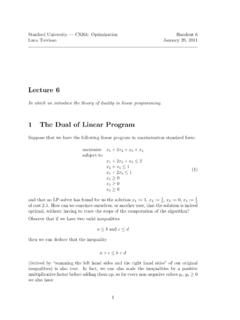
Lecture 6 1 The Dual of Linear Program
theory.stanford.eduWhat is surprising is that, for bounded and feasible linear programs, there is always a dual solution that certi es the exact value of the optimum. Theorem 5 (Strong Duality) If either LP 1 or LP 2 is feasible and bounded, then so is the other, and opt(LP 1) = opt(LP 2) To summarize, the following cases can arise: If one of LP 1 or LP

MATH 304 Linear Algebra
www.math.tamu.eduLinear Algebra Lecture 20: Inner product spaces. Orthogonal sets. Norm The notion of norm generalizes the notion of length of a vector in Rn. Definition. Let V be a vector space. ... where w is bounded, piecewise continuous, and w > 0 everywhere on [a,b]. w is called the weight function. Theorem Suppose hx,yi is an inner product on a vector ...