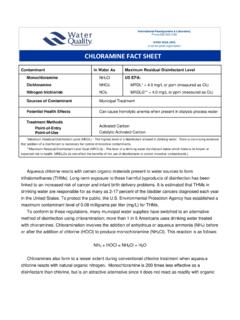
CHLORAMINE FACT SHEET
Chloramines do pose a risk for hemodialysis patients and fish. Chloramines easily enter the bloodstream through dialysis membranes and the gills of fish. Once in the blood stream, chloramines denature hemoglobin and cause hemolytic anemia. Accidental use of chloramine treated water for
Download CHLORAMINE FACT SHEET

Information
Domain:
Source:
Link to this page:
Documents from same domain
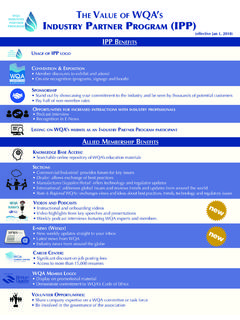
WQA HE ALUE OF WQA’ S I P (IPP)
www.wqa.orgTHE VALUE OF WQA’ S INDUSTRY PARTNER PROGRAM (IPP) ALLIED MEMBERSHIP BENEFITS CAREER CENTER: • Significant discount on job posting fees • Access to more than 15,000 resumes VOLUNTEER OPPORTUNITIES: • Share company expertise on a WQA committee or task force

LAS VEGAS CONVENTION EXPOSITION L A S V E G A S , N E V …
www.wqa.orgTOP 5 REASONS FOR EXHIBITING PURCHASING POWER W Q A C O N V E N T I O N & E X P O S I T I O N EXHIBITOR PROSPECTUS Display new products, services or
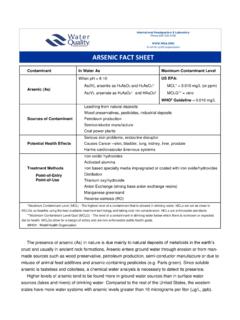
ARSENIC FACT SHEET - Water Quality Association
www.wqa.orgWQA Technical Fact Sheet: Arsenic Parts of Midwest, New England, and Texas have some systems whose current arsenic levels are greater than 10 µg/L (or ppb).
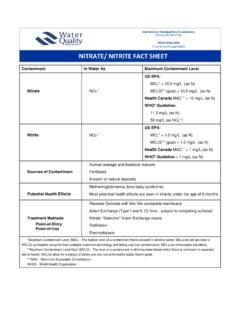
NITRATE/ NITRITE FACT SHEET
www.wqa.org11.3 mg/L (as N) 50 mg/L (as NO 3-1) Nitrite NO 2-1 ... tanks – that was found at ... Brine reclaim should be avoided because excess nitrates in the recycled brine can lead to excessive nitrate leakage in the subsequent run. Anion resins are lower in density than softener resins and are
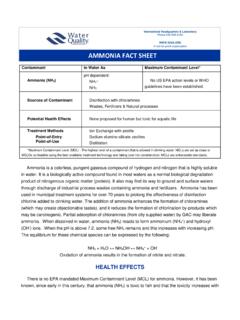
AMMONIA FACT SHEET - Water Quality Association
www.wqa.orgThe concentration of ammonia that exists in drinking water has been determined by the US EPA and WHO not to be of a health risk. WHO does recognize odor effects at a concentration of 1.5 mg/L and taste effects at 35 mg/L. In 2013, the US EPA has recommended water quality criteria for aquatic life expressed as Total ...
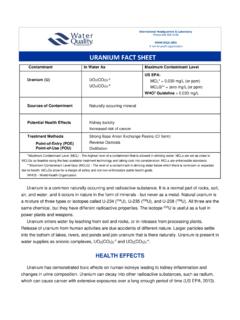
URANIUM FACT SHEET - Water Quality Association
www.wqa.orgWQA Technical Fact Sheet: Uranium The US EPA has issued a Maximum Contaminant Level Goal of zero and a Maximum Contaminant Level (MCL) of 0.030 mg/L for uranium. The 0.030 mg/L is based on increased risk of kidney toxicity and is equivalent to about 27 picocuries per liter (pCi/L) of radioactivity, which also presents an
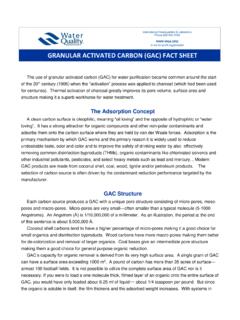
GRANULAR ACTIVATED CARBON (GAC) FACT SHEET
www.wqa.orgWQA Technical Fact Sheet Activated Carbon for Radon Removal Radon (Symbol Rn) is a radioactive gas that does not impart taste or odor to water. It stems from the natural decay of uranium to radium and radium to radon (radon is known to increase the risk of lung cancer when inhaled). Radon is the second leading cause of lung cancer in the US today.
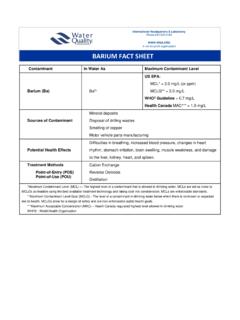
BARIUM FACT SHEET - Water Quality Association
www.wqa.orgAnimal studies have found increased blood pressure and changes in the heart from ingesting barium over a long time. Based on such studies, the United States Environmental Protection Agency (US EPA) has set a Maximum Contaminant Level Goal (MCLG) at 2.0 mg/L (or ppm) in water. The federal Safe
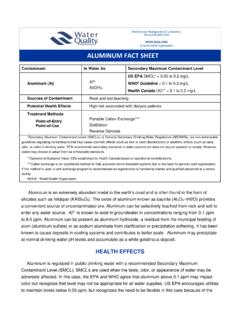
ALUMINUM FACT SHEET - Water Quality Association
www.wqa.orgenter any water source. Al3+ is known to exist in groundwater in concentrations ranging from 0.1 ppm to 8.0 ppm. Aluminum can be present as aluminum hydroxide, a residual from the municipal feeding of alum (aluminum sulfate) or as sodium aluminate from clarification or precipitation softening. It has been
Related documents
Bloodstream Infection Event (Central Line-Associated ...
www.cdc.govInfection and Non-central Line Associated Bloodstream Infection) Introduction Although a 46% decrease in CLABSIs has occurred in hospitals across the U.S. from 2008-2013, an estimated 30,100 central line-associated bloodstream infections (CLABSI) still occur in intensive care units and wards of U.S. acute care facilities each year. 1
Methicillin-Resistant Staphylococcus Aureus (MRSA)
www.ndhealth.govwound infections and the second most common cause of nosocomial bloodstream infections.12 Long-term care facilities (LTCFs) have developed rates of MRSA ranging ... infections or receiving hemodialysis may pose a greater risk than nasal carriers. Other ... microorganisms in patients with renal failure (for ease of dosing schedule).

Vancomycin Pharmacokinetics, Dosing & Therapeutic Drug ...
www.unmc.edu• Treatment of infections caused by Staphylococci, Streptococci and Enterococci including bacteremia/sepsis, pneumonia and skin among others • Not for definitive therapy of most infections once patient is stable or susceptibilities known • Alternative to beta- lactam agents for patients with resistance or a severe allergy. 6

University of Wisconsin Hospital and Clinics Guidelines ...
www.uwhealth.orgBastani et.al. demonstrated that, in hemodialysis patients with dialysis catheter-related infection, systemic vancomycin administration produces a therapeutic plasma concentration; however, during the intradialytic period, the diffusion of the anti-infective from the plasma into the catheter lumen is

Environmental Surface Disinfection in Dialysis Facilities ...
www.cdc.govTokars JI, Jarvis WR. A cluster of bloodstream infections and pyrogenic reactions among hemodialysis patients traced to dialysis machine waste-handling option units. Am J Nephrol 1998; 18 (6): 485-9. Wang SA, Levine RB, Carson LA, Arduino MJ, Killar T, Grillo FG, Pearson ML, Jarvis WR. An outbreak of gram-negative bacteremia in hemodialysis ...