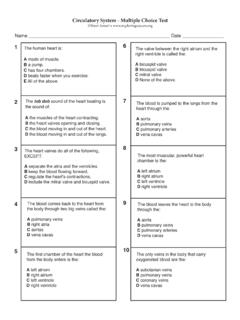
Circulatory System - Multiple Choice Test - Exploring Nature
C has four chambers. D beats faster when you exercise. E All of the above. The lub dub sound of the heart beating is the sound of: A the muscles of the heart contracting. B the heart valves opening and closing. C the blood moving in and out of the heart. D the blood moving in and out of the lungs. The heart valves do all of the following, EXCEPT:
Download Circulatory System - Multiple Choice Test - Exploring Nature

Information
Domain:
Source:
Link to this page:
Documents from same domain

Cellular Respiration - Exploring Nature Science …
www.exploringnature.org1) photosynthesis creates glucose molecules (instead of eating) → 2) this fuels cellular respiration in the plant cells → 3) creates ATP → 4) fuels plant growth and reproduction → 5) provides carbohydrates to animals for
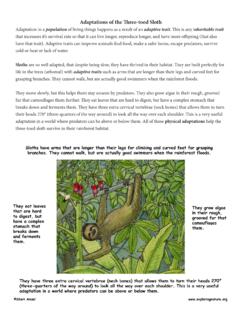
Adaptations of the Three-toed Sloth - The Exploring Nature ...
www.exploringnature.orgAdaptations of the Three-toed Sloth Adaptation in a population of living things happens as a result of an adaptive trait.This is any inheritable trait that increases it’s survival rate so that it can live longer, reproduce longer, and have more offspring (that also
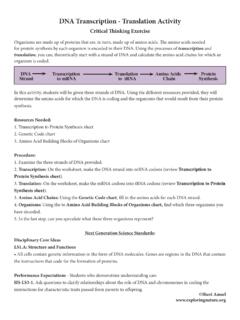
DNA Transcription - Translation Activity
www.exploringnature.orgGenes are regions in the DNA that contain the instructions that code for the formation of proteins. Performance Expectations - Students who demonstrate understanding can: HS-LS3-1. Ask questions to clarify relationships about the role of DNA and chromosomes in coding the
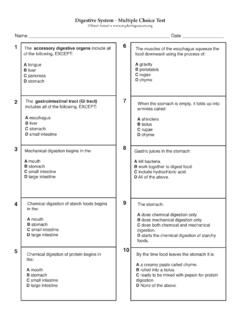
Digestive System - Multiple Choice Test - Exploring Nature
www.exploringnature.orgThe accessory digestive organs include all of the following, EXCEPT: A tongue B liver C pancreas D stomach The gastrointestinal tract (GI tract) includes all of the following, EXCEPT: A esophagus B liver C stomach D small intestine Mechanical digestion begins in the: A mouth B stomach C small intestine D large intestine
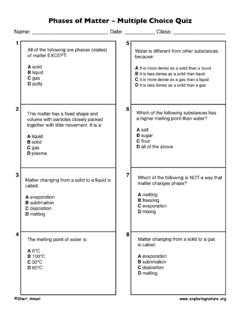
Matter Assessment and NGSS - Exploring Nature
www.exploringnature.orgScience and Engineering Practices: Developing and Using Models Modeling in 6–8 builds on K–5 and progresses to developing, using and revising models to describe, test, and predict more abstract phenomena and design systems. • Develop a model to predict and/or describe phenomena. (MS-PS1-1),(MS-PS1-4)
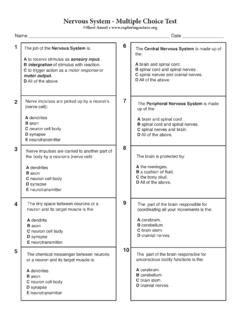
Nervous System - Multiple Choice Test - Exploring Nature
www.exploringnature.orgThe Central Nervous System is made up of the: brain and spinal cord. B spinal cord and spinal nerves. C spinal nerves and cranial nerves. D All of the above. The Peripheral Nervous System is made up of the: A brain and spinal cord. B spinal cord and spinal nerves. C spinal nerves and brain. D All of the above. The part of the brain responsible for
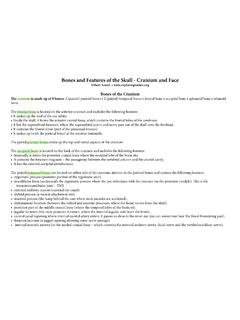
Bones and Features of the Skull - Cranium and Face
www.exploringnature.orgBones and Features of the Skull - Cranium and Face ©Sheri Amsel • www.exploringnature.org Bones of the Cranium The cranium is made up of 8 bones: 2 (paired) parietal bones • 2 (paired) temporal bones • frontal bone • occipital bone • sphenoid bone • ethmoid bone The frontal bone is located on the anterior cranium and includes the following features:

Phases of the Moon - Exploring Nature
www.exploringnature.org2. The moon takes the same amount of time to rotate once around on its axis as it does to revolve around the Earth - so the same side of the moon always faces the Earth. The moon looks different during its revolution around the Earth, because at each position its is getting a different amount of sunlight on its surface.
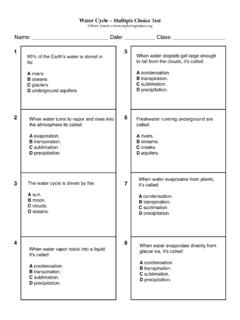
Water Cycle – Multiple Choice Test - Exploring Nature
www.exploringnature.orgC creeks. D aquifers. The water cycle is driven by the: A sun. B moon. C clouds. D oceans. When water turns to vapor and rises into the atmosphere its called: A evaporation. B transpiration. C sublimation. D precipitation. When water evaporates directly from glacial ice, it’s called: A condensation. B transpiration. C sublimation. D ...
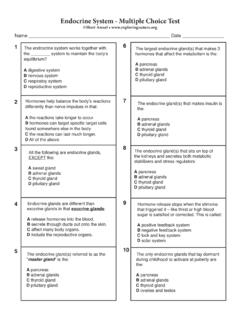
Endocrine System - Multiple Choice Test - Exploring Nature
www.exploringnature.orgEndocrine System - Multiple Choice Test KEY ... The endrocrine system works together with the _____ system to maintain the body’s equilibrium? A digestive system B nervous system C respiratoy system D reproductive system Hormones help balance the body’s reactions differently than nerve impulses in that:
Related documents
LABORATORY SAFETY MANUAL - University of Washington
ehs.washington.eduLABORATORY SAFETY MANUAL DECEMBER 2021 EDITION Environmental Health and Safety Department University of Washington Box 354400 Seattle, WA 98195-4400 Phone: 206.543.7262 FAX: 206.543.3351
Basic Cardiac Rhythms Identification and Response
utmc.utoledo.edu2 upper chambers Right and left atria 2 lower chambers Right and left ventricle 2 Atrioventricular valves (Mitral & Tricuspid) ... valve leaflets. Physiology Blood Flow Unoxygenated blood flows from inferior and superior vena cava Right Atrium Tricuspid Valve Right Ventricle Pulmonic Valve
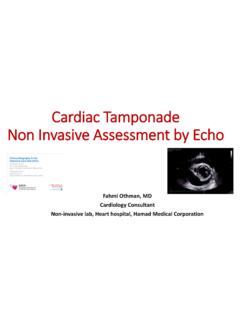
Cardiac Tamponade Non Invasive Assessment by Echo
www.escardio.orgthe cardiac chambers compete for less and less space. • Thus, an increase in filling of one ventricle will cause a decrease in filling of the other ventricle. • Doppler mitral and tricuspid diastolic inflow velocities are used to quantify these exaggerated changes
WATCHMAN Left Atrial Appendage Closure Device
www.bostonscientific.comThe heart is divided into four chambers: two upper atrial chambers (a right and left atrium) and two lower ventricular chambers (a right and left ventricle). The four chambers fill with blood when the heart is at rest and then pump the blood throughout the …