
Classical Dynamics - DAMTP
1.2 Newtonian Mechanics: A Single Particle In the rest of this section, we’ll take a ying tour through the basic ideas of classical mechanics handed down to us by Newton. More details can be found in the lectures on Dynamics and Relativity. We’ll start with a single particle.. A particle is de ned to be an object of insigni cant
Download Classical Dynamics - DAMTP

Information
Domain:
Source:
Link to this page:
Documents from same domain
Mathematical Methods - DAMTP
www.damtp.cam.ac.ukMathematical Methods University of Cambridge Part IB Mathematical Tripos David Skinner Department of Applied Mathematics and Theoretical Physics,
Electromagnetism - DAMTP
www.damtp.cam.ac.ukAt the atomic scale, electromagnetism (admittedly in conjunction with some basic quantum e ects) governs the interactions between atoms and molecules. It is the force that underlies the periodic table of elements, giving rise to all of chemistry and, through this, much of biology. It is the force which binds atoms together into solids and liquids.
Principles of Quantum Mechanics - DAMTP
www.damtp.cam.ac.ukPrinciples of Quantum Mechanics University of Cambridge Part II Mathematical Tripos David Skinner Department of Applied Mathematics and Theoretical Physics,
Part II Principles of Quantum Mechanics Michaelmas 2014
www.damtp.cam.ac.ukCONTENTS iii BOOKS E. Merzbacher Quantum Mechanics, 3rd edition. Wiley 1998 (various prices) B.H. Bransden and C.J. Joachain Quantum Mechanics, 2nd edition.
3. Quantum Gases - University of Cambridge
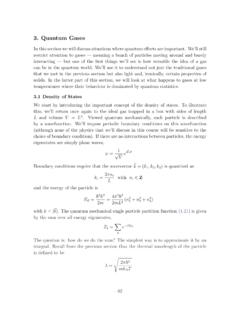
www.damtp.cam.ac.uk3. Quantum Gases In this section we will discuss situations where quantum effects are important. ... is the density of states: g(E)dEcounts the number of states with energy between E ... There is nothing particularly quantum mechanical about the density of states. In-deed, in the derivation above we have replaced the quantum sum with an ...
String Theory - University of Cambridge
www.damtp.cam.ac.ukString theory is a theory of quantum gravity String theory uni es Einstein’s theory of general relativity with quantum mechanics. Moreover, it does so in a manner …
Statistical Physics - DAMTP
www.damtp.cam.ac.ukContents 1. The Fundamentals of Statistical Mechanics 1 1.1 Introduction 1 1.2 The Microcanonical Ensemble 2 1.2.1 Entropy and the Second Law of Thermodynamics 5
Quantum Field Theory - DAMTP
www.damtp.cam.ac.ukRecommended Books and Resources M. Peskin and D. Schroeder, An Introduction to Quantum Field Theory This is a very clear and comprehensive book, covering everything in this course at the
TASI Lectures on Solitons - DAMTP
www.damtp.cam.ac.ukPreprint typeset in JHEP style - PAPER VERSION June 2005 TASI Lectures on Solitons Instantons, Monopoles, Vortices and Kinks David Tong Department of Applied Mathematics and Theoretical Physics,
Electromagnetism - DAMTP
www.damtp.cam.ac.ukLent Term, 2015 Electromagnetism University of Cambridge Part IB and Part II Mathematical Tripos David Tong Department of Applied Mathematics and Theoretical Physics,
Related documents
Introduction to Modern Physics
www.physics.smu.eduNewtonian Physics Developed in the 1800’s, extended forward 200 years. Force and acceleration are related to each other through inertial mass. -Kepler’s laws (accurate for many objects) -Energy is a fundamental quantity that can not be created or destroyed, only transferred. -Mass was recognized as a body’s tendency to resist changes

Lecture Notes on Special Relativity
physics.mq.edu.au3 Newtonian Relativity 15 ... world is very old: it certainly predates Newton and seems to have been first stated concisely by Galileo, though some of the ideas were already around at the time of Aristotle (who apparently did not believe in the principle). What the principle of relativity essentially states is the following:

THE SPECIAL THEORY OF RELATIVITY
physics.mq.edu.authe properties of the physical world is very old: it certainly predates Newton and Galileo, but probably not as far back as Aristotle. What the principle of relativity essentially states is the following: The laws of physics take the same form in all frames of reference moving with constant velocity with respect to one another.

Lecture Notes on General Relativity Columbia University
web.math.princeton.edudi er from each other and lead to radically di erent perspectives for the physical world and its laws. We begin by listing the key assumptions about spacetime in Newtonian physics and then proceed by replacing these assumptions with the postulates of special relativity. 1.1 Newtonian Physics Main assumptions

General Relativity
www.math.toronto.eduthe physical world and its laws. We begin by listing the key assumptions about spacetime in Newtonian physics and then proceed by replacing these assumptions with the postulates of special relativity. 1.1 Newtonian Physics Main assumptions The primary assumptions in Newtonian physics are the following 1.There is an absolute notion of time.

8 Lorentz Invariance and Special Relativity
www.phys.ufl.eduthe Newtonian kinetic energy is obtained at low momentum and that mis the Newtonian mass. At p = 0 we have Einstein’s famous E= mc2! We can easily solve for p in terms of v: v2 c2 = p2 p2 +m2c2, E= mc2 p 1−v2/c2 = γmc2, p = vE c2 = γmv (420) As we shall soon see this modification of the relation between momentum and velocity is
CHAPTER ONE - NCERT
ncert.nic.inNewtonian mechanics, till then a very successful theory, could not explain some of the most basic features of atomic phenomena. Similarly, the then accepted wave picture of light failed to explain the photoelectric effect properly. This led to the development of a radically new theory (Quantum Mechanics) to deal with atomic and molecular phenomena.
MATHEMATICAL MODELING A Comprehensive Introduction
www.math.colostate.educoncrete conclusions concerning the world, both natural and artificial, that we live in. 1.1 EXAMPLES OF MODELING Here we do a quick tour of several examples of the mathematical process. We present the models as finished results as opposed to attempting to develop the models. 1.1.1 Modeling with Difference Equations

Fluid Mechanics 1 034013 Exercise Booklet
cdn1.sph.harvard.edu1. Ordinary Differential Equations, Differential Operators and Newtonian fluids Ordinary Differential Equations In the last two years of your studies you have taken many basic courses in Mathematics, from Calculus to Partial Differential equations and more. In all of these courses you learned Lemmas and rules and many techniques on

Mass, Energy, the Speed of Light— It’s Not Intuitive!
www2.lbl.govNewtonian Physics (pre-Einstein) gives good results if the object is moving pretty slowly—less than about 10% of the speed of light (the speed of light is 300,000,000 meters/sec or 186,000 mi/sec). • The mass of an object does not change with speed; it changes only if we cut off or add a piece to the object.