
CLINICAL PRACTICE GUIDELINE: COCHLEAR IMPLANTS
make individualized decisions for each patient. In addition, the guideline can help inform physicians, reimbursement agencies, government agencies, the hearing health-care industry, patients, families, and caregivers about what research evidence demonstrates as the current best practices related to cochlear implant care.
Download CLINICAL PRACTICE GUIDELINE: COCHLEAR IMPLANTS

Information
Domain:
Source:
Link to this page:
Documents from same domain

Special Tutorial: Principles of Functional Magnetic ...
www.audiology.orgPrinciples of Functional Magnetic Resonance Imaging: Application to Auditory Neuroscience Anthony T. Cacace*' Talin Tasciyan= Joseph P. Cousins° Abstract Functional imaging based on magnetic resonance methods is a new research frontier for exploring a wide range of central nervous system (CNS) functions, including …

Glasgow Hearing Aid Benefit Profile - Audiology
www.audiology.orgGlasgow Hearing Aid Benefit Profile/Gatehouse Rivera, 1992; Cox and Alexander, 1995; Cox, 1997). This list is by no means comprehensive and a …

The California Speech Language Pathology and ... - Audiology
www.audiology.orgCalifornia Speech-Language Pathology and Audiology Board. IMPORTANT – ALL CALIFONIA CONVENTION ATTENDEES: If you would like to have your hours reported to either HADB or …

American Academy of Audiology Clinical Practice Guidelines
www.audiology.orgAmerican Academy of Audiology Clinical Practice Guidelines: Evidence-Based Best Practice Guideline for Adult Patients with Severe-to-Profound Unilateral Sensorineural Hearing Loss. 5/06/2015
ICD-10 Codes Utilized by Audiologists
www.audiology.orgH91.8X2 Other specified hearing loss, left ear H91.8X3 Other specified hearing loss, bilateral H91.8X9 Other specified hearing loss, unspecified ear H91 Other and unspecified hearing loss H91.0 Ototoxic hearing loss (code the hearing loss first and the poisoning due to drug or toxin, if applicable with T36-T65 with fifth or sixth character 1-4 or 6) second.
Related documents
Medical Policy Medical Records Documentation Guidelines
www.bcbstx.comBreast Implant, Removal and/or Insertion – SUR716.009 Breast Surgery for Prophylaxis or Cancer Prevention – SUR716.015 Chemical Peels – SUR716.018 Cochlear Implant – SUR714.004 Cosmetic and Reconstructive Procedures – SUR716.001 Cryosurgical Ablation of Miscellaneous Solid Tumors Other Than Renal, Liver,

Habilitative Services and Outpatient Rehabilitation Therapy
www.uhcprovider.comCochlear implant monitoring (remapping and reprogramming of implant) and rehabilitation following the cochlear implant surgery is usually billed as aural rehabilitation; this is not covered as a speech therapy benefit. The member specific benefit plan document must be referenced for any applicable limits that may apply to aural rehabilitation.

Screening Checklist for Contraindications to Vaccines for ...
www.immunize.orga cochlear implant, or a spinal fluid leak? Is he/she on long-term aspirin therapy? 5. If the child to be vaccinated is 2 through 4 years of age, has a healthcare provider told you that the child had wheezing or asthma in the past 12 months?
NIDCD Fact Sheet Cochlear Implants
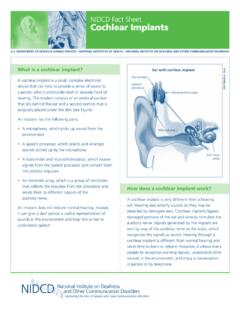
www.nidcd.nih.govWhat is a cochlear implant? A cochlear implant is a small, complex electronic device that can help to provide a sense of sound to a person who is profoundly deaf or severely hard-of-hearing. The implant consists of an external portion that sits behind the ear and a second portion that is surgically placed under the skin (see figure).
Considerations for Use of PCV15 and PCV20 in U.S. Adults
www.cdc.govFeb 25, 2021 · • Simplifying existing pneumococcal vaccine recommendations could help improve vaccine coverage among adults • Disparities in pneumococcal disease burden and vaccine coverage should ... High-risk: those who were immunocompromised or had a cochlear implant *Pfizer funded study. In adults aged 19–49 years, 52% of pneumococcal pneumonia cases
Technology for Deaf People - University of Washington
courses.cs.washington.eduExamples: hearing aids, cochlear implants • Assistive technology › Popular in rehabilitation literature. Emphasis on the need for assistance. • Access technology › Allows an activity that would be difficult to impossible to achieve without it. Emphasis not on restoring function, but on achieving an end goal by whatever means possible.

Factsheet - Definitions - Derbyshire County Council elections
www.derbyshire.gov.ukcochlear implant to help them hear well. Many can use the telephone with people they know well (and often it will not be realised that partially hearing people can’t hear everything). Many people do not even realise that the partially hearing person can’t hear everything.

DEAF & HARD OF HEARING - Pennsylvania Department of …
www.dli.pa.govCOCHLEAR IMPLANT • A surgically implanted device that provides direct electrical stimulation to the auditory nerve in the inner ear. Cochlear implants are an option for individuals who do not benefit from hearing aids, and they are usually covered by insurance. Telephones and Relay Services ODHH understands the impact hearing loss has on