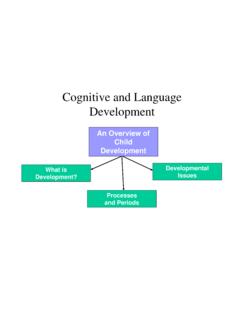
Cognitive and Language Development - Stony Brook
The Brain Vygotsky’s Theory ... Problems with social perspective taking. The Three Mountain Tasks. Pre-operational Period: Egocentric Speech ... Children’s Cognitive Development University of Geneva 12 3 4 X. Jean Piaget: Mixing Colors …
Download Cognitive and Language Development - Stony Brook

Information
Domain:
Source:
Link to this page:
Documents from same domain
THE ORIGINS OF ATTACHMENT THEORY ... - …
www.psychology.sunysb.eduTHE ORIGINS OF ATTACHMENT THEORY: JOHN BOWLBY AND MARY AINSWORTH INGE BRETHERTON Attachment theory is the joint work of John Bowlby and Mary Ainsworth (Ainsworth &
ADULT ATTACHMENT INTERVIEW PROTOCOL - …
www.psychology.sunysb.edu3 then say something like "Well, that's fine. Thank you, we'll just go with he ones you've already given me." The interviewer's tone here should make it clear that the participant's response is perfectly acceptable and not un-
American Psychologist. Vol. 46 (4) April 1991, pp. …
www.psychology.sunysb.edu3 a person should be fully emancipated from parents. Blatz viewed any substantial continuation of de-pendence on them to be undesirable. But one cannot
Attachment and Socialization - Stony Brook
www.psychology.sunysb.eduThe belief that child-parent attachment plays an im-portant role in social development occupies center stage in most contemporary theories of childhood
Why Chinese Mothers Are Superior - Stony Brook
www.psychology.sunysb.eduWhy Chinese Mothers Are Superior By AMY CHUA Erin Patrice O'Brien The Wall Street Journal January 8, 2011 Amy Chua with her daughters, Louisa and Sophia, at

The Ainsworth Strange Situation - Stony Brook
www.psychology.sunysb.edu© 2012 E. Waters The Ainsworth Strange Situation Specifically, is the infant able to use the person it is attached to as a secure base from which to explore

Why Do We Do the Things We Do?” - Stony Brook
www.psychology.sunysb.edudo I engage in the behavior described in the immediately lower box?” To help you with this exercise, the rectangles on the left show how our example, participating in a psychology experiment, can be linked to important life goals.
Explaining Disorganized Attachment - Stony Brook
www.psychology.sunysb.eduMain & Solomon’s (1990) sequential contradictory behavior criterion for Disorganized attachment. The key findings were (1) very high rates of Atypical attachment in mild-to-moderately undernourished
Learning and Thinking Styles - Stony Brook
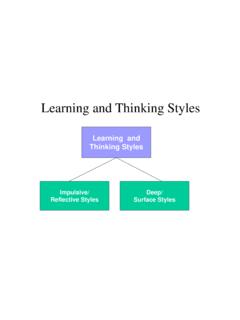
www.psychology.sunysb.eduReflective vs. Impulsive Thinking Styles Reflective students surpass impulsive students at Remembering structured information Reading comprehension Problem solving and decision making Goal setting Setting high standards for performance
A Review of Adult Attachment Measures: Implications for ...
www.psychology.sunysb.edu2 A Review of Adult Attachment Measures: Implications for Theory and Research The past few years have seen a rise in interest in adult attachment from both theoretical and empirical perspe c-
Related documents
A Comparison of Two Theories of Learning -- Behaviorism ...
www.g-casa.comPiaget’s theory was comprised of two major elements “ages” and “stages. ” According to Piaget, “these elements help to predict what children can and cannot understand at different ages.” (Rummel, 2008, p. 80). It is the theory of development that is the major foundation for cognitive constructivist approaches to teaching and learning.

Vygotsky’s Theory - Stony Brook
www.psychology.sunysb.eduZone of Proximal Development Scaffolding: Teacher adjusts the level of support as performance rises. Language and Thought: Develop independently of each other, then merge. Have external or social origins “Private Speech” Vygotsky’s Theory
EARLY CHILDHOOD DEVELOPMENT THEORIES
courses.aiu.eduJean Piaget. Piaget is best known for his theory of cognitive development in children, which proposed that children’s cognitive skills progress through a series of stages in which new information from experiences is taken in and understood. Stages in early childhood development include the sensori-motor (ages birth to 24
Physical and Cognitive chapter 7 Development in Early ...
edge.sagepub.comdevelopment and their implications for young children’s development. 7.3 Distinguish two processes of brain development and the role of plasticity in development. 7.4 Contrast Piaget’s and Vygotsky’s perspectives on young children’s thinking. 7.5 Discuss changes that occur in attention, episodic memory, and autobiographic memory

Social Development Theory - Esteem Journey
esteemjourney.comSocial Development Theory Socialize and Learn S o c i a l i ze a n d L e a r n In the social development theory, Leo Vygotsky primarily explains that socialization affects the learning process in an individual. It tries to explain consciousness or awareness as the result of

Mother Tongue, a Necessary Step to Intellectual …
files.eric.ed.govuse of language generally refers to Piaget and Vygotsky. The most well-known and influential theory of cognitive development is that of Jean Piaget (1896–1980). Piaget's theory grew out of decades of extensive observation of children, including his own, in their natural environments as opposed to the laboratory experiments of the behaviorists.

Child Growth and Development - Miami Coral Park Senior ...
www.mcpshs.netOct 21, 2013 · development theories of Maslow, Erikson, Piaget, Vygotsky, and Montessori; and will understand the implications of these theories for children ... • Summarize the main ideas of each child development theory • Explain at least one implication of each child development theory as it relates to children’s learning ... Social, Self-Esteem, and ...

Assessment for learning: theoretical perspectives and ...
www.sagepub.comVygotsky believed that children’s development (cognitive, social and language development) is enhanced through social interaction. This contrasts with Piaget’s views of the child as a solitary learner. Jerome Bruner used the metaphor scaffolding as an analogy to explain how adults or more able peers can support children’s learning. The