
Complete Blood Count Normal Pediatric Values
Complete Blood Count Normal Pediatric Values Complete Blood Count Normal Pediatric Values Age Red Blood Cells (x 106/µL) Hemoglobin (g/dL) Hematocrit (%) MCV (fL) MCHC (%) Reticulocyte Count (%) Cord blood 14.0-18.8 42-68 96-125 30-34 3-7 Term newborn 5.00-6.30 18.0-21.5 51-68 95-125 30-35 3-7 1-3 days 4.10-6.10 14.0-24.0 43-68 95-125 30-38 1 ...
Download Complete Blood Count Normal Pediatric Values

Information
Domain:
Source:
Link to this page:
Documents from same domain

Surgical Pathology - Mayo Medical Laboratories
a1.mayomedicallaboratories.comSurgical Pathology Any UNLISTED specimen should be assigned to the CPT code which most closely reflects the work involved when compared to other specimens assigned to that code.
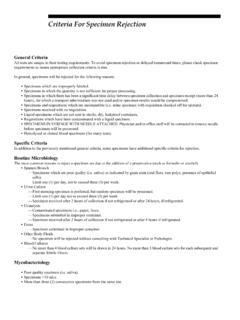
Criteria For Specimen Rejection - Mayo Medical Laboratories
a1.mayomedicallaboratories.comCytology • Fixative not added. • Unsatisfactory (acellular). Histology • Unresolved mislabeled or unlabeled specimen. Policy For Handling Rejected Specimens All specimens will be order entered into the computer. They may then be cancelled or logged off with an explanation of why they
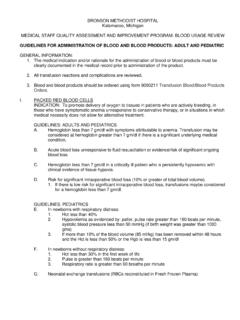
GUIDELINES FOR ADMINISTRATION OF BLOOD AND …
a1.mayomedicallaboratories.comGUIDELINES FOR ADMINISTRATION OF BLOOD AND BLOOD PRODUCTS: ADULT AND PEDIATRIC GENERAL INFORMATION: 1. The medical indication and/or rationale for the administration of blood or blood products must be clearly documented in the medical record prior to administration of the product. 2. All transfusion reactions and complications are reviewed. 3.

Specimen Collection, Preparation, and Transport
a1.mayomedicallaboratories.com• On-site chain-of-custody collection is available by special request, scheduled in advance. Training for on-site collection is also available by contacting NetworkReferenceLab. Microbiology Specimen Collection Please see specific test in “Alphebetical Test Listings” for detailed specimen requirement, handling, and transport information.
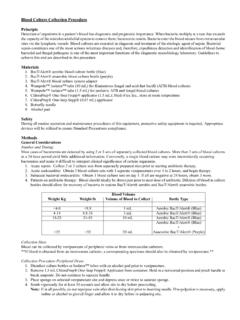
Blood Culture Collection Procedure
a1.mayomedicallaboratories.comBlood Culture Collection Procedure Principle Detection of organisms in a patient’s blood has diagnostic and progn ostic importance. When bacteria multiply at a rate that exc eeds the capacity of the reticuloendothelial system to remove them; b acteremia results. Bacteria enter the blood stream from extrava scular sites via the lymphatic vessels.
Related documents

Drugs to boost white blood cells for cancer patients on ...
www.choosingwisely.orgWhat are white blood cells? Your blood has white cells and red cells. Both kinds of cells are made in the bone marrow. This is the soft tissue inside some bones. White blood cells help your body fight infection. If you have too few white blood cells, you are more likely to get sick. ®
Understanding your MULTIPLE MYELOMA LAB TESTS
www.ninlarohcp.comA CBC measures the number of red blood cell levels, white blood cells, and the total amount of platelets in the blood. Your body produces blood cells in the bone marrow. Since the overgrowth of plasma cells in the bone marrow can crowd out normal cells, leading to low blood counts, blood cells must be carefully monitored. White blood cells (WBCs)
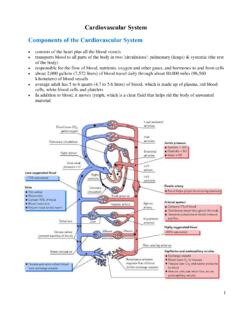
Cardiovascular System Components of the Cardiovascular …
www.soinc.orgcells, white blood cells and platelets • In addition to blood, it moves lymph, which is a clear fluid that helps rid the body of unwanted material . 2 Anatomy of the Heart • The heart is a muscular organ a little larger than your fist weighing between 7 and 15 ounces (200

Anemia Healthy Changes - NHLBI, NIH
www.nhlbi.nih.govBlood cells are made in your bone marrow—the spongy tissue inside many of your bones. Blood cells live for various lengths of time. RBCs live about 120 days, and platelets live about 6 days. WBCs have various lifespans. Some types live about 1 day, while others may live a long time. Your bone marrow is always
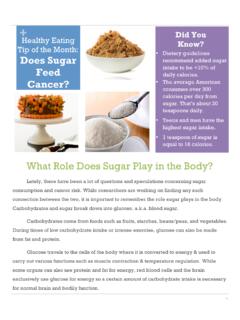
What Role Does Sugar Play in the Body?
www.med.umich.edublood glucose levels, which is preferable. A fast increase in blood sugar causes a rapid increase in insulin, which is the hormone responsible for allowing glucose to enter cells. High insulin levels cause glucose levels to quickly fall, which can then cause you to feel hungry again, prompting you to take in more calories.
The Hematological Complications of Alcoholism
pubs.niaaa.nih.goving those affecting the blood (i.e., the blood cells as well as proteins present in the blood plasma) and the bone marrow, where the blood cells are produced. (For more information on the blood’s composition and on the various types of blood cells and their production, see sidebar, pp. 50–51.) Alcohol’s adverse effects on the blood-

Blood vessels: the endothelium - Yale University
medcell.med.yale.eduEndothelial cells regulate passage of immune cells into surrounding tissue. Not only must specific proteins exit the blood but immune cells must also cross the endothelium to enter the surrounding tissue to fight infections. Given the significantly larger size of cells compared to proteins, this would seem to be a near impossible challenge.

Isolation of mononuclear cells from human peripheral blood ...
www.miltenyibiotec.comThe peripheral blood or buffy coat should not be older than 8 hours and supplemented with anticoagulants (e.g. heparin, EDTA, citrate, ACD-A, or citrate phosphate dextrose (CPD)). 1. Dilute cells with 2–4× the volume of buffer. Note: The more diluted the blood sample, the better the purity of the
Standard Operating Procedure: Peripheral Blood …
www.niaid.nih.govThis document outlines the procedure to obtain peripheral blood mononuclear cells (PBMC) and plasma from human whole blood for use in humoral immunity/serology and cell activation/Cell Mediated Immunity (CMI) studies. 2.0 Scope This SOP applies to work conducted by: 2.1.