
CompTIA Security+ Certification Exam Objectives
Given a scenario, analyze indicators of compromise and determine the type of malware. Compare and contrast types of attacks. 1.1 1.2 ... - Insider threat - Social engineering - Social media - Personal email • Unauthorized software • Baseline deviation • …
Download CompTIA Security+ Certification Exam Objectives

Information
Domain:
Source:
Link to this page:
Documents from same domain

Certification Exam Objectives: SY0-401 - CompTIA
www.comptia.jpCompTIA Security+ Certification Exam Objectives v. 7 1 of 24 Copyright 2013 by the Computing Technology Industry Association.

CompTIA Advanced Security Practitioner Certification Exam ...
www.comptia.jpCompTIA Advanced Security Practitioner Certification Exam Objectives EXAM NUMBER: CAS-002. ... The CASP exam is an internationally targeted validation of advanced-level security skills and knowledge. Candidates are encouraged to use this document to help prepare for the CASP exam, which measures ... - UTM - NIPS - NIDS - INE - SIEM - HSM ...
CompTIA Advanced Security Practitioner (CASP ...
www.comptia.jpThe CompTIA Advanced Security Practitioner (CASP) CAS-003 certification is a vendor-neutral credential. The CASP exam is an internationally targeted validation of advanced-level security skills and knowledge.
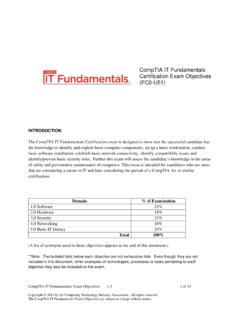
CompTIA IT Fundamentals (FC0-U51)
www.comptia.jpThe CompTIA IT Fundamentals Certification exam is designed to show that the successful candidate has the knowledge to identify and explain basic computer components, set up a basic workstation, conduct basic software installation, establish basic network connectivity, identify compatibility issues and identify/prevent basic security risks.

CompTIA IT Fundamentals (ITF+) Certification Exam Objectives
www.comptia.jp1.0 IT Concepts and Terminology 17% 2.0 Infrastructure 22% 3.0 Applications and Software 18% 4.0 Software Development 12% 5.0 Database Fundamentals 11% 6.0 Security 20% Total 100% TEST DETAILS Required exam FCO-U61 Number of questions 75 Type of questions Multiple choice Length of test 60 minutes

CompTIA Network+ Certification Exam Objectives
www.comptia.jp• Speed and distance requirements • Channel bandwidth • Channel bonding ... network storage technologies. Compare and contrast WAN technologies. 2.3 2.4 2.5 • Multilayer switch • Wireless controller • Load balancer ... • Transmission mediums - Satellite - Copper - Fiber - Wireless • Characteristics of service - MPLS

CompTIA A+ Certification Exam: Core 2 Objectives
www.comptia.jpCompTIA A+ Certification Exam: Core 2 Objectives Version 4.0 (Exam Number: Core 2) Given a scenario, implement methods for securing mobile devices. Given a scenario, implement appropriate data destruction and disposal methods. Given a scenario, configure security on SOHO wireless and wired networks. 2.8 2.9 2.10 • Screen locks - Fingerprint lock
CompTIA A+ Certification Exam: Core 1 Objectives
www.comptia.jp• Understand the basics of networking and security forensics • Properly and safely diagnose, resolve, and document common hardware and software issues ... - High-end video - Maximum RAM • Audio/video editing workstation - Specialized audio and video card - Large, fast hard drive - Dual monitors
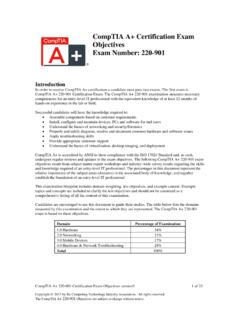
CompTIA A+ 220-901
www.comptia.jpThe CompTIA A+ 220-901 Objectives are subject to change without notice. CompTIA A+ Certification Exam Objectives Exam Number: 220-901 Introduction In order to receive CompTIA A+ certification a candidate must pass two exams. The first exam is CompTIA A+ 220-901 Certification Exam. The CompTIA A+ 220-901 examination measures necessary

CompTIA PenTest+ Certification Exam Objectives
www.comptia.jpThe CompTIA PenTest+ exam will certify the successful candidate has the knowledge and skills required to: • Plan and scope an assessment • Understand legal and compliance requirements • Perform vulnerability scanning and penetration testing using appropriate tools and techniques
Related documents
CompTIA Security+ Certification Exam Objectives
comptia.jp- Threat feeds - Adversary tactics, techniques, and procedures (TTP) Explain the security concerns associated with various types of vulnerabilities. Explain different threat actors, vectors, and intelligence sources. 1.6 1.5 1.0 Threats, Attacks, and Vulnerabilities CompTIA Security+ Certification Exam Objectives Version 3.0 (Exam Number: SY0-601)
THE DEFINITIVE GUIDE TO DATA CLASSIFICATION
infosecpartners.comMay 02, 2016 · The value to classification was once limited to protection from insider threats. With the growth in outsider threats, classification takes on a new ... advanced threat detection tools escalate alarms accordingly to allow more immediate response. 14 ... or creator among other variables as indicators
OPERATIONS SECURITY (OPSEC) PROGRAM
media.defense.govMar 24, 2017 · critical data. Indicators are data derived from open (unprotected) sources or detectable actions. These indicators may be prevalent in our daily routines, such as administrative, operational and logistical activities. A comprehensive listing of these indicators is provided in Enclosure 3.

Department of Defense
www.esd.whs.milMay 17, 2011 · DoDD 5240.06, May 17, 2011 . Change 3, 8/31/2020 2. and the Joint Staff, the Combatant Commands, the Office of the Inspector General of the Department of Defense, the Defense Agencies, the DoD Field Activities, and all other

Forcepoint Data Loss Prevention (DLP)
www.forcepoint.comindicators into a framework of Bayesian belief networks to assess the likelihood of data risk scenarios, such as data theft and broken business processes. Focus response teams on greatest risk with prioritized incidents that highlight the people responsible for risk, the critical data at risk and common patterns of behavior across users.