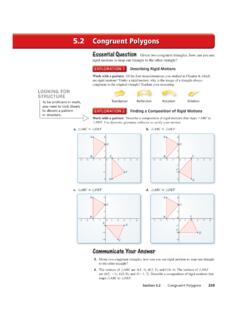
Congruent Polygons
242 Chapter 5 Congruent Triangles Using the Third Angles Theorem Find m∠BDC. SOLUTION ∠A ≅ ∠B and ∠ADC ≅ ∠BCD, so by the Third Angles Theorem, ∠ACD ≅ ∠BDC. By the Triangle Sum Theorem (Theorem 5.1), m∠ACD = 180° − 45° − 30° = 105°. So, m∠BDC = m∠ACD = 105° by the defi nition of congruent angles. Proving That Triangles Are Congruent
Download Congruent Polygons

Information
Domain:
Source:
Link to this page:
Documents from same domain
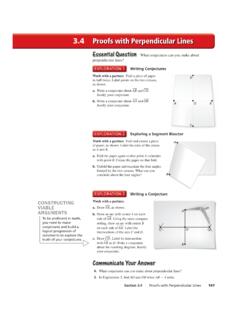
Proofs with Perpendicular Lines - Big Ideas Math
static.bigideasmath.com148 Chapter 3 Parallel and Perpendicular Lines 3.4 Lesson WWhat You Will Learnhat You Will Learn Find the distance from a point to a line. Construct perpendicular lines. Prove theorems about perpendicular lines. Solve real-life problems involving perpendicular lines.

9.3 Solving Quadratic Equations Using Square Roots
static.bigideasmath.comSection 9.3 Solving Quadratic Equations Using Square Roots 497 EEssential Questionssential Question How can you determine the number of solutions of a quadratic equation of the form ax2 + c = 0? The Number of Solutions of ax2 + c = 0 Work with a partner.

9.4 Solving Quadratic Equations by Completing the Square
static.bigideasmath.com508 Chapter 9 Solving Quadratic Equations Finding and Using Maximum and Minimum Values One way to fi nd the maximum or minimum value of a quadratic function is to write the function in vertex form by completing the square.

Solving Absolute Value Equations - Big Ideas Math
static.bigideasmath.comSolving Absolute Value Equations 5 Match the absolute value equation with its graph. 22. ∣ x − 4 ∣ = 3 23.∣ x + 4 ∣ = 3 24.∣ x − 3 ∣ = 4 A. y22 y1 01 3 45678 4 4 B. y12301 4 56789
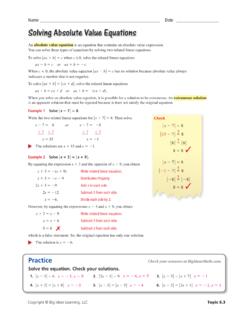
SSolving Absolute Value Equationsolving Absolute Value ...
static.bigideasmath.comAn absolute value equation is an equation that contains an absolute value expression. You can solve these types of equations by solving two related linear equations. To solve ∣ ax + b ∣ = c when c ≥ 0, solve the related linear equations

Graphic Organizers - Big Ideas Math
static.bigideasmath.comTitle: Microsoft Word - Graphic Organizer.docx Author: mwolfe Created Date: 4/30/2013 4:16:43 PM

Piecewise Functions
static.bigideasmath.comGraphing and Writing Step Functions A step function is a piecewise function defi ned by a constant value over each part of its domain. The graph of a step function consists of a series of line segments. x y 0 2 4 6 8 10 12 0 2 4 6 STUDY TIP The graph of a step function looks like a staircase. Graphing and Writing a Step Function

Graphing Polynomial Functions
static.bigideasmath.comCheck this by graphing the function on a graphing calculator, as shown. MMonitoring Progressonitoring Progress Help in English and Spanish at BigIdeasMath.com Evaluate the function for the given value of x. 4. f(x) = −x3 + 3x2 + 9; x = 4 5. f(x) = 3x5 − x4 − 6x + 10; x = −2 6. Describe the end behavior of the graph of f(x) = 0.25x3 − ...
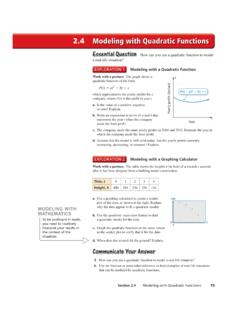
Modeling with Quadratic Functions
static.bigideasmath.comSection 2.4 Modeling with Quadratic Functions 77 Writing an Equation Using a Point and x-Intercepts A meteorologist creates a parabola to predict the temperature tomorrow, where x is the number of hours after midnight and y is the temperature (in degrees Celsius). a.

Completing the Square
static.bigideasmath.comWrite quadratic functions in vertex form. Solving Quadratic Equations Using Square Roots Previously, you have solved equations of the form u2 = d by taking the square root of each side. This method also works when one side of an equation is a perfect square trinomial and the other side is a constant. 3.3 CCore ore CConceptoncept Completing the ...
Related documents

PROBLEMS IN PLANE AND SOLID GEOMETRY v.1 Plane …
e.math.hr§6. Regular polygons 142 * * * 142 * * * 143 §7. The inscribed and circumscribed polygons 144 * * * 144 §8. Arbitrary convex polygons 144 §9. Pascal’s theorem 145 Problems for independent study 145 Solutions 146 Chapter 7. LOCI 169 Background 169 Introductory problems 169 §1. The locus is a line or a segment of a line 169 * * * 170 §2.
The Foundations of Geometry - UCB Mathematics
math.berkeley.edument of the euclidean geometry is clearly shown; for example, it is shown that the whole of the euclidean geometry may be developed without the use of the axiom of continuity; the signifi-cance of Desargues’s theorem, as a condition that a given plane geometry may be regarded as a part of a geometry of space, is made apparent, etc. 5.
Problems and Solutions in Euclidean Geometry - Aref ...
www.isinj.comCHAPTER 1 - Triangles and Polygons Theorems and corollaries I Solved problems 4 Miscellaneous exercises 25 CHAPTER 2 - Areas, Squares, and Rectangles Theorems and corollaries 33 Solved problems 35 Miscellaneous exercises 56 CHAPTER 3 - Circles and Tangency Theorems and corollaries 64 Solved problems 67 Miscellaneous exercises 95 …

An Introduction to Riemannian Geometry - ULisboa
www.math.tecnico.ulisboa.pt10. Notes on Chapter 1 51 Chapter 2. Differential Forms 57 1. Tensors 57 2. Tensor Fields 64 3. Differential Forms 66 4. Integration on Manifolds 72 5. Stokes Theorem 75 6. Orientation and Volume Forms 78 7. Notes on Chapter 2 80 Chapter 3. Riemannian Manifolds 87 1. Riemannian Manifolds 87 2. Affine Connections 94 3. Levi-Civita Connection 98 4.
Computational Geometry - ELTE
people.inf.elte.huChapter 2 introduces plane sweep algorithms, and it is best to read this chapter before any of the other chapters that use this technique. Similarly, Chapter 4 should be read before any other chapter that uses randomized algorithms. For a first course on computational geometry, we advise treating Chapters 1– 10 in the given order.

Geometry Workbook with Answers - Hialeah Senior High …
www.hialeahhigh.orgNov 14, 2011 · For Exercises 10 and 11, use a ruler to draw each figure. Label the figure and mark the congruent parts. N L K M 8 cm 8 cm O P NS Q Discovering Geometry Practice Your Skills CHAPTER 1 1 ©2008 Key Curriculum Press 10. AB and CD with M as the midpoint of both AB and CD. AB 6.4 cm and CD 4.0 cm.A, B, and C are not collinear. 11. AB and CD. C is ...

Discovering Geometry - Flourish
www.flourishkh.comThe Solutions Manualfor Discovering Geometry: An Investigative Approach contains solutions to the exercises at the end of each lesson and to the Extensions, Improving Your Reasoning Skills, Improving Your Visual

CK-12 Geometry - Second
allinonehighschool.comwww.ck12.orgChapter 1. Basics of Geometry, Answer Key CHAPTER 1 Basics of Geometry, Answer Key Chapter Outline 1.1 GEOMETRY - SECOND EDITION, POINTS, LINES, AND PLANES, REVIEW AN- SWERS 1.2 GEOMETRY - SECOND EDITION, SEGMENTS AND DISTANCE, REVIEW ANSWERS 1.3 GEOMETRY - SECOND EDITION, ANGLES AND …

Honors Geometry Solutions Manual
www.ahschools.us4¬ x LM 2x 3 LM 2(4) 3 8 3 LM 11 11. BC 6CD because they both have length 10 inches. BE ED because they both have length 8 inches. BA DAbecause they both have length 14.4 inches. Pages 17–19 Practice and Apply 12. Each inch on the ruler is divided into sixteenths. Point B is closer to the 11 5 6-inch mark.Thus,AB is about 11 5