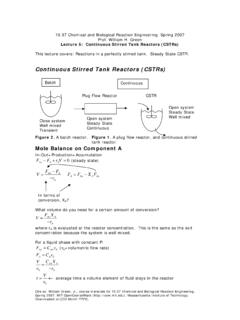
Continuous Stirred Tank Reactors (CSTRs)
Approach to steady state in a continuous stirred tank reactor (CSTR). The time at which ½ of the steady state concentration of C A is achieved is the h time: ln(2) τ 1+Da CSTRs in Series (Liquid and at constant pressure) alf C C A0 Da 1 Da 2 Figure 4. Two tanks in series. The output of the first tank is the input of the second tank.
Download Continuous Stirred Tank Reactors (CSTRs)

Information
Domain:
Source:
Link to this page:
Documents from same domain
Wireless Communications - MIT OpenCourseWare
ocw.mit.eduWireless Communications Wireless telephony Wireless LANs Location-based services 1 The Technology: ... Cellular Phone Networks Frequency reuse
SYSTEMS ENGINEERING FUNDAMENTALS - MIT …
ocw.mit.eduSystems Engineering Fundamentals Introduction iv PREFACE This book provides a basic, conceptual-level description of engineering management disciplines that
Fundamentals of Chemical Reactions - MIT …
ocw.mit.edu10.37 Chemical and Biological Reaction Engineering, Spring 2007 Prof. William H. Green Lecture 4: Reaction Mechanisms and Rate Laws Fundamentals of Chemical Reactions
The Heart of a Vampire - MIT OpenCourseWare
ocw.mit.eduThe Heart of a Vampire ... Interview with the Vampire might not have convinced me that vampires could be sexy until I read a fantasy book on the subject, ...
Heijunka Product & Production Leveling
ocw.mit.eduHeijunka Product & Production Leveling Module 9.3 Mark Graban, LFM Class of ’99, Internal Lean Consultant, Honeywell Presentation for: Summer 2004
15.501/516 Final Examination December 18, 2002
ocw.mit.edu15.501/516 Final Examination December 18, 2002 ... accounting, used for many years ... Metro Area Inc. was in severe financial difficulty and threatened to
Sloan School of Management Massachusetts …
ocw.mit.eduSloan School of Management Massachusetts Institute of Technology ... Managerial Accounting ... Financial accounting information facilitates the
USS Vincennes Incident - MIT OpenCourseWare
ocw.mit.eduOverview • Introduction and Historical Context • Incident Description • Aegis System Description • Human Factors Analysis • Recommendations
Stochastic Processes and Brownian Motion
ocw.mit.eduChapter 1. Stochastic Processes and Brownian Motion 2 1.1 Markov Processes 1.1.1 Probability Distributions and Transitions Suppose …
Stochastic Processes I - MIT OpenCourseWare
ocw.mit.eduLecture 5 : Stochastic Processes I 1 Stochastic process A stochastic process is a collection of random variables indexed by time. An alternate view is that it is a probability distribution over a space
Related documents
Fundamentals of Chemical Reactor Theory1
www.seas.ucla.eduA Continuous-Stirred Tank Reactor (CSTR) is a well-mixed vessel that operates at steady-state (Qin=Qout=Q). The main assumption in this case is that the concentration of the incoming fluid will become instantaneously equal to the outgoing upon entering the vessel. Fig. 2 explains visually this concept.

Boiling Water Reactor (BWR) Systems
www.nrc.govStorage Tank Reactor Core Isolation Cooling The reactor core isolation cooling (RCIC) system provides makeup water to the reactor vessel for core cooling when the main steam lines are isolated and the normal supply of water to the reactor vessel is lost. The RCIC system consists of a turbine-driven pump, piping, and valves necessary to deliver ...
Wastewater Technology Fact Sheet: Sequencing Batch Reactors
www3.epa.govand secondary clarification in a single tank using a timed control sequence. This type of reactor does, in some cases, also perform primary clarification. In a conventional activated sludge system, these unit processes would be accomplished by using separate tanks. A modified version of the SBR is the Intermittent

Total Solids, Volatile Solids - University of Florida
biogas.ifas.ufl.eduTotal Solids, Volatile Solids Total Solids (TS)= Dry matter content of substrate Inverse of moisture content one of the most variable parameters between substrates water Volatile Solids (VS)= Combustible proportion of TS, organic matter Non-volatile Solids (Ash)= Inorganic material (Minerals, salts), does not contribute to methane
Distributions of Residence Times for Chemical Reactors
websites.umich.eduIn a gas–liquid continuous-stirred tank reactor (Figure 13-1), the gaseous reactant was bubbled into the reactor while the liquid reactant was fed through an inlet tube in the reactor’s side. The reaction took place at the gas–liquid interface of the bubbles, and the product was a …
Elements of Chemical Reaction Engineering
ptgmedia.pearsoncmg.com1.4.1 Continuous-Stirred Tank Reactor (CSTR) 12 1.4.2 Tubular Reactor 14 1.4.3 Packed-Bed Reactor (PBR) 18 1.5 Industrial Reactors 22 CHAPTER 2 CONVERSION AND REACTOR SIZING 31 2.1 Definition of Conversion 32 2.2 Batch Reactor Design Equations 32 2.3 Design Equations for Flow Reactors 35 2.3.1 CSTR (Also Known as a Backmix Reactor or a Vat) 36
Design and Control of a Methanol Reactor/Column Process
terpconnect.umd.eduJun 02, 2010 · evaluated. These variables include reactor pressure, reactor size, concentration of inert components in the recycle gas, and pressure in a flash tank upstream of the column. The purpose of the flash tank is to keep light components from entering the column that would blanket the condenser. The investigation reveals that the economics are ...
Reactor Design Lectures Notes - University of Technology, Iraq
www.uotechnology.edu.iqreactor, exit stream has the same composition as in the tank. •The reaction rate associated with the final (output) concentration. •Reactor equipped with an impeller to ensure proper mixing. •Dividing the volume of the tank by the average volumetric flow rate through the tank gives theresidence time, or the average

16-1
websites.umich.eduto a particular reactor type; markedly different reactors and reactor sequencing can display identical RTDs. Nevertheless, the RTD exhibited by a given reactor yields distinctive clues to the type of mixing occurring within it and is one of the most informative characterizations of the reactor. 16.2 Measurement of the RTD