
Convolutional Neural Networks for Visual Recognition
This image is licensed under CC BY-NC-SA 2.0; changes made This image is licensed under CC BY-SA 3.0; changes made Object detection car ime Action recognition bicycling Scene graph prediction <person - holding - hammer> Captioning: a person holding a hammer This image is licensed under CC BY-SA 3.0; changes made
Download Convolutional Neural Networks for Visual Recognition

Information
Domain:
Source:
Link to this page:
Documents from same domain
NaveenAppiah SagarVare - Stanford University
cs231n.stanford.eduNaveenAppiah Mechanical Engineering nappiahb@stanford.edu SagarVare Stanford ICME svare@stanford.edu ... the popular mobile game - Flappy Bird. It involves navi-gating a bird through a bunch of obstacles. Though, this ... the game emulator and learns to make good decisions over time. It is this simple learning framework and their

Fei-Fei Li & Justin Johnson & Serena Yeung Lecture 2 ...
cs231n.stanford.eduFei-Fei Li & Justin Johnson & Serena Yeung Lecture 2 - April 6, 2017 Administrative: Piazza For questions about midterm, poster session, projects,

Lecture 9: CNN Architectures
cs231n.stanford.eduLecture 9 - 22 May 2, 2017 ImageNet Large Scale Visual Recognition Challenge (ILSVRC) winners First CNN-based winner. Fei-Fei Li & Justin Johnson & Serena Yeung Lecture 9 - 23 May 2, 2017 ImageNet Large Scale Visual Recognition Challenge (ILSVRC) winners ZFNet: Improved hyperparameters over AlexNet. Fei-Fei Li & Justin Johnson & Serena Yeung ...

Attention and Transformers Lecture 11
cs231n.stanford.edugraph with shared weights h 0 f W h 1 f W h 2 f W h 3 x 3 y T ... Extract spatial features from a pretrained CNN Image Captioning using spatial features 11 CNN Features: H x W x D h 0 [START] Xu et al, “Show, Attend and Tell: Neural Image Caption Generation with Visual Attention”, ICML 2015 z 0,0 z 0,1 z 0,2 z 1,0 z 1,1 z 1,2 z 2,0 z 2,1 z ...

CNNs for Face Detection and Recognition
cs231n.stanford.edudevelopment of object classification, localization and detec-tion techniques. 2.1. Sliding Window In the early development of face detection, researchers tended to treat it as a repetitive task of object classifica-tion, by imposing sliding windows and performing object classification with the neural networks on the window re-gion.
Vector, Matrix, and Tensor Derivatives
cs231n.stanford.eduErik Learned-Miller The purpose of this document is to help you learn to take derivatives of vectors, matrices, and higher order tensors (arrays with three dimensions or more), and to help you take ... At this point, we have reduced the original matrix equation (Equation 1) …

Lecture 14: Reinforcement Learning
cs231n.stanford.eduFei-Fei Li & Justin Johnson & Serena Yeung Lecture 14 - May 23, 2017 Markov Decision Process 19 - Mathematical formulation of the RL problem - Markov property: Current state completely characterises the state of the
Lecture 11: Detection and Segmentation
cs231n.stanford.eduFei-Fei Li & Justin Johnson & Serena Yeung Lecture 11 - 1 May 10, 2017 Lecture 11: Detection and Segmentation

Lecture 13: Generative Models
cs231n.stanford.eduFei-Fei Li & Justin Johnson & Serena Yeung Lecture 13 - May 18, 2017 Generative Models 17 Training data ~ p data (x) Generated samples ~ p model (x) Want to learn p

Lecture 10: Recurrent Neural Networks
cs231n.stanford.eduimage -> sequence of words. Fei-Fei Li & Justin Johnson & Serena Yeung Lecture 10 - 13 May 4, 2017 Recurrent Neural Networks: Process Sequences e.g. Sentiment Classification sequence of words -> sentiment. Fei-Fei Li & Justin Johnson & Serena Yeung Lecture 10 - 14 May 4, 2017
Related documents
SLIC Superpixels - Université de Montréal
www.iro.umontreal.ca2.1 Graph-based algorithms In graph based algorithms, each pixel is treated as a node in a graph, and edge weight between two nodes are set proportional to the similarity between the pixels. Superpixel segments are extracted by e ectively minimizing a cost function de ned on the graph. The Normalized cuts algorithm [9], recursively partitions a ...
PCT: Point Cloud Transformer - arXiv
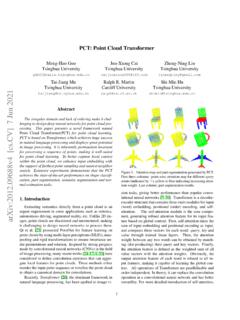
arxiv.orgPCT is based on Transformer, which achieves huge success in natural language processing and displays great potential in image processing. It is inherently permutation invariant for processing a sequence of points, making it well-suited for point cloud learning. To better capture local context within the point cloud, we enhance input embedding with

Analysis of Footwear Impression Evidence
www.ojp.govthe components: an attribute relational graph (ARG), based on representing the image as a composite of sub-patterns together with relationships between them. The structural method was found to perform the best and was selected for image retrieval. The structural method is based on rst detecting the presence of geometrical patterns

Non-local Neural Networks
arxiv.orgNon-local image processing. Non-local means [4] is a clas-sical filtering algorithm that computes a weighted mean of all pixels in an image. It allows distant pixels to contribute to the filtered response at a location based on patch appearance similarity. This non-local filtering idea was later developed