
Corn Starch - Corn Refiners Association
THE CORN WET MILLING PROCESS other reagents. In contrast, starch derivatives can be made in which the granule will not gelatinize at all when exposed to the severe conditions of moist heat and pressure. The granular structure of starch, one of nature's fasci-nating architectural forms, is a vital element in the flex-ibility of commercial
Download Corn Starch - Corn Refiners Association

Information
Domain:
Source:
Link to this page:
Documents from same domain

IODIN.01- IODINE AFFINITY - Corn Refiners Association
corn.orgPotentiometer: A precision potentiometer (for example, a Leeds and Northrup type K-2 bridge with a sensitive galvanometer), or a suitable pH meter reading ... The iodine affinity value of amylose (linear fraction) isolated from corn and purified by recrystallization from n-butanol should be 19.0 ± 0.1%.

Guide to the Corn Refiners Association, Inc. RI-DS Program
corn.orgdensity and specific gravity lead to the 1984 tables. This work has been fully described in the scientific literature listed in the reference section.
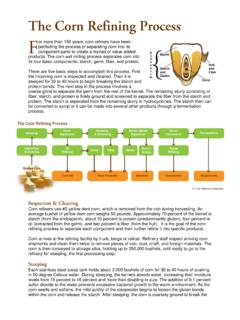
The Corn Refining Process
corn.orgoil (extracted from the germ), and two percent is fiber (from the hull). It is the goal of the corn refining process to separate each component and then further refine it into specific products. Corn arrives at the refining facility by truck, barge or railcar. Refinery staff inspect arriving corn

SUGAR.02- REDUCING SUGARS (Schoorl Method)
corn.orgB. Dissolve 173 g of reagent grade potassium sodium tartrate tetrahydrate and 50 g of reagent grade sodium hydroxide in purified water and dilute to 500-mL volume. Let stand overnight. If precipitation is present, filter through glass wool prior to use.

STAPHYLOCOCCUS AUREUS (CULTURE METHOD)
corn.orgMEDIA AND REAGENTS 1. Tryptic Soy Broth. Prepare medium according to the manufacturer's directions. Dispense 100 mL into 250 mL Erlenmeyer flasks. Sterilize by autoclaving at 121°C for 15 mins. 2. Use one of the following: a. Baird-Parker Agar Base. Prepare medium according to manufacturer's directions. Sterilize by autoclaving at 121°C for ...
Related documents

1. Cereal Grains Structure & Composition
www.iea.usp.br• Removed with pericarp in wet milling Germ • 10 to 12% of kernel dry weight • Stores nutrients and minerals • Contains 81 to 85% of total kernel oil (mostly triglycerides) ... • Dent corn typically has 23-25% Amylose and 75-77% Amylopectin • Waxy …
INDUSTRIAL PHARMACY - I PRACTICAL LAB MANUAL
www.sarajapharmacycollege.comEg : talc, corn starch, silica derivatives etc. The usual methods of formulation include wet granulation, dry granulation and direct compression. The most widely used and most general method of tablet preparation is the wet granulation method. The active ingredient, diluent and disintegrents are mixed or blended well.

High fructose corn syrup: Production, uses and public ...
academicjournals.orgHFCS is produced from corn. The corn grain undergoes several unit processes starting with steeping to soften the hard corn kernel followed by wet milling and physical separation into corn starch (from the endosperm); corn hull (bran) and protein and oil (from the germ). Corn starch composed of glucose molecules of infinite length,
The Corn Refining Process - Corn Refiners Association
corn.orgThe Corn Refining Process or more than 150 years, corn refiners have been perfecting the process of separating corn into its component parts to create a myriad of value added products. The corn wet milling process separates corn into its four basic components: starch, germ, fiber, and protein. There are five basic steps to accomplish this process.
1987 Standard Industrial Classification (SIC) System
www.bls.govD 20 204 2044 Rice Milling D 20 204 2045 Prepared Flour Mixes and Doughs D 20 204 2046 Wet Corn Milling D 20 204 2047 Dog and Cat Food D 20 204 2048 Prepared Feeds and Feed Ingredients For Animals and Fowls, Except Dogs and Cats D 20 205 2050 Bakery Products D 20 205 2051 Bread and Other Bakery Products, Except Cookies and Crackers
LIST OF STANDARD INDUSTRIAL CLASSIFICATION (SIC) CODES
www.state.nj.us2044 Rice Milling 2045 Prepared Flour Mixes And Doughs 2046 Wet Corn Milling 2047 Dog And Cat Food 2048 Prepared Feeds And Feed Ingredients For Animals And Fowls, Except Dog And Cat 205 BAKERY PRODUCTS 2051 Bread And Other Bakery Products, Except Cookies And Crackers 2052 Cookies And Crackers 2053 Frozen Bakery Products, Except Bread
9.9.7 Corn Wet Milling - United States Environmental ...
www3.epa.govThe overall corn wet milling process consists of numerous steps or stages, as shown schematically in Figure 9.9.7-2. Shelled corn is delivered to the wet milling plant primarily by rail and truck and is unloaded into a receiving pit. The corn is then elevated to temporary storage bins and scale hoppers for weighing and sampling.
Vegetable Oil Production: Industry Profile
www3.epa.govcodes: SIC 2046—Wet Corn Milling, SIC 2075—Soybean Oil Mills, SIC 2074—Cottonseed Oil Mills, and SIC 2076—Vegetable Oil Mills, not elsewhere classified (N.E.C.). Of the facilities classified as wet corn mills (2046), only nine produce corn oil.1 The facilities included in SIC 2076 process peanut,