
CRITICAL THINKING ACTIVITY: THE METHANE CYCLE
atmosphere remains there for 8 years until it is removed by oxidization into carbon dioxide (CO 2) and water (H 2 O). It is difficult to quantify methane emissions since sources are spread out over large areas and emission values are small and variable in time and space.
Download CRITICAL THINKING ACTIVITY: THE METHANE CYCLE

Information
Domain:
Source:
Link to this page:
Documents from same domain

PROBLEM SOLVING ACTIVITY: HOW DO EARTH’S SPHERES …
gml.noaa.gov1. After discussing the information in the introduction section, give students an opportunity to put the process to work by analyzing a sample event. Images can be handed out or projected for the class. 2. Each pair/small group will select/be assigned/select …

living organisms, the oceans, the atmosphere, and the ...
gml.noaa.govliving organisms, the oceans, the atmosphere, and the Earth’s crust in what is known as the carbon cycle. The directions taken by carbon atoms through this cycle are very complicated and can take millions of years to make a full circle.
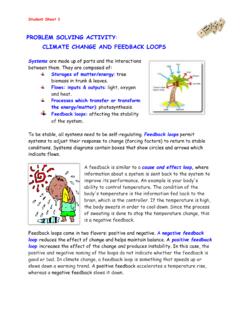
PROBLEM SOLVING ACTIVITY CLIMATE CHANGE AND …
gml.noaa.govability to control temperature. The condition of the body's temperature is the information fed back to the brain, which is the controller. If the temperature is high, the body sweats in order to cool down. Since the process of sweating is done to stop the temperature change, this is a negative feedback.

solar radiation, electromagnetic radiation spectrum. Solar ...
gml.noaa.govradiation spectrum. Solar radiation includes visible light, ultraviolet light, infrared, radio waves, X-rays, and gamma rays. The Electromagnetic Spectrum Radiation is one way to transfer heat. To “radiate” means to send out or spread from a central location. Whether it is light, sound, waves, rays, flower petals, wheel spokes or pain,

CRITICAL THINKING ACTIVITY: THE ELECTROMAGNETIC …
gml.noaa.gov8 Student Sheet 8 RESEARCH GUIDE GROUP 5: ULTRAVIOLET RADIATION 1. Define ultraviolet radiation: 2. Describe where ultraviolet is found on the EMS compared to the other six forms of radiation. In your description, compare and contrast its wavelength, frequency and energy with those of other regions of the EMS. 3.

LAB ACTIVITY: HEAT, TEMPERATURE AND CONDUCTION
gml.noaa.gov2 Student Sheet 2 Cooling things by conduction works the same way as warming. This time, a hot metal spoon is put in room-temperature water. The faster-moving atoms in the spoon contact the slower-moving molecules in the water. The atoms in the spoon transfer some of their energy to the molecules in the water. The spoon will get
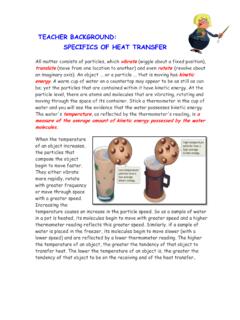
TEACHER BACKGROUND: SPECIFICS OF HEAT TRANSFER
gml.noaa.govIn a new scenario, a metal can containing hot water is placed in a Styrofoam cup containing cold water. Heat is transferred from the hot water to the cold water until both samples have the same temperature. The transfer of heat from the hot water through the metal can to the cold water is referred to as conduction.

The Lithosphere--contains all of the cold, hard solid land ...
gml.noaa.govBelow that is a liquid outer core of nickel and iron. At the center of Earth is a solid inner core of nickel and iron. The Hydrosphere-- contains all the solid, liquid, and gaseous water of the planet. It ranges from 10 to 20 kilometers in thickness. The hydrosphere extends from Earth's surface

MODELING EARTH’S ATMOSPHERIC
gml.noaa.govEarth's surface. Measure and draw a line 80 mm from the Earth's surface. Label this layer mesosphere. Color it red. Draw pictures to help show characteristics. Draw the ionosphere. This is the fourth layer of the atmosphere. It extends 80km-400km from the surface. Label it the ionosphere and color it pink.
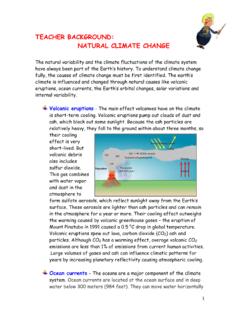
TEACHER BACKGROUND: NATURAL CLIMATE CHANGE
gml.noaa.govmeans cooler summers and milder winters. Slow changes in the Earth’s orbit lead to small but climatically important changes in the strength of the seasons over tens of thousands of years. Climate feedbacks amplify these small changes, thereby producing ice ages. Solar variations - The Sun is the source of energy for the Earth’s climate system.
Related documents

The Semiconductor Supply Chain: Assessing National ...
cset.georgetown.eduCenter for Security and Emerging Technology | 5 Introduction and Overview The half-trillion-dollar semiconductor supply chain4 is one of the world’s most complex. The production of a single computer chip often requires more than

The List of Active Licensees and Registrants under ... - USDA
www.aphis.usda.govThe List of Active Licensees and Registrants under the AWA can be found at the following URL. Please update your bookmarks. https://www.aphis.usda.gov/animal_welfare ...
CARBON SEQUESTRATION IN SOILS Over the past 150 …
www.esa.orgThe carbon that remains as plant tissue is then consumed by animals or added to the soil as litter when plants die and decompose. The primary way that carbon is stored in the soil is as soil organic matter (SOM). SOM is a complex mixture of carbon compounds, consisting of decomposing plant and animal tissue, microbes (protozoa, nematodes, fungi ...