Data Collection methods (Questionnaire & Interview)
• Interviews consist of collecting data by asking questions. • Data can be collected by listening to individuals, recording, filming their responses, or a combination of methods. • There are four types of interview: 1. Structured interview 2. Semi-structured interview 3. In-depth interview 4. Focused group discussion
Download Data Collection methods (Questionnaire & Interview)

Information
Domain:
Source:
Link to this page:
Documents from same domain

Introduction to operations research - gfmer.ch
www.gfmer.chIntroduction to Operations Research Aminu Magashi Garba, MBBS, MSc.PH, DLSHTM Geneva Workshop 27th-31st August 2012 Training Course in Sexual and Reproductive Health Research

Introduction to Excel, Word and Powerpoint - …
www.gfmer.chIntroduction to Excel, Word and Powerpoint Developing Valuable Technology Skills! Shawn Koppenhoefer Training in Research in Reproductive Health/Sexual Health 2005. Excel spreadsheets ... Microsoft Word • What you should know – Opening a file (an existing file or a new file)

MENOPAUSE, PERIMENOPAUSE, POSTMENOPAUSE. - gfmer.ch
www.gfmer.chMenopause is the end point of a process. – Hormones are stable – Take care of the long term consequences of hypoestrogenisme. ...

ANATOMY OF THE CERVIX, SQUAMOCOLUMNAR JUNCTION ...
www.gfmer.chThe endocervix (endocervical canal) is a luminal cavity within the cervix forming a passageway between the external os and the internal os. The upper limit of the endocervical canal called the internal os or isthmus, marks the transition from the endocervix to …

Abr é gé d Acupuncture - gfmer.ch
www.gfmer.chSyndromes du Qi, du Sang et des liquides organiques Thérapeutique Annexes Historique Points les plus utilisés Atlas des points d¶acupuncture Les Correspondances des cinq Mouvements Tableau récapitulatif des points Index 9 20 24 26 45 70 73 78 83 85 87 91 95 97 101 105 115 Introduction Yin ± Yang Constitution de l¶ Homme 5 Mouvements Zang ...

Formative research: What, why, and how
www.gfmer.chmanual for conducting formative research. University of Arizona, National Institutes of Health, University of the Philippines, 2005. Web. May 26, 2011. *Note: These two articles came from a special edition of the Journal of Perinatology which focused on Using Research for Improved Delivery of Newborn Health Interventions. Volume 28; December 2008.
Data collection instruments (questionnaire and interview)
www.gfmer.chAdvantages and disadvantages of interview Advantages: •Collect complete information with greater understanding. •It is more personal, as compared to questionnaires, allowing us to have higher response rates. •It allows for more control over the order and flow of questions.
Principles of Population and Demography
www.gfmer.chGlobal Handbook Family planning guidelines and tools The Medical Eligibility Criteria Wheel Reproductive Choices and Family Planning for People with HIV CIRE Guide to family planning for health care providers and New their clients 4th edition just published! 2010

QUALITATIVE SAMPLING TECHNIQUES
www.gfmer.chA flexible research and sampling design is an important feature of qualitative research, particularly when the research being conducted is exploratory in nature. When little is known about a phenomenon or setting, a priori sampling decisions can be difficult. In such circumstances, creating a research design that is flexible enough to foster
Sampling and sample size estimation
www.gfmer.chHistory of Sampling (Contd) Dates back to 1920 and started by Literary Digest, a news magazine published in the U.S. between 1890 and 1938. Digest successfully predicted the presidential elections in 1920, 1924,1928, 1932 but; Failed in 1936… The Literary Digest poll in 1936 used a sample of 10 million, drawn from government lists of automobile and telephone
Related documents

Revised Data Collection Tools3-1-12
www.ndcompass.orgThe qualitative methods most commonly used in evaluation can be classified in three broad categories: In‐depth interview Observation methods Document review In‐depth interviews: In‐depth interviews are a useful qualitative data collection technique that can be used for a
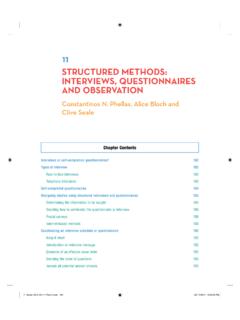
STRUCTURED METHODS: INTERVIEWS, QUESTIONNAIRES …
www.sagepub.comLearning how to design and use structured interviews, questionnaires and observation instruments is an important skill for research-ers. Such survey instruments can be used in many types of research, from case study, to cross-sectional survey, to experiment. A study of this sort can involve anything from a short
CHAPTER 3 RESEARCH METHODOLOGY 3.1 INTRODUCTION …
studentsrepo.um.edu.mysociety.4 Examples of qualitative methods are action research, case study research and grounded theory.5 Qualitative data sources include observation and participation observation (fieldwork), interviews and questionnaires, documents and texts, and the researcher’s impressions and reactions6.

Chapter 5: How Sociologists Do Research
www.csun.eduthe survey themselves (self-administered questionnaires) or by asking respondents the questions directly (interviews). The researcher must consider the effects that interviewers have on respondents that lead to biased answers (interviewer bias) and whether to make the questions structured …
Qualitative Research
www.sagepub.comThe methods covered here—participant observation, in-depth interviews, and focus groups—are the most commonly used methods in applied qualitative inquiry. We do, however, cover other methods such as systematic elicitation and document analysis in Chapter 6, since these are also impor-tant, often-used methods in applied qualitative inquiry.

SOM Research Methods Cover:SOM Research Methods …
www.unrwa.orgThe main methods of asking questions are by face-to-face or telephone interviews, by using questionnaires or a mixture of the two. There are two main types of survey: a descriptive survey: concerned with identifying & counting the frequency of a particular response among the survey group, or an analytical survey: to analyse the relationship

Qualitative Evaluation Methods - ASPHN
asphn.orgQualitative Evaluation Methods . Open-ended questions in structured questionnaires Semi-structured and in- depth interviews Focus groups Document analysis Workshops - table-based/group exercises Go-along interviews - shadowing Photo-elicitation - photovoice Mental models- mind maps Participant diaries, logbooks, recordings Observation

Purposive Sampling as a Tool for Informant Selection
scholarspace.manoa.hawaii.eduSemi-structured interviews, direct observations Persons involved in basket-weaving activities 66 people Percentages Martinez-Romero et al. 2004 Sustainability and use of gara dyeing Field interviews Gara dyers none specified none specified McFoy 2004 Use of hemiepiphytes in craftmaking Interviews, participant observation Male craftmaking and ...

Research Methods for Business Students
sisis.rz.htw-berlin.de9 Collecting primary data through observation • * 10 Collecting primary data using semi-structured, in-depth and group interviews 11 Collecting primary data using questionnaires ^,:. 12 Analysing quantitative data ••-'•' "•••'• 13 Analysing qualitative data 14 Writing and presenting your project report Bibliography Appendices ...
BASIC TOOLS FOR DATA COLLECTION - INTRAC
www.intrac.orgObservation: At its most simple, observation involves ‘seeing’ things – such as objects, processes, relationships, events – and formally recording the information. There are different types of observation. Structured or direct observation is a process in which observations are recorded against an agreed checklist.
Related search queries
Methods, Observation methods, Interviews, STRUCTURED METHODS: INTERVIEWS, QUESTIONNAIRES, Structured interviews, Questionnaires and observation, Research, Observation, Questionnaires, Structured, Qualitative Research, Qualitative Evaluation Methods, Structured questionnaires, Research Methods for Business Students, BASIC TOOLS FOR DATA COLLECTION