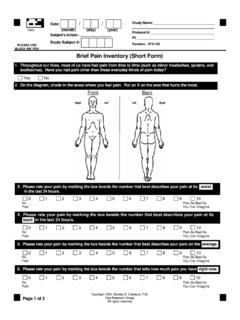
Date: / / Study Name: (month) (day) (year) Protocol ...
Have you had pain other than these everyday kinds of pain today? Brief Pain Inventory (Short Form) 2. On the diagram, shade in the areas where you feel pain. Put an X on the area that hurts the most. Yes No ... Please rate your pain by marking the box beside the number that best describes your pain at its worst in the last 24 hours.
Download Date: / / Study Name: (month) (day) (year) Protocol ...

Information
Domain:
Source:
Link to this page:
Documents from same domain

n i a p e l nb i i as pso oN p1234567890t s r o0W1
npcrc.orgCapital Health Guidelines for using the Edmonton Symptom Assessment System (ESAS) CH-0373 Mar 2001 Regional Palliative Care Program Purpose of the ESAS This tool is designed to assist in the assessment of …
The Brief Pain Inventory - NPCRC
npcrc.org25) I take my pain medicine (in a 24 hour period): 1. Not every day 4. 5 to 6 times per day 2. 1 to 2 times per day 5. More than 6 times per day
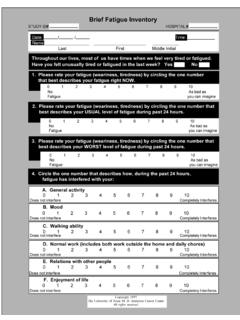
Brief Fatigue Inventory - NPCRC
npcrc.orgDate: / / Time:_____ Name:_____ _____ _____ Last First Middle Initial Brief Fatigue Inventory

HAMILTON DEPRESSION RATING SCALE - NPCRC
npcrc.orgThe total Hamilton Depression (HAM-D) Rating Scale provides and indication of depression and, over time, provides a valuable guide to progress. • Classification of symptoms which may be difficult to obtain can be scored as:

Caregiver Strain Index (CSI) - NPCRC
npcrc.orgCaregiver Strain Index (CSI) I am going to read a list of things that other people have found to be difficult. Would you tell me whether any of these apply to you?
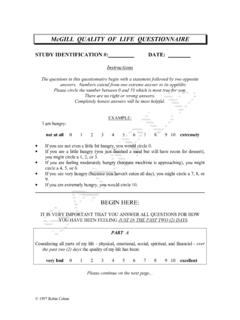
McGILL QUALITY OF LIFE QUESTIONNAIRE - NPCRC
npcrc.orgMcGILL QUALITY OF LIFE QUESTIONNAIRE STUDY IDENTIFICATION #: DATE: Instructions The questions in this questionnaire begin with a statement followed by two opposite answers. Numbers extend from one extreme answer to its opposite. Please circle the number between 0 and 10 which is most true for you. There are no right or wrong answers.

Geriatric Depression Scale (GDS) Short Form - NPCRC
npcrc.orgScoring for Geriatric Depression Scale • Score 1 point for every “yes” in questions 2, 3, 4, 6, 8, 9, 10, 12, 14, 15 • Score 1 point for every “no” in ...
Related documents
List of Psychological Tests - Beacon Health Options
valueoptions.comBRIEF (Behavior Rating Inventory of Executive Functioning) Neuro/Educational ; Child/adolesce nt . 45 ; Versions for preschool and child/adolescent . Brief Neuropsychological Cognitive Exam ; Neuro . 13+ 30 . Brief Symptom Inventory . Behav Rating Scale ; 13+ 5 ; Short form of SLR-90-R. Brief Test of Attention
New York Non-Acute Pain Medical Treatment Guidelines
www.wcb.ny.govNew York State Workers' Compensation Board New York Non-Acute Pain Medical Treatment Guidelines First Edition, September 15, 2014 iv SPINAL CORD STIMULATOR AND INTRATHECAL DRUG
The Life Recovery Workbook
liferecovery.weebly.comThe brief excerpt from Alcoholics Anonymous and the Twelve Steps are reprinted and adapted with permission of Alcoholics Anonymous World Services, Inc. Permission to reprint and adapt the Twelve Steps does not mean that AAWS has reviewed or approved the contents of this publication, or that AAWS necessarily agrees with the views expressed herein.
Module 4: Case Conceptualization and Treatment Planning
athealth.comdepression and anxiety include Beck Depression Inventory – Second Edition, Patient Health Questionnaire (depression), Geriatric Depression Scale, Beck Anxiety Inventory, and the State- Trait Anxiety Inventory. Self-report measures are often completed by patients while in the waiting room and evaluated by the clinician during the session.

BRIEF PAIN INVENTORY (SHORT FORM) - IUPUI
static.medicine.iupui.eduBRIEF PAIN INVENTORY (SHORT FORM) Patient Initials: Date of Birth(dd,mm,yyyy): Visit Date (dd,mm,yyyy) : 1. Throughout our lives, most of us have had pain from time to time (such as minor headaches, sprains, and toothaches). Have you had pain other than these everyday kinds of pain during the last week? 2.
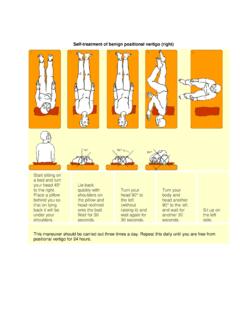
Self-treatment of benign positional vertigo (right)
www.activator.comExercises for low-back pain should be stopped for a week. No "sit-ups" should be done for at least one week and no "crawl" swimming. (Breast stroke is OK.) Also avoid far head-forward positions such as might occur in certain exercises (i.e. touching the toes). Do not
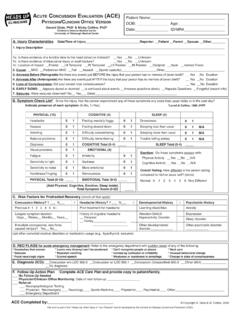
Acute Concussion Evaluation
www.cdc.gov850.1 (Concussion, with brief loss of consciousness < 1 hour) – Positive injury description with evidence of forcible direct/ indirect blow to the head (A1a); plus evidence of active symptoms (B) of any type and number related to the trauma (Total Symptom Score >0); …
Management of Neuropathic Pain for Adults in Primary Care
www.nottsapc.nhs.ukThe Brief Pain Inventory in appendix 1 is a useful tool to monitor the effect of management. Refer patient to specialist at any stage – where the diagnosis is in doubt or patient is not responding to treatment. CAUTIONS WITH NEUROPATHIC PAIN THERAPIES

Free Access to100+ Digital Manuals & Stimulus Books in Q ...
www.pearsonassessments.comMBMD Manual Supplement, Pain Patient Reports MCCI® Manual MCMI®-III Corrections Report User’s Guide MCMI-III Manual Fourth Edition MCMI-IV Manual MIPS® Revised Manual MMPI®-2 Adult Clinical System-Revised, 4th Edition User’s Guide MMPI-2 Manual for Administration, Scoring, and Interpretation, Revised Edition
The Outcome Rating Scale: A Preliminary Study of the ...
www.scottdmiller.comThe ORS was developed as a brief alternative to the Outcome Questionnaire 45.2 (Lambert, Hansen, et al., 1996). The first two authors were familiar with the latter instrument, having used it in their own practices, as well as in research and consultation with numerous mental health agencies and a number of third-party payers.