Deep Residual Learning for Image Recognition
the residual learning principle is generic, and we expect that it is applicable in other vision and non-vision problems. 2. Related Work Residual Representations. In image recognition, VLAD [18] is a representation that encodes by the residual vectors with respect to a dictionary, and Fisher Vector [30] can be
Download Deep Residual Learning for Image Recognition

Information
Domain:
Source:
Link to this page:
Documents from same domain

Predicting the Future Behavior of a Time-Varying ...
www.cv-foundation.orgPredicting the Future Behavior of a Time-Varying Probability Distribution Christoph H. Lampert IST Austria chl@ist.ac.at Abstract We study the problem of predicting the future, though
Deep Convolutional Neural Fields for Depth Estimation From ...
www.cv-foundation.orgvolutional neural networks (CNN). CNN features have been setting new records for a wide variety of vision applica-tions [13]. Despite all the successes in classification prob-
Image Style Transfer Using Convolutional Neural Networks
www.cv-foundation.orgImage Style Transfer Using Convolutional Neural Networks Leon A. Gatys Centre for Integrative Neuroscience, University of Tubingen, Germany¨ Bernstein Center for Computational Neuroscience, Tubingen, Germany¨

NTU RGB+D: A Large Scale Dataset for 3D Human Activity ...
www.cv-foundation.orgMultiview 3D event [43] and Northwestern-UCLA [40] datasets used more than one Kincect cameras at the same time to collect multi-view representations of the same ac-tion, and scale up the number of samples. It is worth mentioning, there are more than 40 datasets specifically for 3D human action recognition [47]. Al-
Single-Image Crowd Counting via Multi-Column …
www.cv-foundation.orgSingle-Image Crowd Counting via Multi-Column Convolutional Neural Network Yingying Zhang Desen Zhou Siqin Chen Shenghua Gao Yi Ma Shanghaitech University {zhangyy2,zhouds,chensq,gaoshh,mayi}@shanghaitech.edu.cn Abstract ... column CNN is adaptive to (hence the overall network

Unsupervised Visual Representation Learning by Context ...
www.cv-foundation.orghigh-resolution natural images. Unsupervisedrepresentation learning can also be formu-lated as learning an embedding (i.e. a feature vector for each image) where images that are semantically similar are close, while semantically different ones are far apart. One way to build such a representation is to create a supervised

Hierarchical Convolutional Features for Visual Tracking
www.cv-foundation.orgVisual representations are of great importance for object tracking. Numerous hand-crafted features have been used to represent the target appear-ance such as subspace representation [24] and color his-tograms [37]. The recent years have witnessed significant

Learning Spatiotemporal Features With 3D Convolutional ...
www.cv-foundation.orgthe networks lose their input’s temporal signal after the first convolution layer. Only the Slow Fusion model in [18] uses 3D convolutions and averaging pooling in its first 3convo-lution layers. We believe this is the key reason why it per-forms best …

Convolutional Neural Networks at Constrained Time Cost
www.cv-foundation.orgConvolutional neural networks (CNNs) [15, 14] have re-cently brought in revolutions to the computer vision area. Deep CNNs not only have been continuously advancing the image classification accuracy [14, 21, 24, 1, 9, 22, 23], but also play as generic feature extractors for various recogni-tion tasks such as object detection [6, 9], semantic ...

Fully Convolutional Networks for Semantic Segmentation
www.cv-foundation.orgConvolutional networks are powerful visual models that yield hierarchies of features. We show that convolu-tional networks by themselves, trained end-to-end, pixels-to-pixels, exceed the state-of-the-art in semantic segmen-tation. Our key insight is to build “fully convolutional” networks that take input of arbitrary size and produce
Related documents
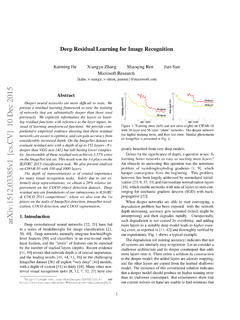
Deep Residual Learning for Image Recognition
arxiv.orgthe residual learning principle is generic, and we expect that it is applicable in other vision and non-vision problems. 2. Related Work Residual Representations. In image recognition, VLAD [18] is a representation that encodes by the residual vectors with respect to a dictionary, and Fisher Vector [30] can be
Faster R-CNN: Towards Real-Time Object Detection with ...
arxiv.orgoped for learning segmentation proposals. Shared computation of convolutions [9], [1], [29], [7], [2] has been attracting increasing attention for ef-ficient, yet accurate, visual recognition. The OverFeat paper [9] computes convolutional features from an image pyramid for …
ImageNet Classification with Deep Convolutional Neural …
www.cs.toronto.eduCurrent approaches to object recognition make essential use of machine learning methods. To im-prove their performance, we can collect larger datasets, learn more powerful models, and use bet-ter techniques for preventing overfitting. Until recently, datasets of …
![Wide Residual Networks arXiv:1605.07146v4 [cs.CV] 14 Jun ...](/cache/preview/f/7/8/5/a/7/7/4/thumb-f785a7744743f4acbd6636c813dabbb6.jpg)
Wide Residual Networks arXiv:1605.07146v4 [cs.CV] 14 Jun ...
arxiv.orgFigure 1: Various residual blocks used in the paper. Batch normalization and ReLU precede each convolution (omitted for clarity) [28], which is an architecture that had been proposed prior to residual networks. The essen-tial difference between residual and highway networks is that in the latter residual links are
![arXiv:1812.01187v2 [cs.CV] 5 Dec 2018](/cache/preview/c/b/1/2/d/d/5/b/thumb-cb12dd5b147004c786bfda6881481412.jpg)
arXiv:1812.01187v2 [cs.CV] 5 Dec 2018
arxiv.orginitial learning rate is , then at batch i, 1 i m, we will set the learning rate to be i =m. Zero . A ResNet network consists of multiple residual blocks, each block consists of several convolutional lay-ers. Given input x, assume block(x) is the output for the last layer in the block, this residual block then outputs x+ block(x).
Local Relation Networks for Image Recognition
openaccess.thecvf.comLocal Relation Networks for Image Recognition ... recognition tasks1. By learning how to adaptively compose 1For example, geometric priors are intrinsically encoded in the con- ... is also achieved with basic residual blocks and on deeper networks (50 and 101 layers).

Residual Attention Network for Image Classification
openaccess.thecvf.comResidual Attention Network for Image Classification Fei Wang1, Mengqing Jiang2, Chen Qian1, Shuo Yang3, Cheng Li1, Honggang Zhang4, Xiaogang Wang3, Xiaoou Tang3 1SenseTime Group Limited, 2Tsinghua University, 3The Chinese University of Hong Kong, 4Beijing University of Posts and Telecommunications 1{wangfei, qianchen, chengli}@sensetime.com, …

Aggregated Residual Transformations for Deep Neural …
openaccess.thecvf.comAggregated Residual Transformations for Deep Neural Networks Saining Xie1 Ross Girshick2 Piotr Dollar´ 2 Zhuowen Tu1 Kaiming He2 1UC San Diego 2Facebook AI Research {s9xie,ztu}@ucsd.edu {rbg,pdollar,kaiminghe}@fb.com Abstract We present a simple, highly modularized network archi-tecture for image classification. Our network is constructed
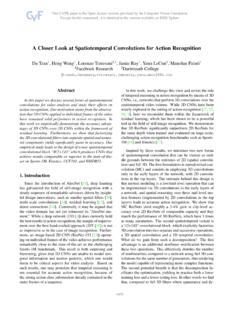
A Closer Look at Spatiotemporal Convolutions for Action ...
openaccess.thecvf.comresidual learning, which has been shown to be a powerful tool in the field of still-image recognition. We demonstrate that 3D ResNets significantly outperform 2D ResNets for the same depth when trained and evaluated on large-scale, challenging action recognition benchmarks such as Sports-1M [16] and Kinetics [17].