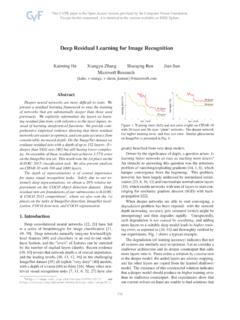
Deep Residual Learning for Image Recognition
3. Deep Residual Learning 3.1. Residual Learning Let us consider H(x)as an underlying mapping to be fit by a few stacked layers (not necessarily the entire net), with xdenoting the …
Download Deep Residual Learning for Image Recognition

Information
Domain:
Source:
Link to this page:
Documents from same domain

Predicting the Future Behavior of a Time-Varying ...
www.cv-foundation.orgPredicting the Future Behavior of a Time-Varying Probability Distribution Christoph H. Lampert IST Austria chl@ist.ac.at Abstract We study the problem of predicting the future, though
Deep Convolutional Neural Fields for Depth Estimation From ...
www.cv-foundation.orgvolutional neural networks (CNN). CNN features have been setting new records for a wide variety of vision applica-tions [13]. Despite all the successes in classification prob-
Image Style Transfer Using Convolutional Neural Networks
www.cv-foundation.orgImage Style Transfer Using Convolutional Neural Networks Leon A. Gatys Centre for Integrative Neuroscience, University of Tubingen, Germany¨ Bernstein Center for Computational Neuroscience, Tubingen, Germany¨

NTU RGB+D: A Large Scale Dataset for 3D Human Activity ...
www.cv-foundation.orgMultiview 3D event [43] and Northwestern-UCLA [40] datasets used more than one Kincect cameras at the same time to collect multi-view representations of the same ac-tion, and scale up the number of samples. It is worth mentioning, there are more than 40 datasets specifically for 3D human action recognition [47]. Al-
Single-Image Crowd Counting via Multi-Column …
www.cv-foundation.orgSingle-Image Crowd Counting via Multi-Column Convolutional Neural Network Yingying Zhang Desen Zhou Siqin Chen Shenghua Gao Yi Ma Shanghaitech University {zhangyy2,zhouds,chensq,gaoshh,mayi}@shanghaitech.edu.cn Abstract ... column CNN is adaptive to (hence the overall network

Unsupervised Visual Representation Learning by Context ...
www.cv-foundation.orghigh-resolution natural images. Unsupervisedrepresentation learning can also be formu-lated as learning an embedding (i.e. a feature vector for each image) where images that are semantically similar are close, while semantically different ones are far apart. One way to build such a representation is to create a supervised

Hierarchical Convolutional Features for Visual Tracking
www.cv-foundation.orgVisual representations are of great importance for object tracking. Numerous hand-crafted features have been used to represent the target appear-ance such as subspace representation [24] and color his-tograms [37]. The recent years have witnessed significant

Learning Spatiotemporal Features With 3D Convolutional ...
www.cv-foundation.orgthe networks lose their input’s temporal signal after the first convolution layer. Only the Slow Fusion model in [18] uses 3D convolutions and averaging pooling in its first 3convo-lution layers. We believe this is the key reason why it per-forms best …

Convolutional Neural Networks at Constrained Time Cost
www.cv-foundation.orgConvolutional neural networks (CNNs) [15, 14] have re-cently brought in revolutions to the computer vision area. Deep CNNs not only have been continuously advancing the image classification accuracy [14, 21, 24, 1, 9, 22, 23], but also play as generic feature extractors for various recogni-tion tasks such as object detection [6, 9], semantic ...

Fully Convolutional Networks for Semantic Segmentation
www.cv-foundation.orgConvolutional networks are powerful visual models that yield hierarchies of features. We show that convolu-tional networks by themselves, trained end-to-end, pixels-to-pixels, exceed the state-of-the-art in semantic segmen-tation. Our key insight is to build “fully convolutional” networks that take input of arbitrary size and produce
Related documents

Introduction to Deep Learning - Stanford University
cs230.stanford.edu1. Neural Networks and Deep Learning 2. Improving Deep Neural Networks: Hyperparameter tuning, Regularization and Optimization 3. Structuring your Machine Learning project 4. …

Deep Learning: State of the Art (2020) - Lex Fridman
lexfridman.comDeep Learning and Deep RL Frameworks Hopes for 2020 •Framework-agnostic Research: Make it even easier to translate a trained PyTorch model to TensorFlow and vice-versa. •Mature …
Model-Agnostic Meta-Learning for Fast Adaptation of …
www.cs.utexas.eduModel-Agnostic Meta-Learning for Fast Adaptation of Deep Networks large improvements in the task loss. The primary contribution of this work is a simple model-and task-agnostic …

TVM: An Automated End-to-End Optimizing Compiler for …
www.usenix.orgDeep learning (DL) models can now recognize images, process natural language, and defeat humans in challeng-ing strategy games. There is a growing demand to deploy smart …