Developing a Code of Behaviour: Guidelines for Schools
The code of behaviour helps the school community to promote the school ethos, relationships, policies, procedures and practices that encourage good behaviour and prevent unacceptable behaviour. The code of behaviour helps teachers, other members of staff, students and parents to work together for a happy, effective and safe school.
Download Developing a Code of Behaviour: Guidelines for Schools

Information
Domain:
Source:
Link to this page:
Documents from same domain

Child Safeguarding: A Guide for Policy, Procedure and Practice
www.tusla.ie5 Introduction Welcome to Tusla’s Child Safeguarding: A guide for policy, procedure and practice. This document is designed as a best practice guide to help all providers of services to children and families to develop guiding principles and safeguarding procedures to keep children and

Child Protection and Welfare 2 - Child and Family Agency
www.tusla.ie2 Child Protection and Welfare Practice Handbook 2 • Parents/guardians have a right to respect, and should be consulted and involved in matters that concern their family. • A proper balance must be struck between protecting children and respecting the rights and needs of parents/guardians and families.

Child Protection and Welfare Strategy - Tusla
www.tusla.ieCHILD PROTECTION AND WELFARE. THESE PRINCIPLES ARE EMBEDDED IN ALL ASPECTS OF TUSLA’S NEW CHILD PROTECTION AND WELFARE STRATEGY, INCLUDING THE SIGNS OF SAFETY, OUR NATIONAL APPROACH TO PRACTICE. 1 The safety and welfare of children is everyone’s responsibility. The best interests should be paramount. 2 5 …

A Practical Guide - Tusla
www.tusla.iePart 12 of the Child and Family Agency Act, 2013 defines an early years service as a service providing a pre-school service, or a school-age service. A pre-school service, according to the Act, means any pre-school, play group, day nursery, crèche, day-care or other similar service which caters for pre-school children.

Quality Early Years Care and Education - Tusla
www.tusla.ienow’. The early years of life are just as important and as much a part of life as any later life stage. For parents, recognising the importance of this life stage in its own right is important when considering the approach that an early years care and education service takes to the curriculum or programme of activities that they provide.

CONTEXT OF EARLY CHILDHOOD EDUCATION AND CARE …
www.tusla.ieearly years providers and educators to help meet these requirements and expectations. The developments which impact on service provision for young children include: The development of Síolta: The National Quality Framework for Early Childhood Education (CECDE, 2006) and the Síolta Quality Assurance Programme (QAP).

Quality and Regulatory Framework - Child and Family Agency
www.tusla.ieThe definitions for services are taken from the Child and Family Act 2013. Under this Act, an Early Years Service is a service providing a pre-school service, or ... » introducing a national registration system; ... and easy to read. To do this, we have used several reader-friendly devices to help guide you through the Framework.
National Guidance for the Protection and Welfare of …
www.tusla.ieInforming the employer or designated liaison person 25 Consequences of non-reporting 26 Mandated assisting 27 ... professionals and voluntary workers are well placed to be aware of a child’s ... - Child and Family Agency. . ...
Tusla Inspection Tool
www.tusla.ieaward in Early childhood Care and Education at Level 5 on the National Qualifications Framework or a qualification deemed by the Minister to be equivalent. (5) Paragraph (4) shall apply— (a) on or after 31 December 2016 in respect of pre-school services registered on or before 30 June 2016, and
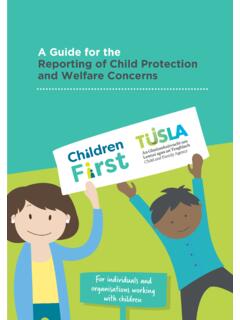
A Guide for the Reporting of Child Protection and Welfare ...
www.tusla.ieDesignated Liaison Person in keeping with best practice in child safeguarding. This person’s role is to be a resource for any staff member or volunteer who has a child protection or welfare concern. The Designated Liaison Person should be well-informed about child protection and have received all the necessary training for the role.
Related documents

Positive Behaviour Support Information Sheet for ...
www.disability.wa.gov.aubehaviour but the challenge often belongs to those surrounding the person. Family, carers and support people are often challenged to find out why the person has a need to engage in that behaviour. They want to know what they can do to support the person so they no longer have a need to engage in challenging behaviour.
Sexual violence and sexual harassment between children in ...
assets.publishing.service.gov.ukHarmful sexual behaviour 12 Part two: What are schools’ and colleges’ legal responsibilities 14 Legal responsibilities and equality policies 15 violence and sexual harassment 17 Introduction 17 Extra-familial harms 17 Safeguarding training 18 The role of education in prevention 18

Teaching online safety in school - GOV.UK
assets.publishing.service.gov.ukstandard of behaviour and honesty apply on and offline, including the importance of respect for others. Schools should also teach pupils to recognise unacceptable behaviour in others. Schools can help pupils to recognise acceptable and unacceptable behaviour by: looking at why people behave differently online, for example how anonymity

Internal Exclusion Guidance - UCL Institute of Education
dera.ioe.ac.ukintended to support schools to consider best practice in relation to their own setting and individual circumstances. Internal exclusion can form part of a whole school approach to promoting positive behaviour. Many schools operate behaviour management systems which involve the use of internal exclusion.
Better Relationships, Better Learning, Better Behaviour
education.gov.scotschools and of current policy and practice in relation to managing behaviour, to help inform SAGBIS. The researchers looked at the experiences and perceptions of almost 5,000 individuals who work in schools – headteachers, teachers and classroom support staff.

Why Schools Need Effective Behaviour Policies
parentsandteachers.org.ukWhy schools need effective behaviour policies Good school discipline is essential: disruption in class stops students learning. We know how to ensure good school discipline – hundreds of Academies have turned around schools with poor behaviour and made them great learning environments. There are simple steps all schools can follow to do the ...

Example secondary school anti-bullying policy
www.educateandcelebrate.orgWhy do we need an Anti-Bullying Policy? Persistent bullying can severely inhibit a child’s ability to learn effectively. The negative effects of bullying can have an impact on a person for their entire life. This school wishes to promote a secure and happy environment free from threat, harassment and any type of bullying behaviour.