
Dialectical Behavior Therapy
SECTION 5 Emotion Regulation 103 ... Sometimes there is a “poor fit” (e.g., temperament) between the person and the environment. The invalidating environment punishes or sometimes reinforces emotional displays and contributes to the person’s suppression or escalation of emotions, and sometimes leaves the person feeling ...
Download Dialectical Behavior Therapy

Information
Domain:
Source:
Link to this page:
Documents from same domain

Mind and Emotions,
www.charlestoncounselingportal.comNature of Emotions. New Research: Universal Treatments for Emotional Problems There are currently three research-based universal treatments for emotional disorders. The first is dialectical behavior therapy (DBT; Linehan 1993), which focuses on the following key skills for
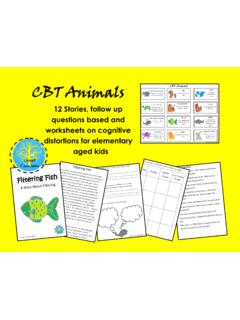
CBT Animals - CHARLESTON COUNSELING RESOURCE PORTAL
www.charlestoncounselingportal.comthem to get stuck. The follow up questions and worksheets can help children identify different ways of thinking to help them get unstuck. Directions: Read the story to the child and ask the follow up questions. To help the child understand the …

Worksheets and Handouts-Stress Management
www.charlestoncounselingportal.comProgressive relaxation Jump rope Build with blocks or Legos Talk to an adult Use a fidget object This is a list of 50 great ways to cope with stress! Before you use them, think about what you want to accomplish—do you need to calm down? Distract yourself? Express your feelings? Take a break? Then, choose the coping skill(s) that will work ...

Teaching aids
www.charlestoncounselingportal.comTeaching aids for cognitive distortions Pairs with T Animal Stories. Description Page/ Puppet Pictures (as found in the other CBT animal story animals) ... children identify either positive coping skills or positive self-talk they can use when upset. Closet Counselor ©2015 Closet Counselor ©2015 .
Handouts Emotional Regulation, Social Skills & Problem …
www.charlestoncounselingportal.comStrengthening Prosocial Skills & Problem Solving Workshop #6 Behavior Plan Step #1: Step #3: Step #8: Step #9: Negative Classroom Behaviors Poking, ouching Speaks without raising hand alks while directions are given Off-task, daydreaming Desired Positive Opposite Behaviors Keep Listen hands quiet to own body Raise a quietly hand when directions are
Related documents
Expressing Warmth and Affection to Children
csefel.vanderbilt.edutemperament, and disabilities of each child, as well as communi-cating warmth in ways that are comfortable for them. Setting the Stage for Expressing Warmth and ... 9 Recognize that frequent expressions of negative emotion toward children make it more difficult to feel and express warmth and affection. Avoid criticism, nagging, yelling,

DISGRACE - kkoworld.com
kkoworld.comHis temperament is not going to change, he is too old for that. His temperament is fixed, set. The skull, followed by the temperament: the two hardest parts of the body. ... No emotion, or none but the deepest, the most unguessed-at: a ground bass of contentedness, like the hum of traffic that lulls the city-dweller to sleep, or like the ...
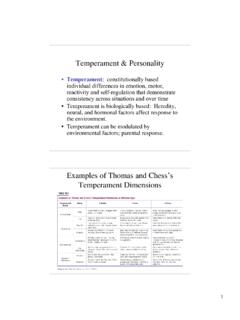
Temperament & Personality - University of Colorado Boulder
psych.colorado.eduTemperament & Personality •Temperament: constitutionally based individual differences in emotion, motor, reactivity and self-regulation that demonstrate consistency across situations and over time •Temperament is biologically based: Heredity, neural, and hormonal factors affect response to the environment. •Temperament can be modulated by
EMPLOYEE ATTITUDES AND JOB SATISFACTION
www.utm.edustudy, childhood temperament was found to be statistically related to adult job satisfac-tion up to 40 years later (Staw, Bell, & Clausen, 1986). Evidence even indicates that the job satisfaction of identical twins reared apart is statistically similar (see Arvey, Bouchard, Segal, & Abraham, 1989). Although this literature has had its critics
Positive Emotions in Early Life and Longevity: Findings ...
www.apa.orgrelationships among emotion , temperament and physiology that might influence longevity. This study builds on the knowledge that there are universal, patterned emotional responses that affect phys-iology in ways that are potentially damaging or beneficial. Over the past 30 years, emotion researchers have identified
Reproducible Materials: DBT® Skills Manual for Adolescents
cmhconline.comEmotion Regulation Handout 19: Check the Facts and Problem Solving Emotion Regulation Handout 20: Opposite Action to ... Sometimes there is a “poor fit” (e.g., temperament) between the person and the environment. The invalidating environment punishes or sometimes reinforces emotional displays and contributes to the person’s suppression or ...

The Birth-Mark - Columbia University
www.columbia.eduBut, if any shifting emotion caused her to turn pale, there was the mark again, a crimson stain upon the snow, in what Aylmer sometimes deemed an almost fearful distinctness. Its shape bore not a little similarity to the human hand, though of the ... according to the difference of temperament in the beholders. Some fastidious persons--but they ...

Emotions that facilitate language learning: The positive ...
files.eric.ed.govemotion facilitates the building of resources because positive emotion tends to broaden a person’s perspective, opening the individual to absorb the lan- ... mood and temperament. Whereas emotions are short-lived reactions to personally significant events, moods are longer-lasting, more dif-
The Four Emotional Quotient (EQ) Skills
hrs.wsu.eduUnderstanding Temperament (ID: COMM0141) Feedback and Your Emotional Quotient (ID: COMM0522) The Link between Feedback and Emotions (ID: COMM0522) Understanding Empathy (ID: COMM0141) The Emotional Mind and the Rational Mind (ID: COMM0141) Defining Intelligence (ID: COMM0142) Managing Emotions (ID: COMM0145)