
Dietary Reference Values for nutrients Summary report
Dietary reference values (DRVs) is an umbrella term for the complete set of nutrient reference values which include population reference intakes (PRIs), the average requirements (ARs), adequate intakes (AIs) and reference intake (RIs) ranges for macronutrients. These values indicate the amount of a
Download Dietary Reference Values for nutrients Summary report

Information
Domain:
Source:
Link to this page:
Documents from same domain

Perfluorooctane sulfonate (PFOS), …
www.efsa.europa.euPFOS/PFOA The EFSA Journal (2008) 653, 2-131 MS/MS and gas chromatography-mass spectrometry (GC-MS) can be used for the determination of precursors of …

Dietary Reference Values for sodium - European Food Safety ...
www.efsa.europa.euSCIENTIFIC OPINION ADOPTED: XX MM YYYY ... Dietary Reference Values for sodium EFSA Panel on Dietetic Products, Nutrition and Allergies (NDA), Dominique Turck, Jean-Louis Bresson, Barbara Burlingame, Tara Dean, Susan Fairweather- ... 77 bodies in many European Union Member States and in the United States have reported on 78 ...
Nitrites and nitrates added to food
www.efsa.europa.euThe current acceptable daily intakes (ADIs) for nitrite, set by the European Commission’s former Scientific Committee for Food (SCF) in 1997 and the Joint FAO/WHO Expert Committee on Food Additives (JECFA) in 2002, are 0.06 and 0.07 milligrams per kilogram of body weight per day (mg/kg bw/day), respectively. For nitrate both bodies set the ADI at
Caffeine - European Food Safety Authority
www.efsa.europa.euthan cultural habits – is the variable concentrations of caffeine found in some food products. Concentrations in coffee beverages depend on the manufacturing process, the type of coffee beans used, and the type of preparation (e.g. drip coffee, espresso). The levels found in cocoa-based beverages depend

Annual Quality Management Review 2020
www.efsa.europa.euAnnual Quality Management Review 2020 2 List of abbreviations AF EFSA Advisory Forum AQMR Annual Quality Management Review ART Architecture Transformation Programme BAU Business as usual BUS Business Services Department CORSER EFSA Corporate Services Unit DEV Development DG SANTE Directorate-General for Health and Food Safety DG ENV The …

Overview on Dietary Reference Values for the EU population ...
www.efsa.europa.euimplication of an AI is similar to that of a PRI, i.e. describe the level of intake that is considered adequate for health reasons. The terminological distinction relates to the different way in which these values are derived and to the resultant difference in the “firmness” of the value.

Overview on Tolerable Upper Intake Levels as derived by ...
www.efsa.europa.euSummary of Tolerable Upper Intake Levels – version 4 (September 2018) 1 Overview on Tolerable Upper Intake Levels as derived by the Scientific Committee on Food (SCF) and the EFSA Panel on Dietetic Products, Nutrition and Allergies (NDA) The Tolerable Upper Intake Level (UL) is the maximum level of total chronic intake of a nutrient from

Scientific Opinion on the safety of caffeine
www.efsa.europa.euSafety of caffeine EFSA Journal 20YY;volume(issue):NNNN 2 SUMMARY26 27 Following a request from the European Commission, the EFSA Panel on Dietetic products, Nutrition

Your Career - European Food Safety Authority
www.efsa.europa.euYour Career at the European Food Safety Authority Frequently Asked Questions

TOLERABLE UPPER INTAKE LEVELS FOR VITAMINS AND …
www.efsa.europa.eu2002/46/EC1 related to food supplements containing vitamins and minerals. In 2003, the Commission published a proposal for harmonising legislation concerning the addition of vitamins and minerals to foods2. The SCF was therefore asked to advise the European Commission in accordance with the following terms of reference.
Related documents

Dietary reference intakes: application of tables in ...
www.scielo.brAs Dietary Reference Intakes (DRI) cons-tituem-se na mais recente revisão dos valores de recomendação de nutrientes e energia adotados pelos Estados Unidos e Canadá, e vêm sendo publicadas desde 1997, na forma de relatórios parciais elaborados por comitês de especialistas organizados por uma parceria entre o Institute of
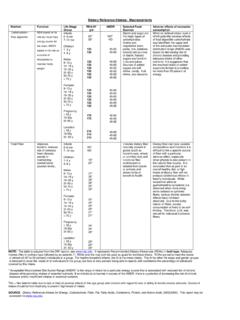
Dietary Reference Intakes: Macronutrients - USDA
nal.usda.govDietary Reference Intakes: Macronutrients Nutrient Function Life Stage Group RDA/AI* g/d AMDRa Selected Food Sources Adverse effects of excessive consumption Total Fat Energy source and when found in foods, is a source of n-6 and n-3 polyunsaturated fatty acids. Its presence in the diet increases absorption of fat soluble vitamins and precursors
Nutritive V alue - Agricultural Research Service
www.ars.usda.govDietary Reference Intakes for Vitamin C, Vitamin E, Selenium, and Carotenoids. National Academy Press, Washington, D.C. Subcommittee on the Tenth Edition of the RDAs, Food and Nutrition Board, Commission on Life Sciences, National Research Council. 1989. Recommended Dietary Allowances, 10th ed.
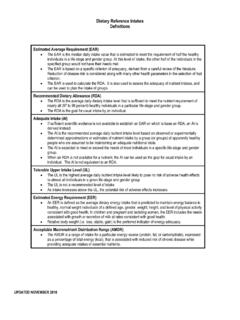
Dietary Reference Intakes Definitions - Canada
www.canada.caDietary Reference Intakes Definitions Estimated Average Requirement (EAR) • The EAR is the median daily intake value that is estimated to meet the requirement of half the healthy individuals in a life-stage and gender group. At this level of intake, the other half of the individuals in the

Fact Sheet: ADOLESCENTS’ DIETARY HABITS
www.euro.who.intvegetables and dietary fibre, such as whole grains. Some diet-related behaviours are particularly important during adolescence. Regularly eating breakfast, for example, is thought to reduce snacking and consumption of energy-rich foods. It also increases intake of essential micronutrients, including iron, calcium and vitamins C, B and D, and fibre.