
Differential Equations for Engineers
These are second-order differential equations, categorized according to the highest order derivative. The RLC circuit equation (and pendulum equation) is an ordinary differential equation, or ode, and the diffusion equation is a partial differential equation, or pde. An ode is an equation for a function of
Download Differential Equations for Engineers

Information
Domain:
Source:
Link to this page:
Documents from same domain
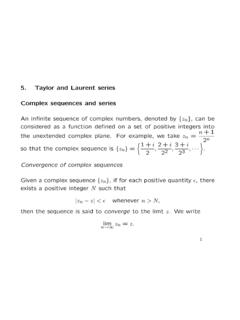
5. Taylor and Laurent series Complex sequences and series
www.math.hkust.edu.hk5. Taylor and Laurent series Complex sequences and series An infinite sequence of complex numbers, denoted by {zn}, can be considered as a function defined on a set of positive integers into the unextended complex plane. For example, we take zn= n+ 1 2n so that the complex sequence is {zn} = ˆ1 + i 2, 2 + i 22, 3 + i 23 ...

Matrix Algebra for Engineers - Hong Kong University of ...
www.math.hkust.edu.hkThe mathematics in this matrix algebra course is at the level of an advanced high school student, but typically students would take this course after completing a university-level single variable calculus course. There are no derivatives and integrals in this course, but student’s are expected to …
Differential Equations - Department of Mathematics, HKUST
www.math.hkust.edu.hkused textbook “Elementary differential equations and boundary value problems” by Boyce & DiPrima (John Wiley & Sons, Inc., Seventh Edition, c 2001). Many of the examples presented in these notes may be found in this book. The material of Chapter 7 is adapted from the textbook “Nonlinear dynamics and chaos” by Steven

Vector Calculus for Engineers - Hong Kong University of ...
www.math.hkust.edu.hkThese are the lecture notes for my online Coursera course,Vector Calculus for Engineers. Students who take this course are expected to already know single-variable differential and integral calculus to the level of an introductory college calculus course. Students should also be familiar with matrices,
Portfolio Selection Harry Markowitz The Journal of Finance ...
www.math.hkust.edu.hkvary with risk. The hypothesis (or maxim) that the investor does (or should) maximize discounted return must be rejected. If we ignore market im- perfections the foregoing rule never implies that there is a diversified portfolio which is preferable to all non-diversified portfolios. Diversi-

Numerical Methods for Engineers - Hong Kong University of ...
www.math.hkust.edu.hk44 Cubic spline interpolation (Part A)115 45 Cubic spline interpolation (Part B)117 46 Interpolation in Matlab 121 47 Project IV: Bessel functions and their zeros123 V Ordinary Differential Equations125 48 Euler method 129 49 Modified Euler method131 50 Runge-Kutta methods133 51 Second-order Runge-Kutta methods135 52 Higher-order Runge-Kutta ...

4. Complex integration: Cauchy integral theorem and …
www.math.hkust.edu.hk4. Complex integration: Cauchy integral theorem and Cauchy integral formulas Definite integral of a complex-valued function of a real variable Consider a complex valued function f(t) of a real variable t: f(t) = u(t) + iv(t), which is assumed to be a piecewise continuous function defined in the closed interval a ≤ t ≤ b.
(2.1) Markowitz’s mean-variance formulation (2.2) Two …
www.math.hkust.edu.hkfrontier portfolios need only invest in combinations of these two funds. Remark Any convex combination (that is, weights are non-negative) of ef-ficient portfolios is an efficient portfolio. Let αi ≥ 0 be the weight of Fund i whose rate of return is Ri f. Since E h Ri f i …

Numerical Methods - Hong Kong University of Science and ...
www.math.hkust.edu.hkIn MATLAB, single(224) has the same value as single(224 +1). Since single(224 +1) is exactly halfway between the two consecutive machine numbers 224 and 224 +2, MATLAB rounds to the number with a final zero-bit in f, which is 224. 1.10Machine epsilon Machine epsilon (e mach) is the distance between 1 and the next largest number. If

Systems of Linear Equations - Hong Kong University of ...
www.math.hkust.edu.hkSystems of Linear Equations Beifang Chen 1 Systems of linear equations Linear systems A linear equation in variables x1;x2;:::;xn is an equation of the form a1x1 +a2x2 +¢¢¢+anxn = b; where a1;a2;:::;an and b are constant real or complex numbers. The constant ai is called the coe–cient of xi; and b is called the constant term of the equation. A system of linear equations …
Related documents

Numerical Methods for Partial Differential Equations
skim.math.msstate.eduschemes, and an overview of partial differential equations (PDEs). In the study of numerical methods for PDEs, experiments such as the im-plementation and running of computational codes are necessary to under-stand the detailed properties/behaviors of the numerical algorithm under …
ORDINARY DIFFERENTIAL EQUATIONS
users.math.msu.eduThe equations in examples (c) and (d) are called partial di erential equations (PDE), since the unknown function depends on two or more independent variables, t, x, y, and zin these examples, and their partial derivatives appear in the equations.
DIFFERENTIAL EQUATIONS - University of Kentucky
www.ms.uky.edueigenvectors of a matrix. This topic will be key to solving systems of differential equations. Systems of Differential Equations – Here we will look at some of the basics of systems of differential equations. Solutions to Systems – We will take a look at what is involved in solving a system of differential equations.

1 INTRODUCTION TO DIFFERENTIAL EQUATIONS
www.personal.psu.edu1.3 Differential Equations as Mathematical Models CHAPTER 1 IN REVIEW The words differential and equations certainly suggest solving some kind of equation that contains derivatives y, y, . . . . Analogous to a course in algebra and trigonometry, in which a good amount of time is spent solving equations such as

Solving Differential Equations in R - The R Journal
journal.r-project.orgPartial differential equations In contrast to ODEs where there is only one indepen-dent variable, partial differential equations (PDE) contain partial derivatives with respect to more than one independent variable, for instance t (time) and x (a spatial dimension). To distinguish this type of equations from ODEs, the derivatives are repre-

Partial Differential Equations I: Basics and Separable ...
howellkb.uah.eduMar 08, 2014 · Partial Differential Equations I: Basics and Separable Solutions We now turn our attention to differential equations in which the “unknown function to be deter-mined” — which we will usually denote by u — depends on two or more variables. Hence the derivatives are partial derivatives with respect to the various variables.

First Order Partial Differential Equations
people.uncw.eduFirst Order Partial Differential Equations “The profound study of nature is the most fertile source of mathematical discover-ies.” - Joseph Fourier (1768-1830) 1.1 Introduction We begin our study of partial differential equations with first order partial differential equations. Before doing so, we need to define a few terms.

SOLUTION OF Partial Differential Equations (PDEs)
personales.unican.esPartial Differential Equations (PDE's) Learning Objectives 1) Be able to distinguish between the 3 classes of 2nd order, linear PDE's. Know the physical problems each class represents and the physical/mathematical characteristics of each. 2) Be able to describe the differences between finite-difference and finite-element methods for solving PDEs.