
DIFFERENTIAL FORMS AND INTEGRATION
DIFFERENTIAL FORMS AND INTEGRATION 3 Thus if we reverse a path from a to b to form a path from b to a, the sign of the integral changes. This is in contrast to the unsigned definite integral R [a,b] f(x) dx, since the set [a,b] of numbers between a and b is exactly the same as the set of numbers between b and a.
Download DIFFERENTIAL FORMS AND INTEGRATION

Information
Domain:
Source:
Link to this page:
Documents from same domain
Creating A Grade Sheet With Microsoft Excel - UCLA
www.math.ucla.eduUCLA Office of Instructional Development Creating a Grade Sheet With Microsoft Excel Teaching Assistant Training Program 1 Creating A Grade Sheet With Microsoft Excel
Introduction x - math.ucla.edu
www.math.ucla.eduKIRSZBRAUN-TYPE THEOREMS FOR GRAPHS NISHANT CHANDGOTIA, IGOR PAK, AND MARTIN TASSY Abstract. The classical Kirszbraun theorem says that all 1-Lipschitz functions f : A!
Hook-length formulas for skew shapes - UCLA
www.math.ucla.eduHOOK FORMULAS FOR SKEW SHAPES ALEJANDRO H. MORALES?, IGOR PAK , AND GRETA PANOVAy Abstract. The celebrated hook-length formula gives a product formula for the number of standard
THE PRODUCT REPLACEMENT GRAPH ON …
www.math.ucla.eduTHE PRODUCT REPLACEMENT GRAPH ON GENERATING TRIPLES OF PERMUTATIONS Gene Cooperman College of Computer Science, Northeastern University Boston, MA 02115
8'(x) -I - UCLA
www.math.ucla.eduChapter 8: Benefit Reserves . Notations: br . death benefit payable at the end of year of death for the j-th policy year . 71J~l: benefit premium paid at the beginning of the j …
www.math.ucla.edu
www.math.ucla.eduCreated Date: 9/20/2000 8:55:13 AM
: lJ^?:B * @C!#BgP+:@C*m ÇD?&(EI)rr!(BM
www.math.ucla.edu8 o&,# t.!g*m: *m &7w @i)w/ h&b:@r@c!#bj@c)w* !#b:).@c)h. b6lp+@c. !#? -w$:-h , @i!#? ) b:!(@c!#bq!(j ;s " )h'#?: @ib6. '#-.(e>j^!#-2b:!#bv wb: '67@c,( i).@cno$:ec
OntheBorelandvonNeumannPokerModels - UCLA
www.math.ucla.edude poker” of his 1938 book, ApplicationsauxJeuxdesHazard. Von Neumann presents Von Neumann presents his analysis of a similar form of poker in the seminal book on game theory — Theory
THE ENDGAME IN POKER - UCLA
www.math.ucla.eduTHE ENDGAME IN POKER Chris Ferguson, Full Tilt Poker Tom Ferguson, Mathematics, UCLA Abstract. The simple two-person poker model, known as Basic Endgame, may be described as follows. With a certain probability known to both players, Player I is dealt ... theory by von Neumann and Morgenstern (1944) are devoted to the topic. In the 1950’s,
COPS ON THE DOTS IN A MATHEMATICAL MODEL OF …
www.math.ucla.eduCOPS ON THE DOTS 3 Figure 1. A snapshot of the attractiveness Afrom simulations of the discrete model on a toroidal grid. Figure 2. A numerical solution of the continuous model (4) (left)
Related documents

Runge-Kutta 4th Order Method for Ordinary Differential ...
mathforcollege.comOct 13, 2010 · 08.04.1 Chapter 08.04 Runge-Kutta 4th Order Method for Ordinary Differential Equations . After reading this chapter, you should be able to . 1. develop Runge-Kutta 4th order method for solving ordinary differential equations, 2. find the effect size of step size has on the solution, 3. know the formulas for other versions of the Runge-Kutta 4th order method
First-Order Differential Equations and Their Applications
assets.press.princeton.eduThe order of a differential equation is the order of the highest derivative of the unknown function (dependent variable) that appears in the equation. The differential equations in (1) are of first, second, and fourth order, respectively. Most of the equations we shall deal with will …
Second Order Differential Equation Non Homogeneous
bionics.seas.ucla.eduSecond Order Linear Differential Equations – Homogeneous & Non Homogenous v • p, q, g are given, continuous functions on the open interval I ¯ ® c ( ) 0 ( ) ( ) g t y p t y q t y Homogeneous Non-homogeneous
APPLICATIONS OF SECOND-ORDER DIFFERENTIAL …
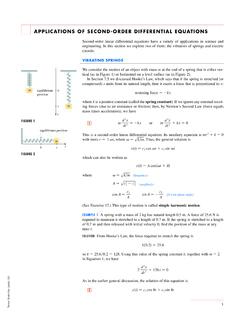
www.math.pitt.edu4 APPLICATIONS OF SECOND-ORDER DIFFERENTIAL EQUATIONS FORCED VIBRATIONS Suppose that, in addition to the restoring force and the damping force, the motion of the spring is affected by an external force . Then Newton’s Second Law gives Thus, instead of the homogeneous equation (3), the motion of the spring is now governed
Second Order Linear Differential Equations
www.personal.psu.eduSecond Order Linear Homogeneous Differential Equations with Constant Coefficients For the most part, we will only learn how to solve second order linear equation with constant coefficients (that is, when p(t) and q(t) are constants). Since a homogeneous equation is easier to …
Runge-Kutta 4th Order Method for Ordinary Differential ...
mathforcollege.comOct 13, 2010 · 08.04.1 Chapter 08.04 Runge-Kutta 4th Order Method for Ordinary Differential Equations . After reading this chapter, you should be able to . 1. develop Runge-Kutta 4th order method for solving ordinary differential equations, 2. find the effect size of step size has on the solution, 3. know the formulas for other versions of the Runge-Kutta 4th order method
ORDINARY DIFFERENTIAL EQUATIONS
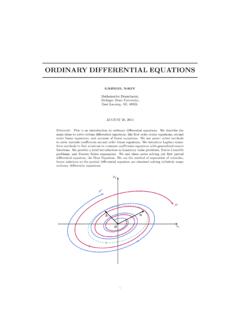
users.math.msu.eduORDINARY DIFFERENTIAL EQUATIONS GABRIEL NAGY Mathematics Department, Michigan State University, East Lansing, MI, 48824. AUGUST 16, 2015 Summary. This is an introduction to ordinary di erential equations. We describe the main ideas to solve certain di erential equations, like rst order scalar equations, second
Second Order Differential Equations
epsassets.manchester.ac.ukSecond Order Differential Equations 19.3 Introduction In this Section we start to learn how to solve second order differential equations of a particular type: those that are linear and have constant coefficients. Such equations are used widely in the modelling

Systems of First Order Linear Differential Equations
www.personal.psu.eduSystems of First Order Linear Differential Equations We will now turn our attention to solving systems of simultaneous homogeneous first order linear differential equations. The solutions of such systems require much linear algebra (Math 220). But since it is not a prerequisite for this course, we have to limit ourselves to the simplest

Neural Ordinary Differential Equations
arxiv.orgNeural Ordinary Differential Equations Ricky T. Q. Chen*, Yulia Rubanova*, Jesse Bettencourt*, David Duvenaud University of Toronto, Vector Institute {rtqichen, rubanova, jessebett, duvenaud}@cs.toronto.edu Abstract We introduce a new family of deep neural network models. Instead of specifying a