Differentiation and the Laplace Transform
We will confirm that this is valid reasoning when we discuss the “inverse Laplace transform” in the next chapter. In general, it is fairly easy to find the Laplace transform of the solution to an initial-value problem involving a linear differential equation with constant coefficients and a ‘reasonable’ forcing function1. Simply take ...
Download Differentiation and the Laplace Transform

Information
Domain:
Source:
Link to this page:
Documents from same domain

A Brief Review of Elementary Ordinary Differential …
howellkb.uah.eduReview of Elementary ODEs 6 Second-Order Linear Homogeneous Equations with Constant Coefficients§ Consider a differential equation of the form ay′′ + by′ + cy = 0 where a, b, and c are (real) constants.
Answers to Selected Exercises - University of Alabama in ...
howellkb.uah.eduAnswers to Selected Exercises Chapter 1 1. second, fifth, fifth, forty-second 3a i. yes, it is 3a ii. no, it is not 3a iii. no 3b i. no 3b ii. yes 3b iii. no 3c i. yes 3c ii. no 3c iii. no 3d i. no

Reduction of Order - University of Alabama in Huntsville
howellkb.uah.eduReduction of Order for Homogeneous Linear Second-Order Equations 285 Thus, one solution to the above differential equation is y 1(x) = x2. As alreadystated,this method is forfinding a generalsolutionto some homogeneous linear

Sturm-Liouville Problems
howellkb.uah.eduSturm-Liouville Problems “Sturm-Liouvilleproblems”areboundary-valueproblemsthat naturallyarisewhen solvingcer-tain partial differential equation problems using a “separation of variables” method that will be discussed in a later chapter. It is the theory behind Sturm-Liouville problems that, …
The Inverse Laplace Transform
howellkb.uah.eduThe fact that the inverse Laplace transform is linear follows immediately from the linearity of the Laplace transform. To see that, let us consider L−1[αF(s)+βG(s)] where α and β are any two constants and F and G are any two functions for which inverse Laplace transforms

Nonlinear Autonomous Systems of Differential Equations
howellkb.uah.eduApr 11, 2014 · Chapter & Page: 43–4 Nonlinear Autonomous Systems of Differential Equations You may have encountered this creature (or its determinant) in other courses involving “two functions of two variables” or “multidimensional change of variables”. It will, in a few pages, provide a link between nonlinear and linear systems.

Integration and Differential Equations
howellkb.uah.eduthe simplest falling object model, starting on page 10). Let us now briefly consider the general case where integration is immediately applicable, and also consider some practical aspects of using both the indefinite integral and the definite integral. ... dy dx = f(x) (2.1)

Partial Differential Equations I: Basics and Separable ...
howellkb.uah.eduMar 08, 2014 · Ordinary Differential Equations, Appendex A of these notes. We will be using some of the material discussed there.) 18.1 Intro and Examples Simple Examples If we have a horizontally stretched string vibrating up and down, let u(x,t) = the vertical position at time t of the bit of string at horizontal position x ,

Convolution - University of Alabama in Huntsville
howellkb.uah.eduLetusstartwithjustseeingwhat“convolution”is. Afterthat,we’lldiscussusingitwiththe Laplace transform and in solving differential equations. 27.1 Convolution, the Basics Definition and Notation Let f (t) and g(t) be two functions. The convolution of f and g , denoted by f ∗ g , is the function on t ≥ 0 given by f ∗ g(t) = Z t x=0 f ...

Sturm-Liouville Problems
howellkb.uah.eduIt is the theory behind Sturm-Liouville problems that, ultimately, justifies the “separation of variables” method for these partial differential equation problems. The simplest applications lead to the various Fourier series, and less simple applications lead to generalizations
Related documents
ELEMENTARY DIFFERENTIAL EQUATIONS
ramanujan.math.trinity.eduChapter 8 Laplace Transforms 8.1 Introduction to the Laplace Transform 394 8.2 The Inverse Laplace Transform 406 8.3 Solution ofInitial Value Problems 414 8.4 The Unit Step Function 421 8.5 Constant Coefficient Equationswith Piecewise Continuous Forcing Functions 431 8.6 Convolution 441 8.7 Constant Cofficient Equationswith Impulses 453
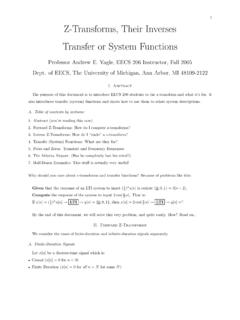
1 Z-Transforms, Their Inverses Transfer or System Functions
web.eecs.umich.eduIf you know what a Laplace transform is, this should look like a discrete-time version of it, as indeed it is. ... Inverse Z-Transforms As long as x[n] is constrained to be causal (x[n] = 0 for n < 0), then the z-transform is invertible: There is only one x[n] having a given z-transform X(z). Inversion of the z-transform (getting x[n] back from ...
The Inverse Laplace Transform
howellkb.uah.eduLinearity of the Inverse Transform The fact that the inverse Laplace transform is linear follows immediately from the linearity of the Laplace transform. To see that, let us consider L−1[αF(s)+βG(s)] where α and β are any two constants and F and G are any two functions for which inverse Laplace transforms exist.
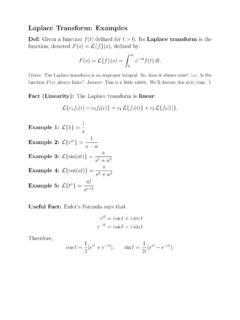
Laplace Transform: Examples
math.stanford.eduInverse Laplace Transform: Existence Want: A notion of \inverse Laplace transform." That is, we would like to say that if F(s) = Lff(t)g, then f(t) = L1fF(s)g. Issue: How do we know that Leven has an inverse L1? Remember, not all operations have inverses. To see the problem: imagine that there are di erent functions f(t) and
Laplace Transform solved problems - cuni.cz
matematika.cuni.czLaplace transform for both sides of the given equation. For particular functions we use tables of the Laplace transforms and obtain sY(s) y(0) = 3 1 s 2 1 s2 From this equation we solve Y(s) y(0)s2 + 3s 2 s3 and invert it using the inverse Laplace transform and the same tables again and obtain t2 + 3t+ y(0)

Power Spectral Density - MIT OpenCourseWare
ocw.mit.eduis useful to have a name for the Laplace transform of the autocorrelation function; we shall refer to Sxx(s) as the complex PSD. Exactly parallel results apply for the DT case, leading to the conclusion that Sxx(ejΩ) is the power spectral density of x[n]. 10.2 EINSTEIN-WIENER-KHINCHIN THEOREM ON EXPECTED TIME AVERAGED POWER

Laplace and Z Transforms - MIT
web.mit.eduLaplace transform: s2Y(s)+3sY(s)+2Y(s) = 1 Solve: Y(s) = 1 (s+1)(s+2) = 1 s+1 − 1 s+2 Inverse Laplace transform: y(t) = e−t−e−2t u(t) These forward and inverse Laplace transforms are easy if • dierential equation is linear with constant coecients, and • …