
Diffusion, Osmosis, Active Transport
active transport mechanisms to allow the passage of those chemicals across the membrane. Some major examples of osmosis • Absorption of water by plant roots. • Re-absorption of water by the proximal and distal convoluted tubules of the nephron. • Re-absorption of tissue fluid into the venule ends of the blood capillaries.
Download Diffusion, Osmosis, Active Transport

Information
Domain:
Source:
Link to this page:
Documents from same domain
Rate of diffusion surface area x concentration …
biologymad.comHuman Breathing System In mammals the gas exchange surfaces are the lungs, which develop in the embryo from the gut wall - which relates us to some fossil fish!
INTRODUCTION TO THE CELL - BiologyMad A …
biologymad.comCHAPTER 1: STRUCTURE AND FUNCTION OF THE CELL INTRODUCTION TO THE CELL Both living and non-living things are composed of molecules made from chemical elements such as
Temperature Homeostasis (thermoregulation) - …
biologymad.comHomeostasis literally means “same state” and it refers to the process of keeping the internal body environment in a steady state, when the external environment is changed.
CHAPTER 5 - BREATHING - BiologyMad A-Level …
biologymad.comCHAPTER 5 - BREATHING "THE RESPIRATORY SYSTEM" You have read how the blood transports oxygen from the lungs to cells and carries carbon dioxide
Enzyme Technology - BiologyMad
biologymad.comEnzyme Technology For thousands of years natural enzymes made by microorganisms have been used to make products such as cheese, bread, wine, and beer.
CHAPTER 4
biologymad.comHow do enzymes work? There are three parts to our thinking about enzyme catalysis. They each describe different aspects of the same process, and …
General Properties Protein Nature of Enzymes - …
biologymad.comIndustrial Uses of Enzymes Bioprocessing is the use of biological materials (organisms, cells, organelles, enzymes) to carry out manufacturing or treatment procedures of commercial or scientific interest.

THE CIRCULATORY SYSTEM - BiologyMad
biologymad.comCHAPTER 6: THE CIRCULATORY SYSTEM THE CIRCULATORY SYSTEM and the LYMPHATIC SYSTEM Most of the cells in the human body are not in direct contact with the external environment, so rely

to renal vein away bladder - BiologyMad
biologymad.comThe first part of the loop (the descending limb) is impermeable to ions, but some water leaves by osmosis.This makes the filtrate more concentrated as it descends. The second part of the loop (the

Continuous and discontinuous variation - …
biologymad.comContinuous and discontinuous variation Variation, the small differences that exist between individuals, can be described as being either discontinuous or continuous. ...
Related documents

CELL TRANSPORT WORKSHEET
mrsslovacek.weebly.com17. Plant cell after being over-watered. a. Water rushes into the plant cell’s vacuole. Is this diffusion or osmosis? Osmosis b. Is this passive or active transport? Passive c. Is the plant cell in a hypertonic, hypotonic, or isotonic environment? Hypotonic Enviornment 18. Plant cell after not being watered lately, so it has begun to wilt: a.

Plant Transport Option - Biology by Napier
www.biologybynapier.comThe vascular tissue system in plants is the transport system made up of two primary specialized tissues: xylem, which carries water from the roots upwards to the leaves of the plant as it is needed for photosynthesis, and phloem, which carries glucose/ manufactured food from the leaves to the rest of the plant.

Plant Water Relations: Absorption, Transport and Control ...
cdn.intechopen.comPlant Water Relations: Absorption, Transport and Control Mechan isms 107 from one point with a lower concentration of solutes (for example, pure water) to a point with a higher concentration. So, the higher concentration of the solutes at a point which makes the system more negative will be the osmotic potential in this place. The water
Ce-2 The Plant Cell to Color Name: Color the plant cell ...
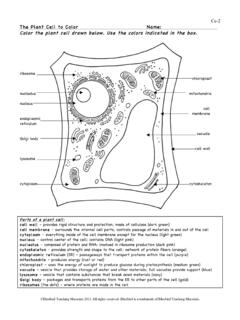
cpb-us-e1.wpmucdn.comThe Plant Cell Worksheet Name: KEY Label the plant cell drawn below and then give the function of each cell part. cell wall 7. 1. mitochondria e ER 8. 2. cytoplasm nucleolus 9. 3. cell membrane 10. nucleus 10.

UNIT 4 - NCERT
ncert.nic.inPLANT PHYSIOLOGY Chapter 11 Transport in Plants Chapter 12 Mineral Nutrition Chapter 13 Photosynthesis in Higher Plants Chapter 14 Respiration in Plants Chapter 15 Plant Growth and Development 2021-22. MELVIN CALVIN born in Minnesota in April, 1911, received his Ph.D. in Chemistry from the University of Minnesota. He served
What is SAF? - International Air Transport Association
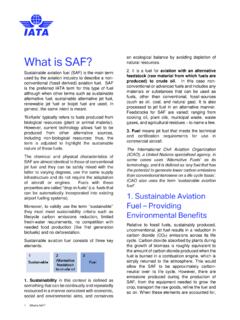
www.iata.orgcooking oil, plant oils, municipal waste, waste gases, and agricultural residues – to name a few. 3. Fuel means jet fuel that meets the technical and certification requirements for use in commercial aircraft. The International Civil Aviation Organization (ICAO), a United Nations specialised agency, in
Transportation of Fresh Produce
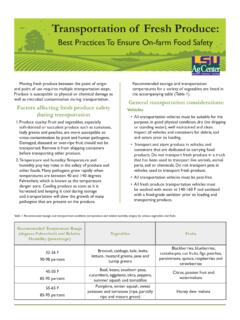
www.lsu.edu• Transport and store produce in vehicles and containers that are dedicated to carrying food products. Do not transport fresh produce in a truck that has been used to transport live animals, animal parts, soil or chemicals. Do not transport pets in vehicles used to transport fresh produce. • All transportation vehicles must be pest-free.
Cellular Transport Review - Neshaminy School District
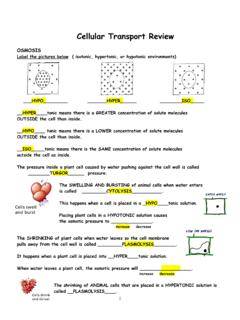
www.neshaminy.orgComplete the transport terms. 1. Active transport requires _ENERGY to move molecules across membranes. 2. _ATP is the molecule that provides the energy for active transport. 3. Golgi bodies use _EXOCYTOSIS to release molecules outside the cell. 4. _DIFFUSIONmoves oxygen and carbon dioxide molecules from a high concentration to a low