
Digestive: Practice Questions # 1
Digestive: Practice Questions # 1 1. The end products of digestion enter the cells of a vertebrate by the process of A. absorption B. osmosis C. emulsification D. egestion 2. In humans, structures that release digestive secretions directly into the small intestine include both the A. salivary glands and the pancreas
Download Digestive: Practice Questions # 1

Information
Domain:
Source:
Link to this page:
Documents from same domain

Enzymes: Practice Questions #1 - Living …
lecoursedebiase.comEnzymes: Practice Questions #1 1. Compound X increases the rate of the reaction below. Compound X is most likely A. an enzyme B. a …
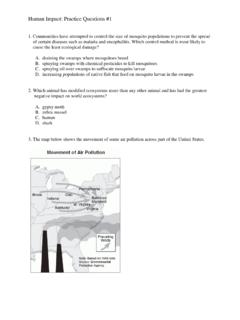
Human Impact: Practice Questions #1 - lecoursedebiase.com
lecoursedebiase.comHuman Impact: Practice Questions #1 1. Communities have attempted to control the size of mosquito populations to prevent the spread of certain diseases such as malaria and encephalitis.

Photosynthesis: Practice Questions #1
lecoursedebiase.comA. can be used for photosynthesis B. cannot pass through cell membranes C. is needed for aerobic respiration D. is used for the hydrolysis of proteins 29. Most of the oxygen gas present in the atmosphere is produced as a result of A. photosynthesis B. cellular respiration C. dehydration synthesis D. decomposition

Ecology: Practice Questions #1
lecoursedebiase.comEcology: Practice Questions #1 1. One biotic factor that affects consumers in an ocean ecosystem is A. number of autotrophs B. temperature variation C. salt content D. pH of water 2. A food web is represented in the diagram below. ... In a forest community, a shelf fungus and a slug live on the side of a decaying tree trunk.
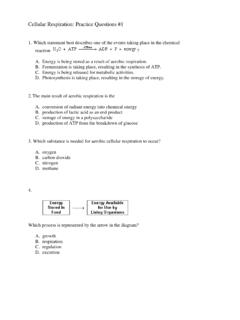
Cellular Respiration: Practice Questions #1
lecoursedebiase.comCellular Respiration: Practice Questions #1 1. Which statement best describes one of the events taking place in the chemical reaction ? A. Energy is being stored as a result of aerobic respiration. B. Fermentation is taking place, resulting in the synthesis of ATP. C. Energy is being released for metabolic activities.
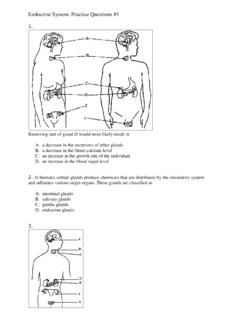
Endocrine System: Practice Questions #1
lecoursedebiase.comEndocrine System: Practice Questions #1 1. Removing part of gland D would most likely result in A. a decrease in the secretions of other glands B. a decrease in the blood calcium level C. an increase in the growth rate of the individual D. an increase in the blood sugar level 2.
Related documents
Anatomy, Physiology, and Pathology by Body Systems
downloads.lww.comThe 11 body systems of the human organism are the integumentary system,the skeletal system, the muscular system, the nervous system, the cardiovascular system, the lymphatic system, the respiratory system, the digestive system, the endocrine sys-tem, the urinary system, and the reproductive system. In addition, the sensory system

Teacher's Guide: Digestive System (Grades 9 to 12)
classroom.kidshealth.orgHow does the food move through the digestive system and into the rest of the body? In addition to the organs of the digestive system, various chemicals are also at
Your Body's Systems - Open School
media.openschool.bc.caOrgans and Organ Systems Your body is an amazing machine! Tissues are organized into organs and organs are organized into organ systems. Get ready—in the upcoming lessons in this learning package you will learn about four of the major body systems: • the circulatory system • the respiratory system • the digestive system • the ...

LESSON Digestive and Excretory Systems - Ponce de Leon ...
pdlhs.hdsb.orgThe Digestive and Excretory Systems ks ©Image Source/Getty Images ts SC.6.L.14.5 Identify and investigate the general functions of the major systems of the human body (digestive, respiratory, circulatory, reproductive, excretory, immune, nervous, and musculoskeletal) and describe ways these systems interact with each other to maintain homeostasis.

DIGESTIVE AND HEPATOBILIARY SYSTEMS
seer.cancer.govDIGESTIVE AND HEPATOBILIARY SYSTEMS DIGESTIVE SYSTEM SITES . Below is information about the subsites of the colon • The ascending colon, measuring 15 to 20 cm, begins with the cecum, a 6 to 9 cm pouch that arises at the proximal segment of the right colon at the end of the terminal ileum. It is covered with a visceral
How Do All the Systems Work Together - Texas A&M …
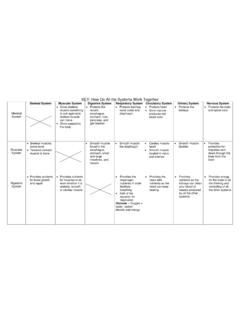
vetmed.tamu.eduKEY: How Do All the Systems Work Together Skeletal System Muscular System Digestive System Respiratory System Circulatory System Urinary System Nervous System • mouth, Skeletal System • muscle something to pull against to skeletal muscle can move Gives skeletal • Gives support to the body • Protects the esophagus, stomach, liver,
Human Anatomy and Body Systems
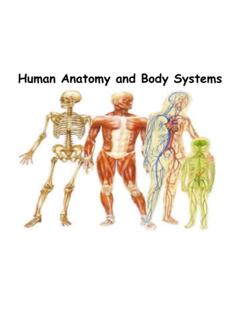
www.bisdtx.orgThe 11 Human Body Systems The 11 human body systems are as follows: -- nervous system -- integumentary system -- respiratory system -- digestive system -- excretory system -- skeletal system -- muscular system -- circulatory system -- endocrine system -- reproductive system -- lymphatic (immune) system

The Human Body Systems for Kids - Denton ISD
www.dentonisd.orgDigestive System is a 9 meter long tube. The digestive process begins in the mouth, where the teeth and tongue break up the food after it has been softened with saliva. The food is then swallowed and travels down the esophagus to the stomach. While the food is in the stomach, it is mixed with a mild acid which breaks
Mammalian digestive tracts - University of Illinois Urbana ...
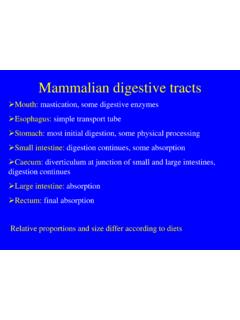
www.life.illinois.eduSerengeti migrations: digestive systems at work 1. Body size and digestive systems. 2. Structure of the herb layer. 3. Local topography and regional migrations. 4. …
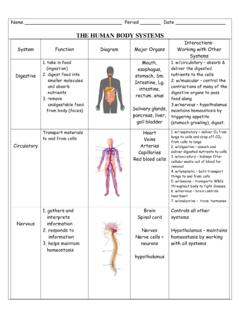
THE HUMAN BODY SYSTEMS - Winston-Salem/Forsyth …
www.wsfcs.k12.nc.usSystems Digestive 1. take in food (ingestion) 2. digest food into smaller molecules and absorb nutrients 3. remove undigestable food from body (feces) Mouth, esophagus, stomach, Sm. Intestine, Lg. intestine, rectum, anus Salivary glands, pancreas, liver, gall bladder 1. …