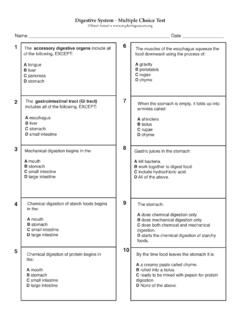
Digestive System - Multiple Choice Test - Exploring Nature
The accessory digestive organs include all of the following, EXCEPT: A tongue B liver C pancreas D stomach The gastrointestinal tract (GI tract) includes all of the following, EXCEPT: A esophagus B liver C stomach D small intestine Mechanical digestion begins in the: A mouth B stomach C small intestine D large intestine
Download Digestive System - Multiple Choice Test - Exploring Nature

Information
Domain:
Source:
Link to this page:
Documents from same domain

Cellular Respiration - Exploring Nature Science …
www.exploringnature.org1) photosynthesis creates glucose molecules (instead of eating) → 2) this fuels cellular respiration in the plant cells → 3) creates ATP → 4) fuels plant growth and reproduction → 5) provides carbohydrates to animals for
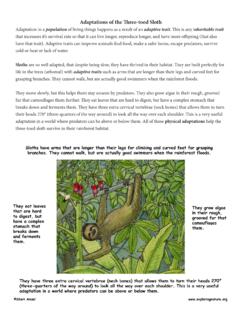
Adaptations of the Three-toed Sloth - The Exploring Nature ...
www.exploringnature.orgAdaptations of the Three-toed Sloth Adaptation in a population of living things happens as a result of an adaptive trait.This is any inheritable trait that increases it’s survival rate so that it can live longer, reproduce longer, and have more offspring (that also
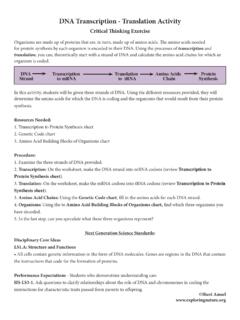
DNA Transcription - Translation Activity
www.exploringnature.orgGenes are regions in the DNA that contain the instructions that code for the formation of proteins. Performance Expectations - Students who demonstrate understanding can: HS-LS3-1. Ask questions to clarify relationships about the role of DNA and chromosomes in coding the
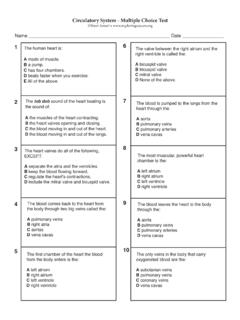
Circulatory System - Multiple Choice Test
www.exploringnature.orgB the heart valves opening and closing. C the blood moving in and out of the heart. D the blood moving in and out of the lungs. The heart valves do all of the following, EXCEPT: A separate the atria and the ventricles. B keep the blood flowing forward. C regulate the heart’s contractions. D include the mitral valve and bicuspid valve.
Matter Assessment and NGSS - Exploring Nature
www.exploringnature.orgScience and Engineering Practices: Developing and Using Models Modeling in 6–8 builds on K–5 and progresses to developing, using and revising models to describe, test, and predict more abstract phenomena and design systems. • Develop a model to predict and/or describe phenomena. (MS-PS1-1),(MS-PS1-4)
Nervous System - Multiple Choice Test - Exploring Nature
www.exploringnature.orgThe Central Nervous System is made up of the: brain and spinal cord. B spinal cord and spinal nerves. C spinal nerves and cranial nerves. D All of the above. The Peripheral Nervous System is made up of the: A brain and spinal cord. B spinal cord and spinal nerves. C spinal nerves and brain. D All of the above. The part of the brain responsible for
Bones and Features of the Skull - Cranium and Face
www.exploringnature.orgBones and Features of the Skull - Cranium and Face ©Sheri Amsel • www.exploringnature.org Bones of the Cranium The cranium is made up of 8 bones: 2 (paired) parietal bones • 2 (paired) temporal bones • frontal bone • occipital bone • sphenoid bone • ethmoid bone The frontal bone is located on the anterior cranium and includes the following features:

Phases of the Moon - Exploring Nature
www.exploringnature.org2. The moon takes the same amount of time to rotate once around on its axis as it does to revolve around the Earth - so the same side of the moon always faces the Earth. The moon looks different during its revolution around the Earth, because at each position its is getting a different amount of sunlight on its surface.
Water Cycle – Multiple Choice Test - Exploring Nature
www.exploringnature.orgC creeks. D aquifers. The water cycle is driven by the: A sun. B moon. C clouds. D oceans. When water turns to vapor and rises into the atmosphere its called: A evaporation. B transpiration. C sublimation. D precipitation. When water evaporates directly from glacial ice, it’s called: A condensation. B transpiration. C sublimation. D ...
Endocrine System - Multiple Choice Test - Exploring Nature
www.exploringnature.orgEndocrine System - Multiple Choice Test KEY ... The endrocrine system works together with the _____ system to maintain the body’s equilibrium? A digestive system B nervous system C respiratoy system D reproductive system Hormones help balance the body’s reactions differently than nerve impulses in that:
Related documents
The Digestive System - Los Angeles Mission College
www.lamission.eduOrganization of The Digestive System Organs of the digestive system are divided into 2 main group : the gastrointestinal tract (GI tract) and accessory structures . GI tract is a continuous tube extending through the ventral cavity from the mouth to the anus –it consists of …
Teacher's Guide: Digestive System (Grades 3 to 5)
classroom.kidshealth.orgdigestive system Materials: Computer with Internet access "Digestive Dance" handout Art supplies (paints, markers, crayons) Music Class Time: 45 minutes Activity: To perform the Digestive Dance, you have to work in small groups to choreograph (or plan out) and do a dance routine that shows an audience how food moves through the digestive system.
Grades 6 to 8 • Digestive System
classroom.kidshealth.orgWhen it’s functioning properly, the digestive system helps the body get the nutrients and energy it needs. But problems can occur in the digestive system. Read the KidsHealth.org article on the digestive system and the articles below, or search for others, and select one problem related to the digestive system. Research as much
Teacher's Guide: Digestive System (PreK to Grade 2)
classroom.kidshealth.org(a doctor who specializes in digestive problems) to your class. Ask him or her to talk about the parts of the digestive system and ways to keep your digestive system working well. After the visit, write a thank-you note to the doctor, including one new fact you learned about the digestive system. Reproducible Materials Handout: Go Fish for Fiber
Teacher's Guide: Digestive System (Grades 9 to 12)
kidshealth.orgYour digestive system works on the foods you eat for about: a. 5 hours. b. 10 hours c. 15 hours d. 20 hours The digestive system breaks down food into: a.nutrients b.amylase c.saliva d.sphincters During the process of absorption, nutrients …
The Digestive System Anatomy of the Digestive System
www.austincc.eduThe GI tract (digestive system) is located mainly in abdominopelvic cavity surrounded by serous membrane = visceral peritoneum this serous membrane is continuous with parietal peritoneum and extends between digestive organs as mesenteries! hold organs in place, prevent tangling
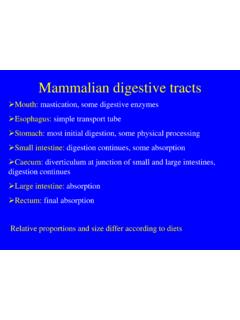
Mammalian digestive tracts
www.life.illinois.eduproportions of digestive and absorptive regions: Carnivores/insectivores: food (meat) is easy to process and digest, so 1. Relatively short post-gastric tract (2-6 X HBL) 2. Caecum reduced or absent 3. Little differentiation between small and large intestines (See examples of carnivores and insectivores on handout)
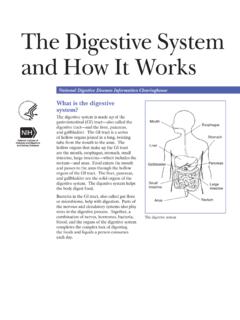
The Digestive System - National Institute of Diabetes and ...
www.niddk.nih.govdigestive system. The digestive system helps the body digest food. Bacteria in the GI tract, also called gut lora or microbiome, help with digestion. Parts of the nervous and circulatory systems also play roles in the digestive process. Together, a combination of nerves, hormones, bacteria, blood, and the organs of the digestive system

THE DIGESTIVE SYSTEM - University of Cincinnati
www.uc.eduDIGESTIVE SYSTEM. People are probably more aware of their digestive system than of any other system, not least because of its frequent messages. Hunger, thirst, appetite, gas ☺, and the frequency and nature of bowel movements, are all issues affecting daily life.