Eigenvalues and Eigenvectors - MIT Mathematics
growing or decaying or oscillating. We can’t find it by elimination. This chapter enters a new part of linear algebra, based on Ax D x. All matrices in this chapter are square. A goodmodel comesfrom the powers A;A2;A3;:::of a matrix. Supposeyou need the hundredth power A100. The starting matrix A becomes unrecognizable after a few steps,
Download Eigenvalues and Eigenvectors - MIT Mathematics

Information
Domain:
Source:
Link to this page:
Documents from same domain
Introduction to Linear Algebra, 5th Edition
math.mit.edu1.3 Matrices 1 A = ... Linear Equations One more change in viewpoint is crucial. Up to now, the numbers x 1,x 2,x 3 were known. The right hand side b was not known. We found that vector of differences by multiplying A times x. Now we think of b as known and we look for x.
Eigenvalues and Eigenvectors
math.mit.eduSpecial properties of a matrix lead to special eigenvalues and eigenvectors. That is a major theme of this chapter (it is captured in a table at the very end). 286 Chapter 6.
Eigenvalues and Eigenvectors - MIT Mathematics
math.mit.edu6.1. Introduction to Eigenvalues 287 Eigenvalues The number is an eigenvalue of Aif and only if I is singular: det.A I/ D 0: (3) This “characteristic equation” det.A I/ D 0 involves only , not x. When A is n by n,
4 Cauchy’s integral formula - MIT Mathematics
math.mit.edu4 Cauchy’s integral formula 4.1 Introduction ... 4 CAUCHY’S INTEGRAL FORMULA 4 4.3.1 Another approach to some basic examples Suppose Cis a simple closed curve around 0. We have seen that Z C 1 z ... Since an integral is basically a sum, this translates to the triangle inequality for integrals.
A FRIENDLY INTRODUCTION TO GROUP THEORY
math.mit.eduA FRIENDLY INTRODUCTION TO GROUP THEORY 3 A good way to check your understanding of the above de nitions is to make sure you understand why the following equation is correct: jhgij= o(g): (1) De nition 5: A group Gis called abelian (or commutative) if gh = hg for all g;h2G. A group is called cyclic if it is generated by a single element, that is,
4.3 Least Squares Approximations
math.mit.edu4.3. Least Squares Approximations 221 Figure 4.7: The projection p DAbx is closest to b,sobxminimizes E Dkb Axk2. In this section the situation is just the opposite. There are no solutions to Ax Db. Instead of splitting up x we are splitting up b. Figure 4.3 shows the big picture for least squares. Instead of Ax Db we solve Abx Dp.

Linear programming 1 Basics - MIT Mathematics
math.mit.edu2 subject to: 5x 1 + 7x 2 8 4x 1 + 2x 2 15 2x 1 + x 2 3 x 1 0;x 2 0: Some more terminology. A solution x= (x 1;x 2) is said to be feasible with respect to the above linear program if it satis es all the above constraints. The set of feasible solutions is called the feasible space or feasible region. A feasible solution is optimal if its ...
Square Roots via Newton’s Method
math.mit.eduSquare Roots via Newton’s Method S. G. Johnson, MIT Course 18.335 February 4, 2015 1 Overview ...
V7. Laplace’s Equation and Harmonic Functions
math.mit.eduA. Existence. Does there exist a φ(x,y) harmonic in some region containing Cand its interior R, and taking on the prescribed boundary values? B. Uniqueness. If it exists, is there only one such φ(x,y)? C. Solving. If there is a unique φ(x,y), determine it by some explicit formula, or approximate it by some numerical method.
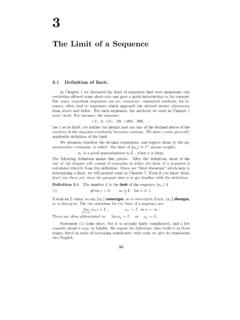
The Limit of a Sequence - MIT Mathematics
math.mit.edu“obvious” using the definition of limit we started with in Chapter 1, but we are committed now and for the rest of the book to using the newer Definition 3.1 of limit, and therefore the theorem requires proof. Theorem 3.2B {an} increasing, L = liman ⇒ an ≤ L for all n; {an} decreasing, L = liman ⇒ an ≥ L for all n. Proof.
Related documents

CHAPTER 8: MATRICES and DETERMINANTS
kkuniyuk.com(Section 8.1: Matrices and Determinants) 8.09 PART D: GAUSSIAN ELIMINATION (WITH BACK-SUBSTITUTION) This is a method for solving systems of linear equations. Historical Note: This method was popularized by the great mathematician Carl Gauss, but the Chinese were using it …
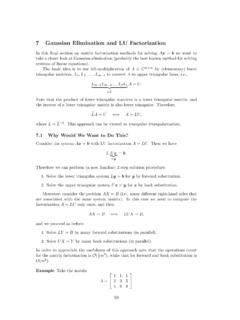
7 Gaussian Elimination and LU Factorization
www.math.iit.edu7 Gaussian Elimination and LU Factorization In this final section on matrix factorization methods for solving Ax = b we want to take a closer look at Gaussian elimination (probably the best known method for solving systems of linear equations). The basic idea is to use left-multiplication of A ∈Cm×m by (elementary) lower triangular matrices ...

Systems of Two Equations
cdn.kutasoftware.comSolve each system by elimination. 15) 8x − 6y = −20 −16 x + 7y = 30 (−1, 2) 16) 6x − 12 y = 24

1.5 Elementary Matrices and a Method for Finding the Inverse
academic.macewan.ca1.5 Elementary Matrices and a Method for Finding the Inverse Deflnition 1 A n £ n matrix is called an elementary matrix if it can be obtained from In by performing a single ... Each of the k transformations in the Gauss-Jordan elimination is equivalent to the multiplication with an elementary matrix.

Factorization into A = LU - MIT OpenCourseWare
ocw.mit.eduelimination matrices Eij, so that A E21 A E31E21 A U. In the two by two case this looks like: → → →···→ E21 A U 1 0 2 1 2 1 −4 1 8 7 = 0 3 . We can convert this to a factorization A = LU by “canceling” the matrix E21; multiply by its inverse to get E−1 21 E21 A ...
Matrix algebra for beginners, Part I matrices ...
vcp.med.harvard.edu9 Gaussian elimination 11 1. 1 Introduction This is a Part I of an introduction to the matrix algebra needed for the Harvard Systems Biology 101 graduate course. Molecular systems are inherently many dimensional—there are usually many ... Matrices first arose from trying to solve systems of linear equations. Such problems go back to the

18.06 Problem Set 7 - Solutions - MIT
web.mit.eduBy Gauss elimination, it is easy to see that one solution is given by v 2 = 2 1 1 0 T (c) Given the eigenvalue λ 3 = 4, write down a linear system which can be solved to find the eigenvector v 3. Solution The system is Av 3 = 4v 3, or (A−4I)v 3 = 0: −5 3 −1 1 −3 1 1 −1 10 −10 −14 14 4 −4 −4 4 v 3 = 0. The solution is v 3 = 0 ...
Linear Programming Lecture Notes
www.personal.psu.eduChapter 3. Matrices, Linear Algebra and Linear Programming27 1. Matrices27 2. Special Matrices and Vectors29 3. Matrices and Linear Programming Expression30 4. Gauss-Jordan Elimination and Solution to Linear Equations33 5. Matrix Inverse35 6. Solution of Linear Equations37 7. Linear Combinations, Span, Linear Independence39 8. Basis 41 9. Rank ...

2.5 Inverse Matrices - MIT Mathematics
math.mit.edu2.5. Inverse Matrices 85 The elimination steps create the inverse matrix while changing A to I. For large matrices, we probably don’t want A 1 at all. But for small matrices, it can be very worthwhile to know the inverse. We add three observations about this particular K 1 because it is an important example.

2.5 Inverse Matrices - MIT Mathematics
math.mit.edu2.5. Inverse Matrices 83 2.5 Inverse Matrices 1 If the square matrix A has an inverse, then both A−1A = I and AA−1 = I. 2 The algorithm to test invertibility is elimination: A must have n (nonzero) pivots. 3 The algebra test for invertibility is the determinant of A: detA must not be zero.